
Asia Update - 2/10/26

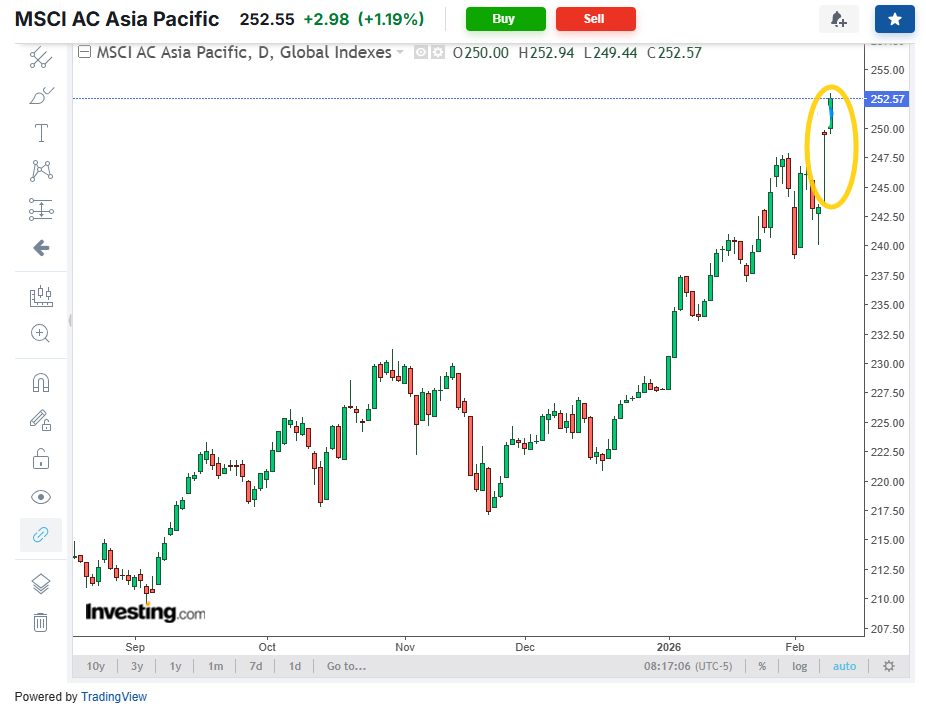
The MSCI Asia Pacific Index was up another +1.2% Tuesday taking its gains for the week to +3.7% to new record highs (after falling last week for the first time in 7 weeks (and 2nd in the last 11 (but on track for its 9th monthly gain in the last 10))).
Major equity indices in the Asia-Pacific region also traded higher Tuesday, with Japan's Nikkei (+2.2%) continuing to run to new records.
Japan's Nikkei: +2.2%, Hong Kong's Hang Seng: +0.6%, China's Shanghai Composite: +0.1%, India's Sensex: +0.3%, South Korea's Kospi: +0.1%, Australia's All Ordinaries: +0.1%.
In news:
RTRS - U.S. President Donald Trump will travel to Beijing during the first week of April for a meeting with Chinese President Xi Jinping, Politico reported on Monday, citing three people familiar with the plan.
RTRS - Taiwan’s trade negotiating team has left for the U.S. to hold their final meeting on a trade and tariff deal struck last month, the island’s government said on Tuesday.
Under the terms of the agreement, tariffs on Taiwan’s exports to the U.S. will be cut to 15% from 20%.
Taiwan companies will also invest $250 billion to boost production of semiconductors, energy and artificial intelligence in the U.S., while Taiwan will also guarantee an additional $250 billion in credit to facilitate further investment.
CNBC - Separately though Taiwan has told Washington that its proposal to move 40% of the island’s semiconductor supply chain to the U.S. was “impossible,” Taipei’s top tariff trade negotiator said in an interview.
Speaking on a local television broadcast Sunday, Vice Premier Cheng Li-chiun said she had made it clear to Washington that the country’s semiconductor ecosystem, built over decades, could not simply be relocated.
The comments push back against onshoring targets outlined by U.S. Commerce Secretary Howard Lutnick in a CNBC interview in January, shortly after the latest U.S.-Taiwan trade agreement. Lutnick said he wanted 40% of Taiwan’s entire chip supply chain to shift to the U.S. within President Donald Trump’s ongoing term.
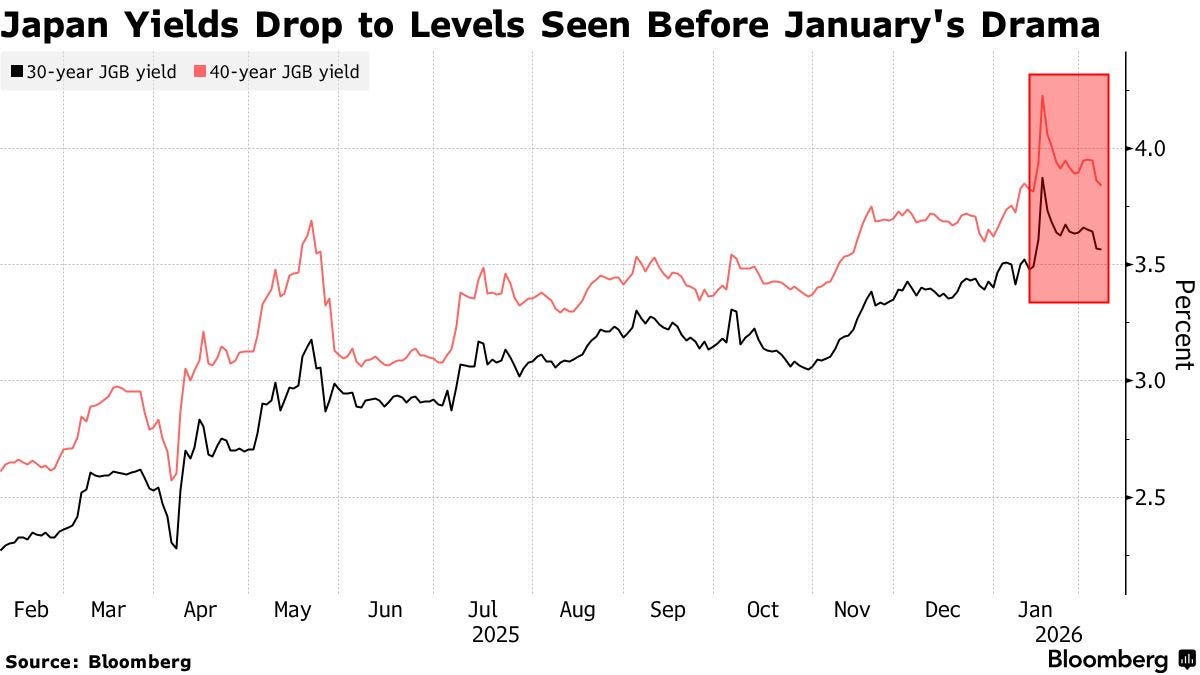
BBG - Japan’s government bonds gained after Prime Minister Sanae Takaichi’s historic election triumph fueled confidence among investors that increased fiscal spending can be digested by the market.
Yields declined across the curve, with the biggest drop seen in that of the volatile 40-year tenor, which fell 9 basis points to 3.725%. Yields have now retreated to near levels seen in early January when Takaichi’s snap vote was first reported. That triggered a rout in Japanese debt that threatened to destabilize global bond markets.
Yields on both 20- and 30-year bonds also fell around 6 basis points, to about 3.105% and 3.495% respectively. The yen, meanwhile, strengthened 0.2% to 155.56 against the dollar. Japanese stocks extended Monday’s rally.
The reaction suggested that some fund managers are ready to give Takaichi the benefit of the doubt for now, betting that her success will allow for clearer policy and lower the risk of worst-case fiscal scenarios. Speaking Monday in a press briefing, the premier vowed to build trust with financial markets as concerns persist over how she’ll pay for a planned tax cut.
“The bigger-than-expected victory over the weekend means the Takaichi government will be more fiscally sound,” as it reduces fiscal demands from her coalition party, said Russel Matthews, a senior portfolio manager at RBC BlueBay Asset Management. “We remain positive on the outlook for Japanese government bonds, particularly in the long and ultra-long sectors of the yield curve,” he said.
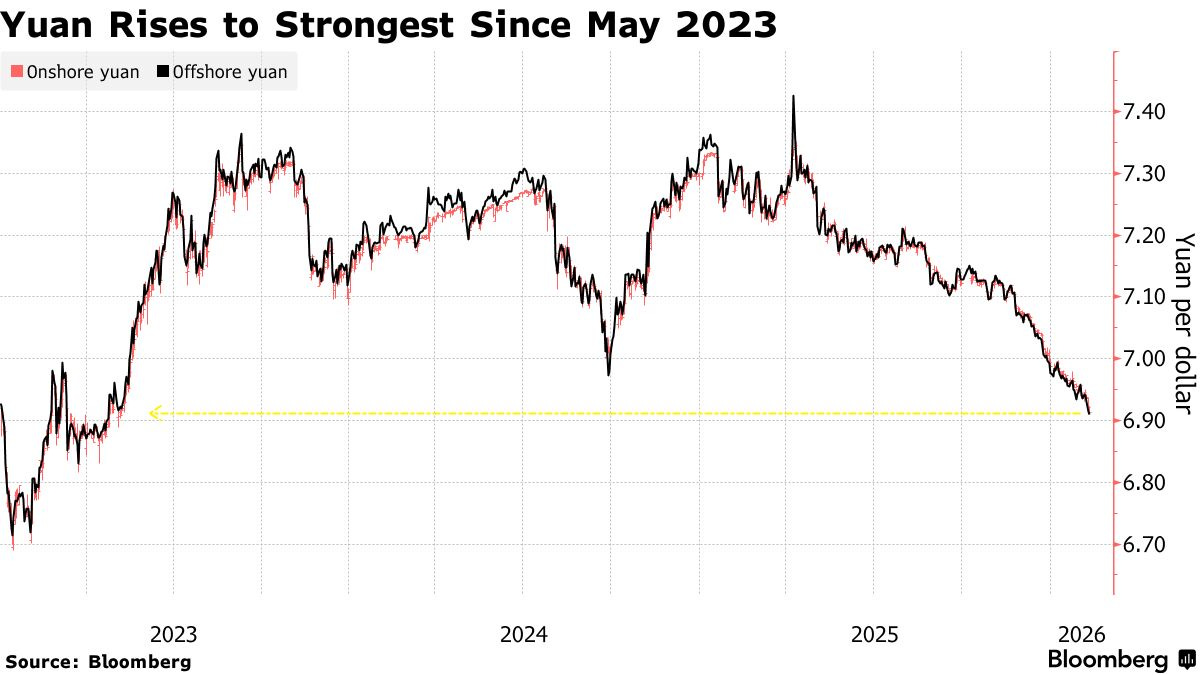
BBG - The yuan surged to its strongest level since May 2023 after China was said to have asked banks to limit their holdings of US Treasuries.
The onshore and offshore yuan both extended their advance to strongest level in more than two years on Tuesday following the report. The latest move is adding momentum for the yuan, which is already the third-best-performing currency in Asia since the end of September with a gain of around 3%.
Most of the yuan’s gains are driven by dollar weakness stemming from uncertainty surrounding fiscal and trade policies from President Donald Trump’s administration. The People’s Bank of China’s higher tolerance for a stronger yuan and a surge in capital inflows have also aided the currency.
The report is also prompting some analysts to predict a structural change in China’s currency strategy. That’s especially as President Xi Jinping’s ambition for a “powerful currency,” detailed in a state media article earlier this month, also strengthened confidence in the yuan.
BBG - Prime Minister Sanae Takaichi’s election victory is handing Chinese leader Xi Jinping a dilemma: Engage with Japan’s most popular post-war leader or continue a deep freeze with the US’s top ally in Asia.
Since November, when she implied in parliament that a Chinese invasion of Taiwan could prompt Japan to deploy its military, Beijing has imposed export controls and tourism curbs to pressure her to retract those remarks.
Chinese leaders must now decide whether to maintain economic pressure on Tokyo, or find an elegant off-ramp to the dispute. Takaichi has stated she wants stable relations with Beijing, but it remains politically impossible to take back her comments without appearing to compromise Japan’s security.
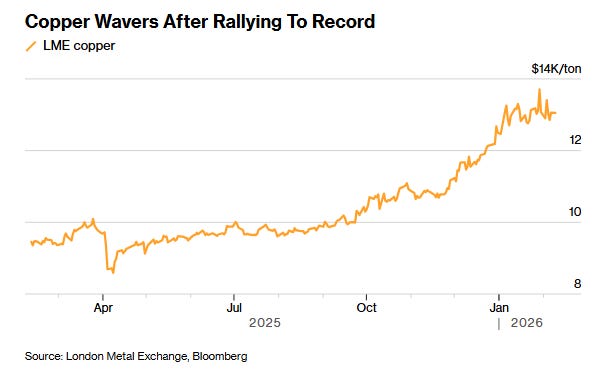
BBG - Chinese copper buyers are extending their break over the Lunar New Year as near-record prices chill industrial demand for the metal.
The rally has “increased financial costs at copper rod and pipe producers, and reduced their order books,” said Wang Wei, general manager of Shanghai Wooray Metals Group Co., which sells refined metal to the fabricators that shape copper for factories. The Chinese holiday begins next Monday and officially ends on Feb. 23, but the lull in demand will fully take hold this week, he said.
The world’s biggest buyers of physical metal have resisted the run-up in prices over the past year due to a slowing Chinese economy. Extended shutdowns over the holiday period are likely to put a bigger dent in the market’s momentum, which saw investors drive copper to new heights at the end of last month.
The rest of the rundown of major Asian political, economic, and corporate news and analysis from Bloomberg, Reuters, FT, Briefing.com, WSJ, BoA, Goldman, etc., follows for paid subscribers.
