
Asia Update - 2/25/26

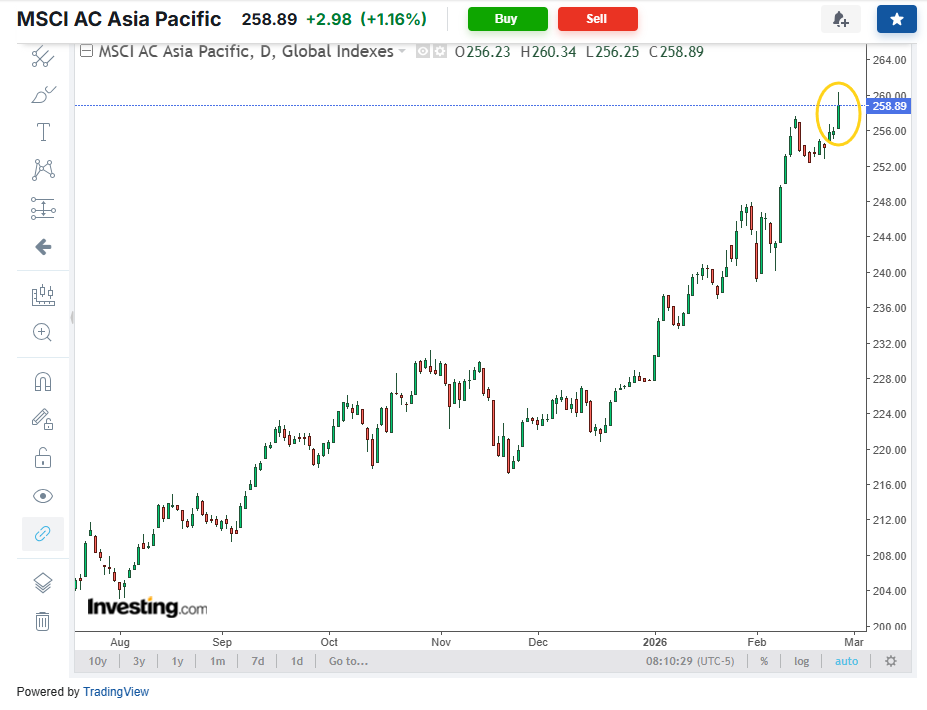
The MSCI Asia Pacific Index jumped +1.2% Wednesday to new record highs as it works on a 10th weekly gain in 11 weeks (and 12th in 14). It is also on track for its 9th gain in the last 10 months.
Major equity indices in the Asia-Pacific region all advanced with Japan's Nikkei (+2.2%) and South Korea's Kospi (+1.9%) reaching fresh records.
Japan's Nikkei: +2.2%, Hong Kong's Hang Seng: +0.7%, China's Shanghai Composite: +0.7%, India's Sensex: +0.1%, South Korea's Kospi: +1.9%, Australia's ASX All Ordinaries: +1.2%.
In news:
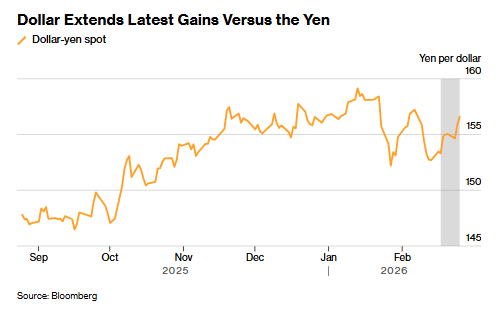
BBG - Japan’s Prime Minister Sanae Takaichi’s government nominated two reflationist academics to join the Bank of Japan policy board on Wednesday, appointments that weakened the yen against the dollar.
[note the subscriber section has thoughts from Goldman about the appointments from ahead of the nominations - this goes against their expectations]
The government named Aoyama Gakuin University Professor Ayano Sato and Chuo University Professor Toichiro Asada as its candidates to replace outgoing BOJ board members Asahi Noguchi and Junko Nakagawa.
The nominating of two academics associated with reflationist economic policies is likely to fuel speculation that Takaichi will be cautious about the central bank raising interest rates quickly.
It’s also a move that might generate irritation in Washington after Treasury Secretary Scott Bessent helped prop up the yen with rate checks just last month.
Forty- and 30-year JGB yields rose by roughly 10 basis points while the Japanese currency hit a fresh two-week low versus the greenback to trade at 156.60. Money markets are pricing 50 basis points of interest rate increases by the central bank this year, compared to 58 basis points ahead of the nomination. Overnight swaps indicate around a 60% chance that the central bank will raise rates by the time of its April meeting, with a quarter percentage-point move fully priced in by July.
“I was surprised. Both of them are total reflationists,” said Masamichi Adachi, chief economist at UBS Securities Japan Co. “You can sense Takaichi’s strong views with the choice of these two people when there’s talk of further interest rate hikes amid problems with yen weakness and inflation.”
“Both Asada and Sato are known for their continued accommodative monetary policy and positive stance toward an active fiscal policy,” said Ryutaro Kimura, a senior fixed-income strategist at AXA Investment Managers. “This selection contradicts investors’ prior assessment that the appointment of at least one person who prioritizes fiscal soundness would curb the further depreciation of the yen,” Kimura said.
WSJ - Japan continues to maintain a tight dialogue with the U.S. on foreign-exchange moves, Finance Minister Satsuki Katayama said Tuesday, as traders remain on alert about potential market intervention.
“I have been in close communication with U.S. officials over the last four months, and our relationship has become even more tightly knit during this time,” Katayama said at a regular news conference.
The finance minister declined to comment on a local media report saying that the rate check conducted by U.S. authorities last month was led by Treasury Secretary Scott Bessent. “Since we both have our own responsibilities to protect, I think we are at a point where we can both say we are doing our jobs thoroughly,” Katayama said.
CNBC - U.S. President Donald Trump avoided directly naming China in his State of the Union (SOTU) address Tuesday, just weeks before his scheduled trip to Beijing, the first time in two decades a US president didn’t directly mention China in the annual speech to Congress (Bush 2005), despite it being the longest SOTU by any U.S. president.
Trump did not directly mention China, other than a reference to “Russian and Chinese military technology” that guarded Venezuelan President Nicolas Maduro during the operation that led to the capture of the foreign leader.
Trump plans to visit Beijing from March 31 to April 2, the first trip by a U.S. president since 2017. China's Foreign Ministry has not confirmed President Trump's visit though.
Trump used the nearly two-hour speech at the US Capitol to focus on domestic issues and paint a rosy picture of the economy under his leadership.
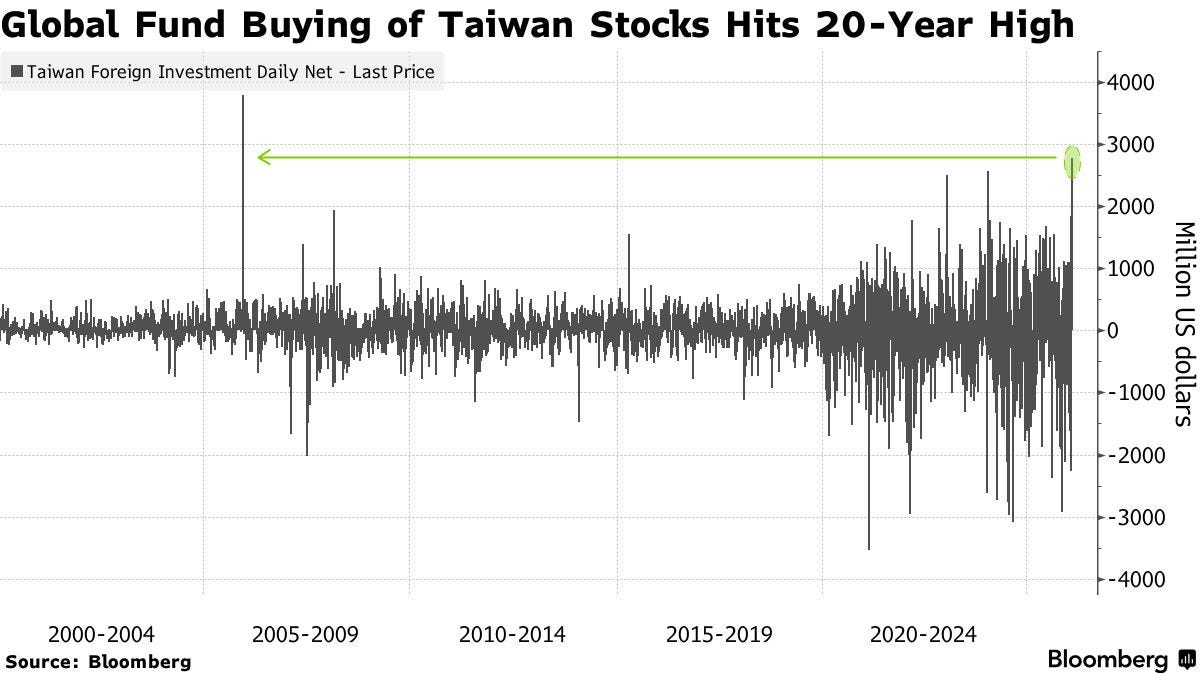
BBG - Overseas investors bought a net $2.77 billion of Taiwan equities on Tuesday, the most since December 2005, according to data compiled by Bloomberg. The investment also marked a sixth straight day of buying by foreign funds.
At the current pace, Taiwan is on track for roughly $7 billion in foreign inflows this month, a contrast to the roughly similar amount that has been pulled from memory chip-focused South Korea over the same period.
BBG - The US and South Korea engaged in a rare public display of friction after it was reported that American and Chinese fighter jets briefly faced off over waters near the Korean Peninsula last week, exposing signs of strains in one of Washington’s key security alliances in Asia.
South Korea’s Defense Minister Ahn Gyu-back lodged a complaint with Gen. Xavier Brunson, commander of the 28,500-strong US Forces Korea, over the drills that he said heightened military tensions near the peninsula, Yonhap News reported.
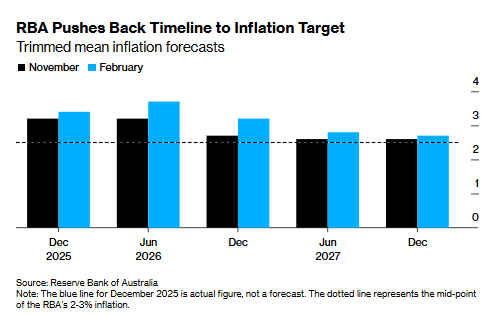
BBG - Australia’s monthly inflation came in stronger than expected in January, driven largely by housing costs and suggesting monetary policy settings may need to be tightened further.
Traders bolstered bets on a second interest-rate hike this year after official data showed the closely-watched trimmed mean gauge of consumer prices rose 3.4% last month from a year earlier. That exceeded economists estimate of 3.3% and meant the reading held above the top of the Reserve Bank’s 2-3% target band for a seventh straight month.
Headline CPI climbed 3.8% in January on a year-on-year basis, holding steady on the prior month
Annual Housing inflation was 6.8% in January, up from 5.5%, reflecting cost increases in electricity, new dwellings and rents
Electricity costs surged 32.2% in the 12 months to January, up from 21.5% to December
Other contributors were a 3.1% increase in food and non-alcoholic beverages driven by rising wage and ingredient costs
“Stronger-than-expected January inflation will keep the RBA on edge. But a rate hike at the March 17 meeting remains unlikely — the data don’t threaten the RBA’s February outlook.” — James McIntyre, BBG economist.
Subscriber section contains more more news, corporate updates, etc., and also Goldman on the importance of new BoJ board member nominations, BoA on China LNY spending, BBG on South Korea’s equity market overtaking France,
The rest of the rundown of major Asian political, economic, and corporate news and analysis from Bloomberg, Reuters, FT, Briefing.com, WSJ, BoA, Goldman, etc., follows for paid subscribers.
