
Asia Update - 3/18/26

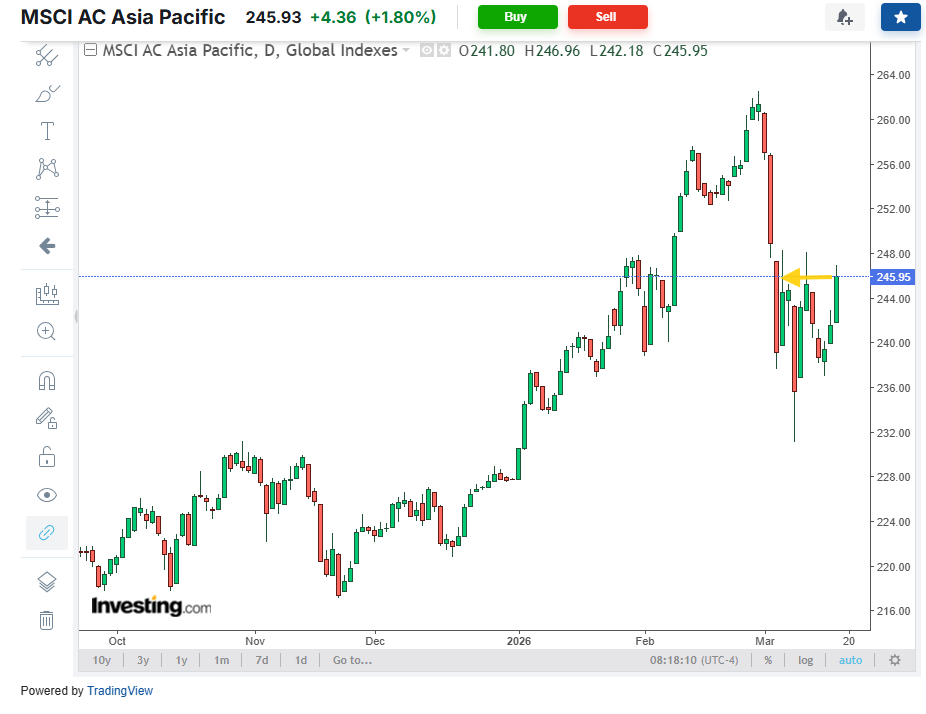
The MSCI Asia Pacific Index was up for a third session accelerating to +1.8%, taking it to a 2-week high, still on track though for its first down month in the last 11.
Major equity indices in the Asia-Pacific region ended broadly higher, with Japan's Nikkei (+2.9%) and South Korea’s Kospi (+5.2%) notable outperformers.
Japan's Nikkei: +2.9%, Hong Kong's Hang Seng: +0.6%, China's Shanghai Composite: +0.3%, India's Sensex: +0.8%, South Korea's Kospi: +5.0%, Australia's All Ordinaries: +0.3%.
In news:
CNBC - South Korean President Lee Jae Myung on Wednesday called for sweeping capital market reforms to eliminate the “Korea discount” and achieve a “Korea premium,” targeting governance flaws, weak transparency and structural distortions, local media reported.
At a policy meeting, Lee Eog-weon, Financial Services Commission chief, also said the government will use current market volatility as a chance to push bold reforms and strengthen fundamentals. Planned measures include accelerating the delisting of weak firms, tightening rules to curb duplicate listings and revitalizing Kosdaq and Konex.
Index heavyweights Samsung Electronics and SK Hynix rose 7.5% and nearly 9%, respectively. Samsung’s gains come even as its unionized workers in South Korea voted to approve a strike, escalating a dispute over bonuses and increasing the risk of disruptions at the world’s largest memory chipmaker.
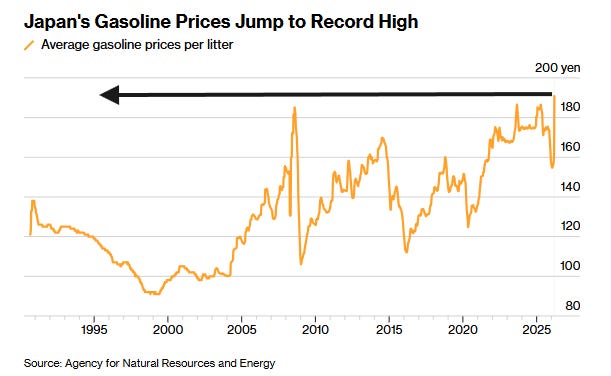
BBG - Japan’s gasoline prices surged to a record high this week, as ripple effects from the US-Israeli conflict with Iran reach Japan.
Prices surged 18% from last week to reach a nationwide average of ¥190.8 per liter, the highest for comparable data back to 1990. The higher prices will put more pressure on households and businesses squeezed by four straight years of inflation above the Bank of Japan’s 2% target.
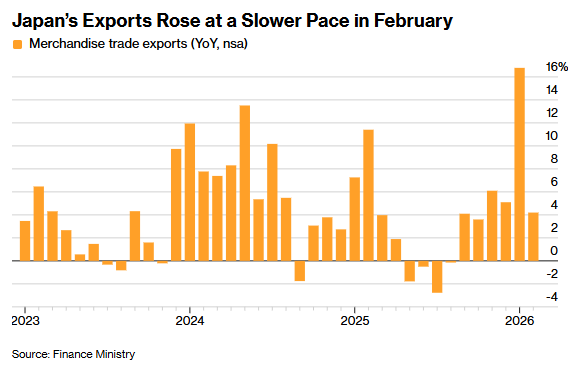
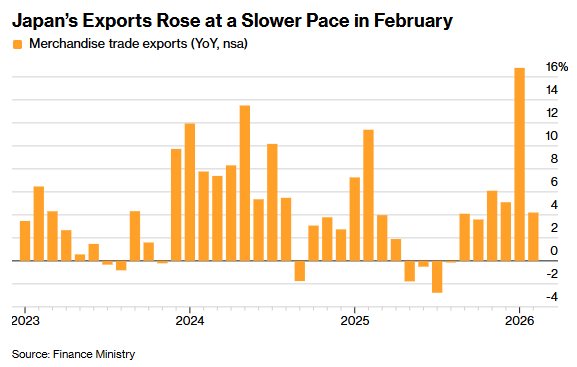
BBG - Japan’s exports grew at a slower pace but better than expected, as tariffs weighed on car shipments to the US fell and as demand in China slumped due to the Lunar New Year holidays.
The value of overall exports rose 4.2% in February from a year earlier, after a big jump in the previous month, the Finance Ministry reported Wednesday. The result beat the median analyst forecast of a 1.9% rise.
Imports rose 10.2%, a little below the consensus estimate, as the trade balance swung to a surplus of ¥57.3 billion on an unadjusted basis.
Exports to the US fell 8% in February, led by a 14.8% retreat in car shipments by value. On a unit basis, exports of cars fell at a slower pace, indicating that Japanese manufacturers continue to protect market share in the US with price cuts as they contend with tariffs.
Exports to the EU though advanced by 14%, with strong results for cars and machinery used in the construction and mining industries.
Exports to China declined 10.9% as the Lunar New Year holidays took place in February this year. Double-digit drops in semiconductor manufacturing equipment, plastics and scientific optical equipment drove that decline even as shipments of semiconductors and other electronic components continued to surge on AI-related demand. “The decline in exports to China was due to the Lunar New Year,” said Shinichiro Kobayashi, chief economist at Mitsubishi UFJ Research and Consulting. “Still, overall exports grew because the global economy remained fundamentally sound despite some signs of slowing down in the US.”
BBG - Japan’s inbound tourism numbers returned to growth in February, as an increase from other regions made up for a continued slump in Chinese tourists.
Total inbound arrivals rose 6.4% last month after a contraction in January, Japan National Tourism Organization data showed Wednesday. Visitors from South Korea rose 28%, while arrivals from the major markets of Taiwan, Hong Kong and the US also increased.
Strong visitor growth from other markets helped offset the decline in Chinese arrivals, which were down about 45% year-on-year. That’s an improvement from January’s 61% drop and broadly in line with December’s 45% decline.
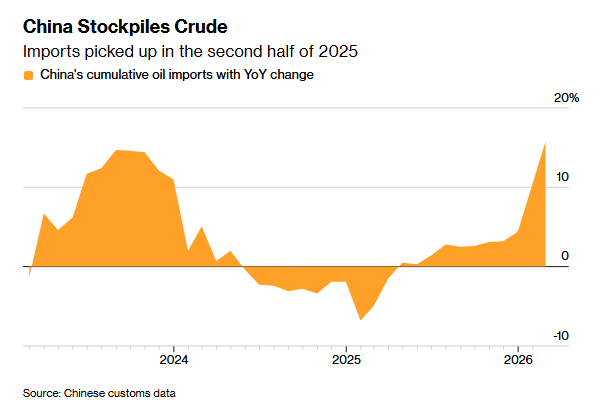
BBG - China, the world’s biggest crude importer, is close to tapping its vast commercial oil reserves as the Middle East war shows no signs of ending, according to FGE NexantECA.
A drawdown in commercial and operational stockpiles amounting to as much as 1 million barrels a day may happen over the next four to six weeks, according to the industry consultant’s base case scenario. Processors — particularly in southern China — may be allowed to draw on commercial stockpiles to limit the extent of run cuts or prevent shutdowns, it said.
It’s a lever that China can afford to pull. After more than a year of aggressive stockpiling, Beijing has built up an estimated 1.4 billion barrels of reserves that could be tapped if the Strait of Hormuz remains effectively shut. Strategic inventories would likely be left untouched, but even drawing on commercial stocks would require layers of internal approvals.
“Given sailing times, it would be a bit early for Gulf disruptions to be felt in China,” said Antoine Halff, co-founder and chief analyst at geospatial analytics company Kayrros. China’s above-ground crude oil stocks dipped by about 7 million barrels between March 5 and 16, but this could be nothing more than “normal short-term volatility,” he said.
WSJ - Nvidia NVDA -0.70%decrease; red down pointing triangle has restarted manufacturing of its H200 processors for sale in China, Chief Executive Jensen Huang said Tuesday, signaling a possible shift in the chip giant’s fortunes in the world’s second-largest market.
Nvidia and the Trump administration have been involved in a complicated tango over the sales of its advanced artificial-intelligence chips in China. Last April, the Commerce Department halted exports of the H20, a processor Nvidia designed especially for the China market, but reversed course in August.
Chinese officials, however, discouraged customers in their country from buying the H20, and Nvidia was at the same time seeking licenses for its more-advanced Blackwell chips. In late August, Nvidia halted production of its H20 chip.
BBG - Apple Inc. Chief Executive Officer Tim Cook showed up at a company event in China on Wednesday after the company lowered the fees it collects from app developers in the country earlier this month.
Cook attended a event at an Apple store in the southwestern Chinese city of Chengdu to commemorate the company’s 50th anniversary, the municipal government said in a post on WeChat. An Apple representative did not immediately respond to a request for comment.
Subscriber section contains more more news, corporate updates, etc., and also BBG on hedge funds ramping up bets for a hawkish BoJ later this week and the battle between Tencent and Alibaba.
The rest of the rundown of major Asian political, economic, and corporate news and analysis from Bloomberg, Reuters, FT, Briefing.com, WSJ, BoA, Goldman, etc., follows for paid subscribers.
