
Asia Update - 3/20/26

Note: This will be the last stand-alone Asia Update. Per subscriber requests, I am folding this and the Europe Update into an “International highlights” of the top stories from Europe, Asia, etc., in the As We Approach the Open piece (which will allow that to come out before 9 am and cut down the morning updates to one email).
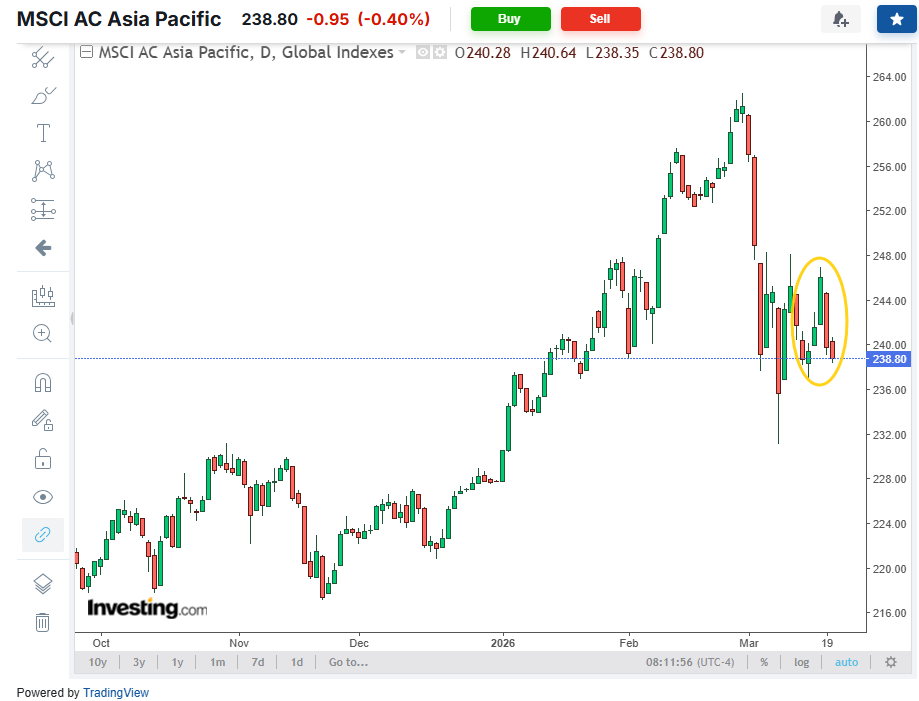
The MSCI Asia Pacific Index was lower -0.4% Friday to end the week little changed but remaining on track for its first down month in the last 11.
Major equity indices in the Asia-Pacific region had a mixed finish to the week while Japan's Nikkei was closed for a holiday.
Japan's Nikkei: CLOSED, Hong Kong's Hang Seng: -0.9%, China's Shanghai Composite: -1.2%, India's Sensex: +0.4%, South Korea's Kospi: +0.3%, Australia's ASX All Ordinaries: -0.7%.
In news:
BBG - Japanese PM Takaichi had warned her first summit with Donald Trump in Washington could be “extremely difficult,” after the US asked her to deploy warships to Iran. Instead, she showcased Japan’s deep ties with the US — and her own agility on the world stage.
Takaichi smiled politely during the only obvious moment of tension during their Oval Office meeting on Thursday, when Trump referenced the Japanese attack on Pearl Harbor in 1941. Otherwise, the Republican leader praised Takaichi, highlighted new areas of economic cooperation and pledged to speak up for Tokyo when he eventually meets Chinese President Xi Jinping.
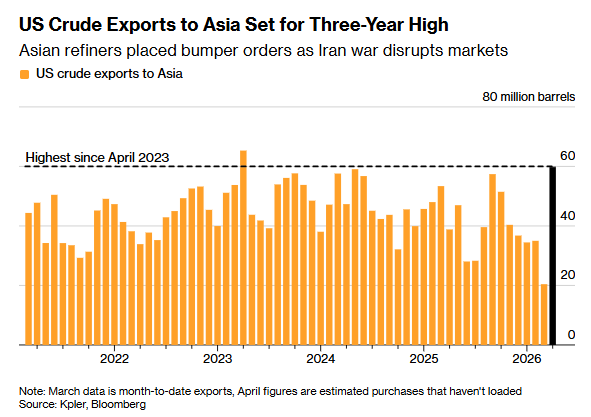
While Takaichi didn’t come to Washington offering warships, she’d prepared plenty of economic sweeteners. That included plans to construct small modular nuclear reactors in Tennessee and Alabama at a cost of as much as $40 billion, as well as projects for natural gas generation facilities in Pennsylvania and Texas for a total of around $33 billion. Those offers come after the announcement only last month of a combined $36 billion investment for a US oil export terminal, gas power plant and synthetic diamond manufacturing facility. Such deals are part of a $550 billion fund established under a US-Japan tariff truce, although Tokyo is still far from fulfilling that whole pledge.
For his part, Trump called Takaichi an “amazing friend” and lauded her landslide election victory last month as a declaration of strength and confidence from the Japanese people “who love you.” Japanese efforts highlighted by Takaichi to put diplomatic pressure on Tehran to stop its attacks on neighboring countries likely also contributed to Trump’s declaration early in the sitdown that Japan was “really stepping up to the plate” on Iran.
“Takaichi is likely breathing a sigh of relief after emerging relatively unscathed from her meeting,” said Bloomberg Economics’ Adam Farrar. “She received a remarkably positive reception from the president, despite a few awkward comments, underscoring the strength of their personal relationship.”
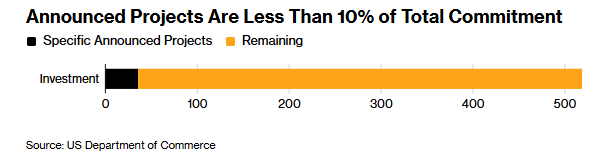
BBG - War in the Middle East is forcing Asia to turn to coal to plug the gaping hole emerging in its supply of liquefied natural gas.
Nations from South Korea to Indonesia and Bangladesh are prioritizing coal as a power source, as the intensifying conflict upends gas supplies from a key exporting region. Among the worst hit countries is Qatar, home to the world’s biggest LNG export facility that Asian customers rely on.
Its Ras Laffan plant has suffered extensive damage after a sharp escalation of attacks on energy infrastructure across the Persian Gulf. Repairs will take three to five years and sideline 12.8 million tons per year of LNG, CEO Saad al-Kaabi said.
As the global gas market buckles under pressure from surging prices, Asian nations are seek alternatives. That means doubling down on their mainstay fuel — coal.
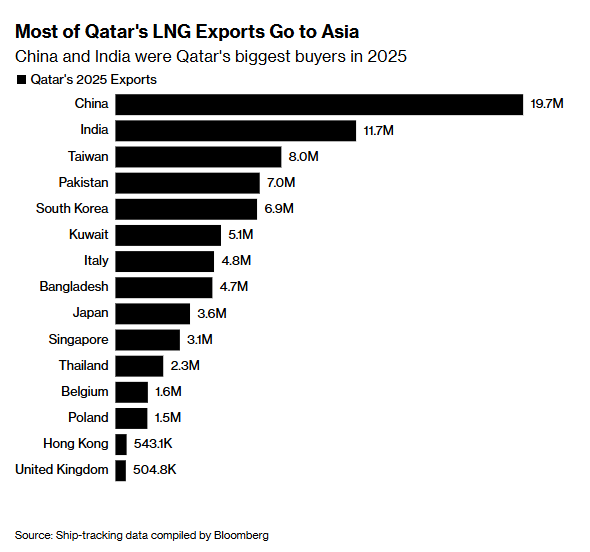
BBG - Asian buyers also have scooped up the most US oil in three years, as the Strait of Hormuz crisis spurs a hunt for alternatives to Persian Gulf crude.
A flurry of purchases in recent days has taken the amount of Asia-bound American oil to be loaded in April to about 60 million barrels, according to traders familiar with the deals, who asked not to be named. That’s the most for a month since April 2023, data from Kpler Ltd. and Vortexa Ltd. show.
One of the shipments, to Taiwan, was priced at a $12-to-$13 a barrel premium to Dated Brent, the traders said. Others were pegged about $18 a barrel above the Dubai marker, although the big swings in benchmarks this week have complicated the pricing process, they said. That compares with $5-to-$6 barrel premiums over Dubai in similar deals done last month, before the war.
BBG - The US charged a Super Micro Computer Inc. co-founder with illegally diverting billions of dollars in Nvidia Corp.-powered servers to China, initiating its highest-profile case against alleged smuggling of restricted AI technology to the Asian country.
US prosecutors charged Yih-Shyan “Wally” Liaw in a scheme to send US-assembled servers containing Nvidia’s cutting-edge chips to China in violation of US export controls. Liaw and two others associated with the company allegedly sold the AI tech through a Southeast Asia company knowing it would be sent on to China.
Also charged in the case were Ruei-Tsang “Steven” Chang, who served as a manager in the company’s Taiwan office, and Ting-Wei “Willy” Sun, an outside contractor described by US authorities as a “fixer” who allegedly aided in the diversion.
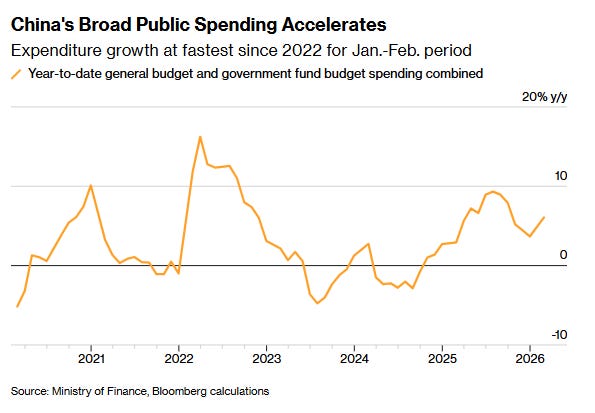
BBG - China’s government spending got off to its fastest start to any year since 2022, likely an effort by authorities to fortify the economy in the face of rising external uncertainty.
A broad measure of public expenditure climbed 6% in the January-February period this year from 2025, according to Bloomberg calculations based on Ministry of Finance data released Thursday.
In contrast, broad fiscal revenue fell 1.4%, leaving a deficit of over 1 trillion yuan ($150 billion) under China’s two main budgets — nearly 70% higher than its level a year ago.
WSJ - All told, global central banks have shown a willingness to hike rates in if the Middle East crisis drives up inflation, said Jain of BNP Paribas. But the path for monetary policy will depend on the duration and intensity of the shock, he said.
For now, fiscal policy is shouldering some of the weight, with governments across Asia resorting to measures like fuel subsidies and price caps to soften the blow to consumers. Still, if the fighting continues, some central banks may be forced to tighten the policy screws. What seems increasingly likely is that rate cuts are off the table.
They now expect central banks in the Philippines and Singapore to tighten policy settings, with other major economies in the Asean bloc likely to remain on hold through the year.
Economists at DBS warn that a concurrent surge in food prices alongside energy costs would pose a significant risk for Southeast Asia, echoing the synchronized, commodity-driven inflation spike observed in 2022.
RTRS - Taiwan's export orders rose less than expected in February, with demand for its AI and technology products losing momentum in the month that ended with the war in Iran raising the risk of trade disruptions.
Export orders in February rose 23.8% from a year earlier to $63.88 billion, the Ministry of Economic Affairs said on Friday. That was below analysts’ expectations for a gain of 25.5%, though it was also the 13th straight monthly gain.
Taiwan’s orders in February for telecoms products were up 55.2% from a year earlier, while those for electronic products jumped 26.2%. Orders from the United States rose 45.1%, after a surge of 64.3% the month before. Orders from Europe were down 5.6%, and those from Japan rose 17.8%.
RTRS - Credit ratings agency Fitch lowered New Zealand’s outlook to ‘Negative’ from ‘Stable’ on Friday, citing the South Pacific country’s increasing difficulty in reducing debt due to a delay in fiscal consolidation over the last few years.
New Zealand’s economic recovery has hobbled in the past few quarters, as tepid consumption and heightened uncertainty about U.S. trade policy and the global economic outlook weighed. Though growth in the economy has started to show early signs of an improvement, there remains plenty of spare capacity.
Briefing.com:
China Securities Journal reported that the Chinese government may reform the consumption tax to increase local income.
The People's Bank of China made no changes to its one-year (3.00%) and five-year (3.50%) loan prime rates.
Australia is scrambling to increase the domestic supply of fuel. Meanwhile, weakness in Australian debt sent its 10-yr yield past the 5.000% mark to a level not seen since mid-2011.
Subscriber section contains more more news, corporate updates, etc., and also SocGen and DB retaining April BoJ rate hike calls, BoA on Asia equity managers.
The rest of the rundown of major Asian political, economic, and corporate news and analysis from Bloomberg, Reuters, FT, Briefing.com, WSJ, BoA, Goldman, etc., follows for paid subscribers.
