
Europe Update - 3/19/26
Includes some Mid-East

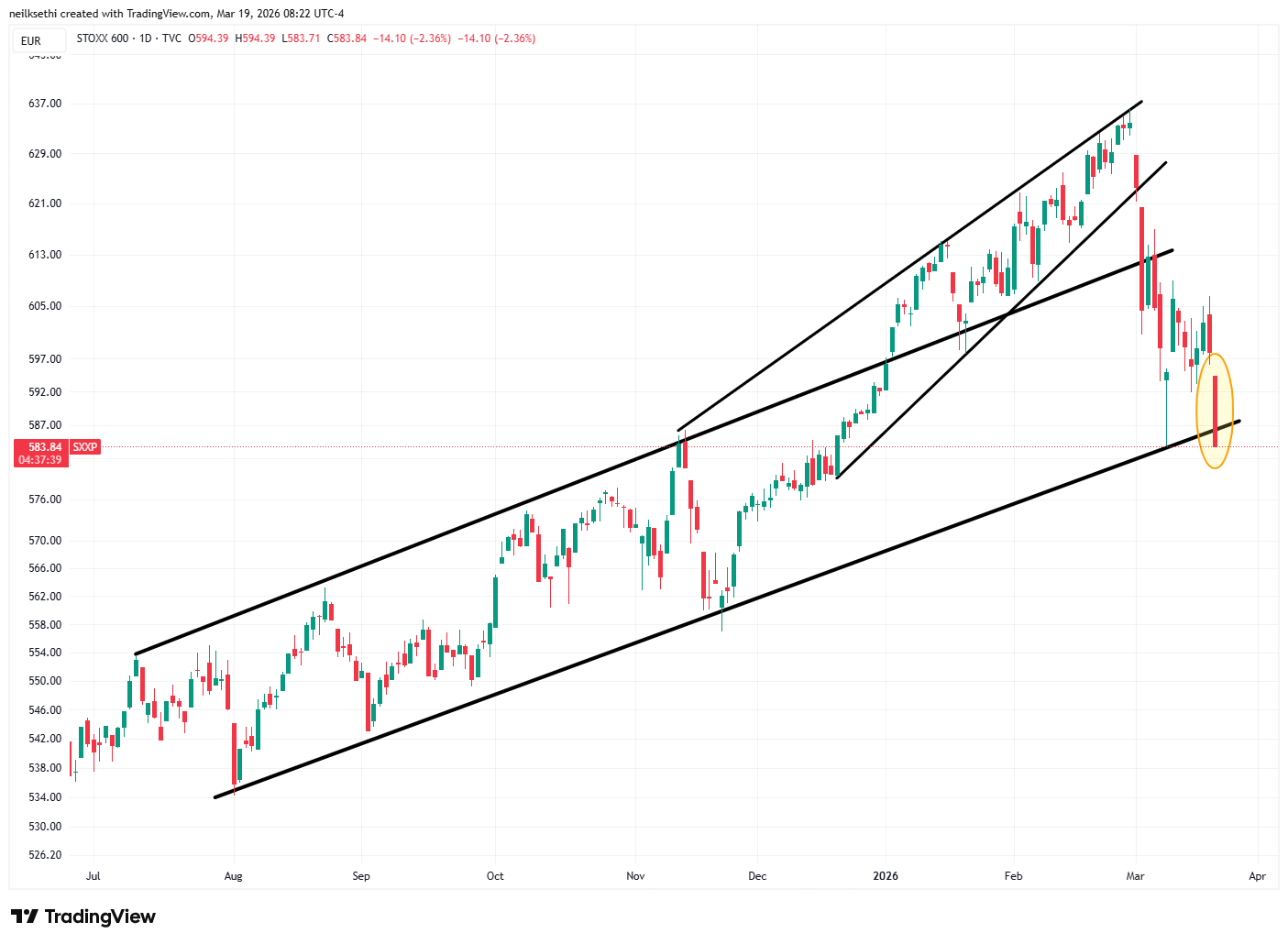
Europe’s benchmark STOXX 600 as of 8.00 am ET was sharply lower -2.3% taking it to the lows hit Mar 9th which were the lowest levels since Dec 18th. It remains easily on track for its first monthly loss in 10 months, currently down nearly -8% on the month.
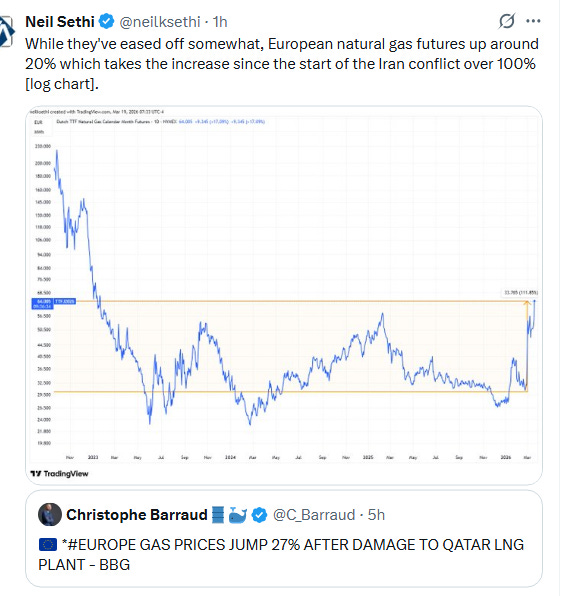
Major European indices were also under selling pressure with another leg higher in energy prices following the back-and-forth attacks on energy facilities in the Mid-East.
Germany's DAX: -2.4%, U.K.'s FTSE 100: -2.1%, France's CAC 40: -2.0%, Italy's FTSE MIB: -2.2%, Spain's IBEX 35: -2.1%.
In news:
BBG - In an unexpected show of hawkish cohesion, the Bank of England voted unanimously to keep interest rates on hold — their first decision without any dissent in four and a half years -- and said it “stands ready to act” to tackle any inflation surge triggered by war in the Middle East, prompting traders to fully price in two quarter-point rate increases by the end of the year.
Governor Bailey warned that policy must “respond to the risk of a more persistent effect on UK CPI inflation.” In a separate statement he added: “Whatever happens, our job is to make sure inflation gets back to its 2% target.”
The nine-member panel dropped language from February’s decision that told investors the benchmark rate was “likely to be reduced further.” The level of concerns was underscored by Swati Dhingra, one of the BOE’s most dovish officials, saying that a hike may be needed in the event of a long-lasting energy supply shock.
The BOE revised its near-term inflation forecasts sharply higher, predicting price growth will accelerate to 3.5% in March - around half a percentage point faster than they had expected before the war.
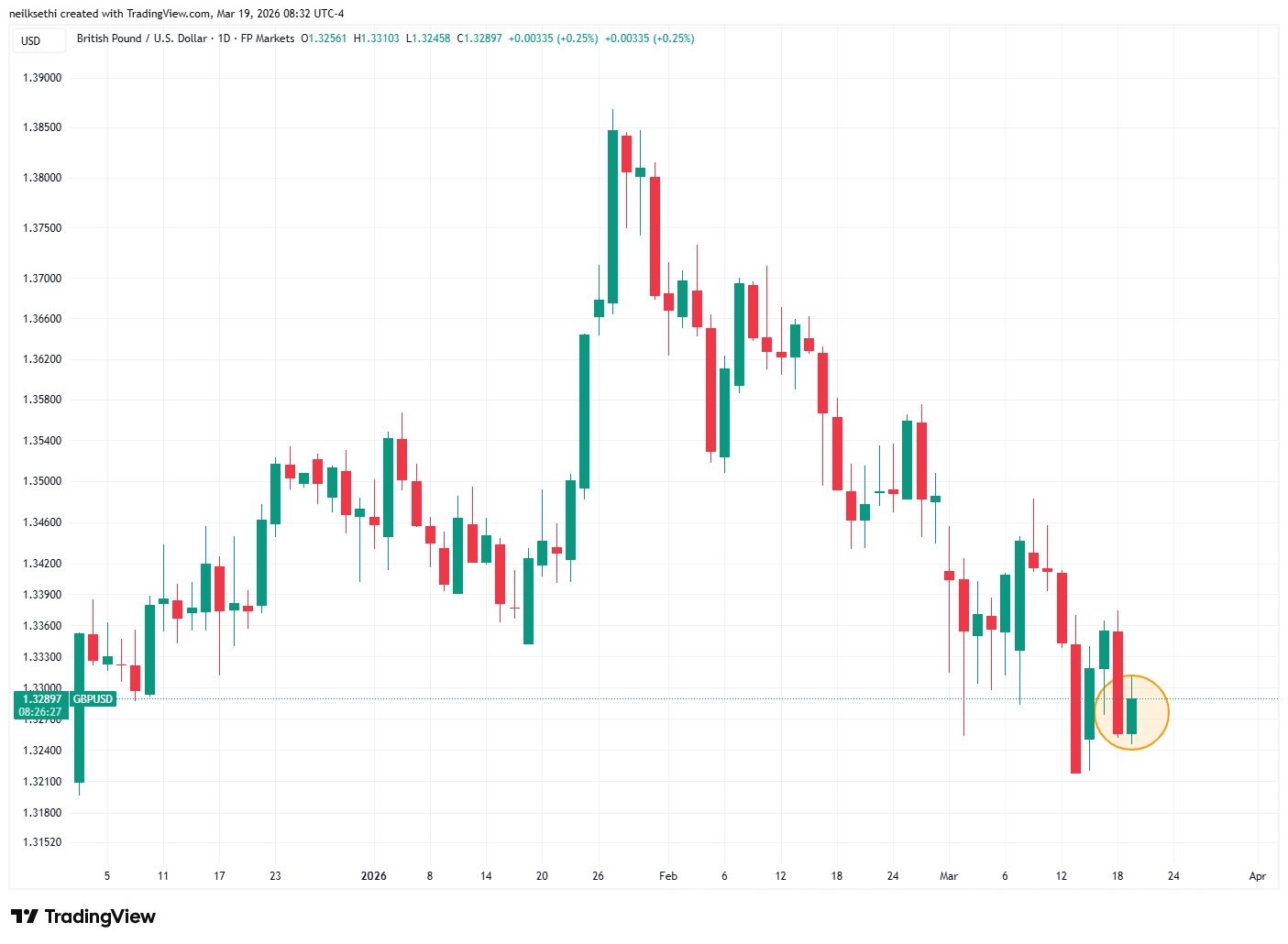
Gilts extended earlier losses, with two-year yields rising as much as 20 basis points to 4.30%, while the pound rose 0.3% against the dollar to $1.3288, btu still near the lows of the year.
In other central bank decisions, the Swiss National Bank kept its key policy rate unchanged at 0.00%, as expected, as did Sweden's Riksbank who said its repo rate is not likely to change for some time. The ECB will be out with rate decision later this morning. It is expected to its key policy rates unchanged.
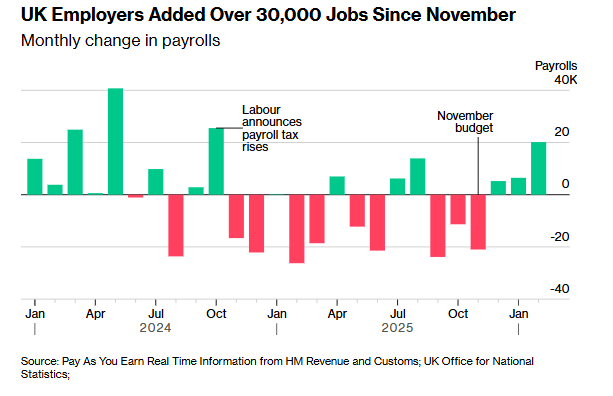
BBG - UK unemployment held steady and employers hired more staff in early signs that the labor market may be stabilizing ahead of the Bank of England’s interest-rate decision later today.
Tax data showed the number of employees on payrolls rose 20,000 in February after a 6,000 increase the previous month, the Office for National Statistics said on Thursday. Economists had expected a 10,000 decline and it was the biggest hiring spree by businesses since October 2024.
The ONS also revised payroll data for December and January, suggesting employers took on more staff in the aftermath of the Labour government’s budget compared with the previous estimates that pointed to continued job losses.
The figures may suggest that the jobs market is past the worst after firms shed workers last year in response to higher costs. However, economists warned the fallout from conflict in the Middle East could cause businesses to downsize once again.
But wage growth excluding bonuses cooled more than expected to 3.8%, down from 4.1%, a sign domestic inflationary pressures were easing before the war in Iran. Private-sector earnings, the gauge watched by the BOE, slowed to 3.3%, the weakest figure since the end of 2020. Real wage growth — nominal earnings adjusted using CPI inflation — was just 0.5%, the lowest since July 2023.
Vacancies fell 6,000 to 721,000 in the three months to February — the lowest level since 2021. Youth unemployed rose to the highest since 2015, including the pandemic.
RTRS - Iran’s foreign minister called for vigilance and regional coordination in separate calls with counterparts in Turkey, Egypt and Pakistan as the military warned of a tougher response to any further attacks on its energy infrastructure, state media reported on Thursday.
After its energy facilities in South Pars gas field and Asaluyeh were targeted on Wednesday, Iran retaliated against what it said were U.S.-linked energy sites in Gulf countries, including Ras Laffan Industrial City in Qatar, the world’s largest LNG complex.
RTRS - European Union leaders piled pressure on Hungarian Prime Minister Viktor Orban on Thursday to lift his blockade on a vital 90-billion-euro ($103 billion) EU loan to Ukraine to keep up its fight against Russia’s invasion.
EU leaders agreed to the loan in December but Orban, who has cordial ties with Russia and has clashed with Ukrainian President Volodymyr Zelenskiy, blocked its implementation last month, citing a dispute over a war-damaged pipeline.
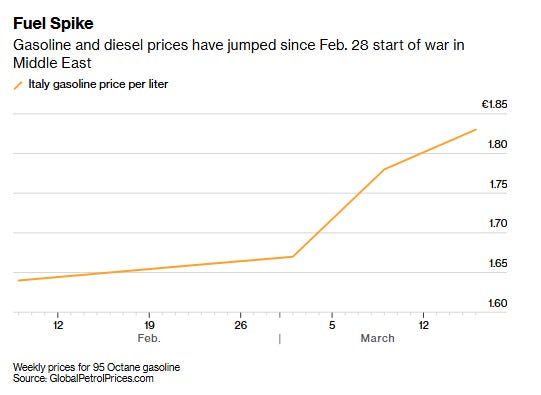
BBG - Italy’s government approved a temporary cut to excise taxes on fuel in a bid to help citizens deal with higher costs caused by the conflict in the Middle East.
Prime Minister Giorgia Meloni said on Wednesday that her cabinet approved the €0.25 ($0.29) per liter reduction in fuel levies, part of a broader package of measures taken as an emergency backstop against soaring energy prices.
The measures are worth hundreds of millions of euros, her deputy Prime Minister Matteo Salvini said, and will be in place only for a limited period of time.
BBG - The UK government said it will hike tariffs on steel imports and cut import quotas, as it seeks to boost the country’s ailing domestic steel industry amid fierce global competition.
Quota levels for steel imports will be reduced by 60% compared to current arrangements from July 1, and tariffs on steel imports outside of the quota will increase to 50% from 25%, the Department for Business and Trade said in an e-mailed statement.
Subscriber portion includes more news, corporate updates, etc., plus Goldman’s thoughts pre-BoE on their likely response to rising energy prices (which they will likely update after today’s decision).
The rest of the rundown of major European political, economic, and corporate news and analysis from Bloomberg, Reuters, FT, Briefing.com, WSJ, BoA, Goldman, etc., follows for paid subscribers.
