
Europe Update - 3/20/26
Includes some Mid-East

Note: This will be the last stand-alone Europe Update. Per subscriber requests, I am folding this and the Asia Update into an “International highlights” of the top stories from Europe, Asia, etc., in the As We Approach the Open piece (which will allow that to come out before 9 am and cut down the morning updates to one email).
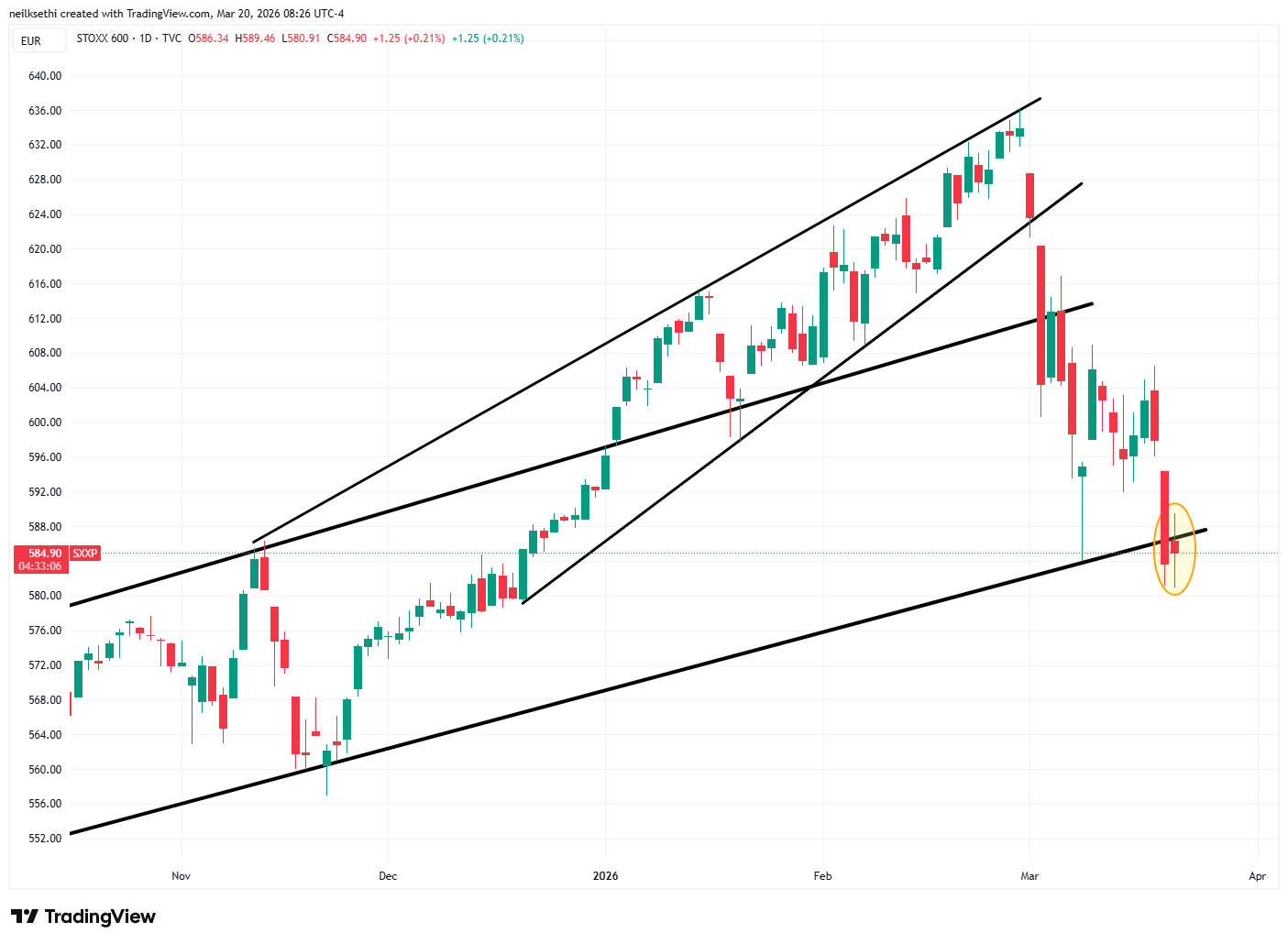
Europe’s benchmark STOXX 600 as of 8.00 am ET was trading with a modest +0.26% gain after having earlier touched the lowest levels of the year. It remains though easily on track for its first monthly loss in 10 months, currently down over -7% on the month.
Major European indices also similarly trading with mostly modest gains.
Germany's DAX: +0.2% U.K.'s FTSE 100: +0.2%, France's CAC 40: +0.3%, Italy's FTSE MIB: +0.4%, Spain's IBEX 35: +0.9%.
In news:
BBG - The European Union is bracing for a protracted energy price shock after Iran crippled a vital Qatar gas plant, raising the prospect of a years-long supply crunch.
During a summit in Brussels on Thursday, EU leaders expressed anxiety at the darkening economic situation and called for a “moratorium” on strikes against energy facilities in the US and Israeli war with Iran. Inside the room, Italian Prime Minister Giorgia Meloni warned that the energy situation is serious, according to people familiar with the matter.
Iran’s latest attack on Qatar damaged facilities that produce about 17% of its liquefied natural gas export capacity, Reuters reported, citing QatarEnergy’s chief executive officer. Repairs will take three to five years and sideline 12.8 million tons per year of LNG, CEO Saad al-Kaabi said
European Central Bank President Christine Lagarde urged governments not to go overboard on help for voters to weather the surge in energy prices, pleading fiscal restraint. In remarks that appeared to caution against a repeat of large-scale aid delivered in the wake of the outbreak of war in Ukraine in 2022, she tackled the matter in her opening statement to reporters on Thursday. “The Governing Council highlights the urgent need to strengthen the euro area economy while maintaining sound public finances,” Lagarde said after the ECB kept its interest rates unchanged. “Any fiscal responses to the energy price shock should be temporary, targeted and tailored.”
BBG - European Central Bank policymakers would be ready to raise interest rates as soon as their next meeting should fallout from the war in Iran push inflation too far above target, according to people familiar with the situation.
While nothing has been decided yet and a later date may be more appropriate, factors including signs of second-round effects could trigger such a move at the April 29-30 gathering, the people said, asking not to be identified because discussions are confidential.
Traders increased wagers on an April hike after the report. Money-market pricing implied a roughly 60% probability of a quarter-point rise, versus about 50% earlier.
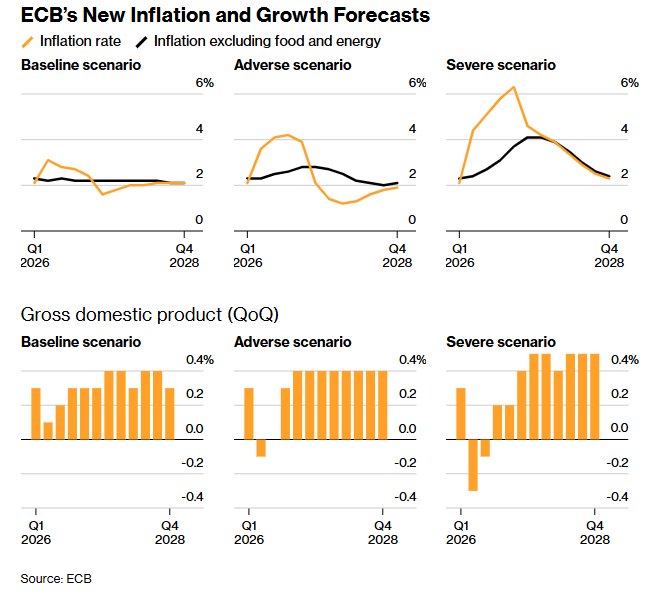
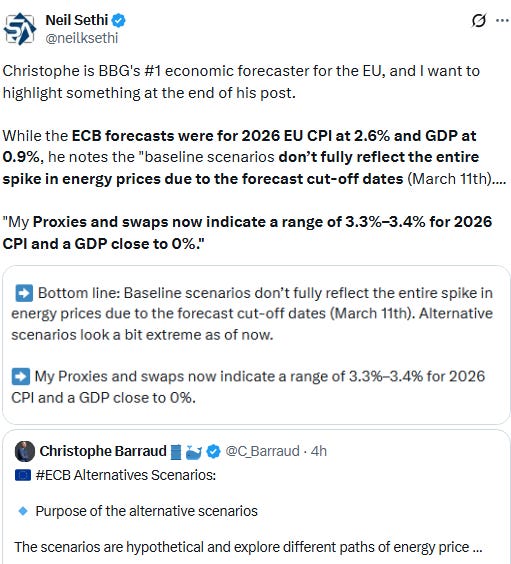
A new quarterly outlook, based on inputs that ran until March 11 to account for the start of the war, pointed to inflation of 2.6% in 2026 — well above the 2% goal.
A severe version of how events in Iran may play out would see price gains peaking at 6.3% in the first quarter of 2027 and the economy experiencing a brief recession in 2026, the ECB said.
JPMorgan economist Greg Fuzesi now predicts ECB hikes in April and July.
The ECB has “made a hawkish shift,” he said in a note to clients. “The staff projections sent a very clear message of upside risks to medium-term inflation, both through a higher baseline forecast and additional upside risks from possible second-round effects.”
That chimes with the view of Bundesbank President Joachim Nagel, who said in an interview published on Friday that policymakers will need to consider hiking rates as soon as next month if price pressures build further due to the Iran war.
The European Central Bank will need to consider hiking interest rates as soon as next month if price pressures build further due to the Iran war, according to Governing Council member Joachim Nagel. “As things currently stand, it is conceivable that the medium-term inflation outlook could deteriorate and inflation expectations could rise on a sustained basis, meaning that a more restrictive monetary-policy stance would probably be necessary,” he told Bloomberg on Friday.
The European Central Bank is determined to meet its inflation goal, Governing Council member Francois Villeroy de Galhau said. “We are fully committed to stabilizing inflation at our medium-term target of 2%,” he said on Ecorama. “We are facing uncertainty, and waiting today will allow us to see which scenario is unfolding. We actually published several different scenarios yesterday. But we have the capacity to act as much as necessary and when necessary.”
European Central Bank Governing Council member Gabriel Makhlouf didn’t rule out an increase in interest rates next month should data signal the need for such a step, though said it’s impossible to commit with uncertainty so high.
Both JP Morgan and Morgan Stanley reckon the central bank will ultimately at least partially reverse its moves. “Faced with lower growth, we think the ECB will likely cut rates again in June and September 2027 to 2%, bringing rates back to neutral territory,” Morgan Stanley economists led by Jens Eisenschmidt said in a report. JPMorgan’s Greg Fuzesi meanwhile is only penciling in one cut in 2027 for now.
BBG - European Union leaders on Thursday couldn’t break the deadlock over a €90 billion ($103 billion) loan to Ukraine, leaving some fuming over Hungarian Prime Minister Viktor Orban’s refusal to budge until he regains access to Russian oil.
In an hour-long discussion during a summit in Brussels, which Ukrainian President Volodymyr Zelenskiy attended via videolink, nearly every EU leader spoke in favor of unlocking the aid, noting they had all agreed to the loan during a marathon meeting in December.
But Hungary, backed by Slovakia, stood its ground, according to people familiar with the matter who spoke on condition of anonymity. Going into the meeting, Orban made it clear that he wouldn’t relent until Kyiv restores oil shipments through the Druzhba pipeline, which was damaged in a Russian drone strike.
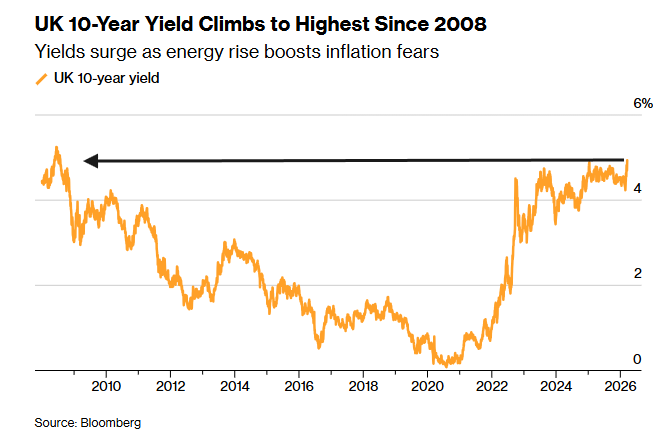
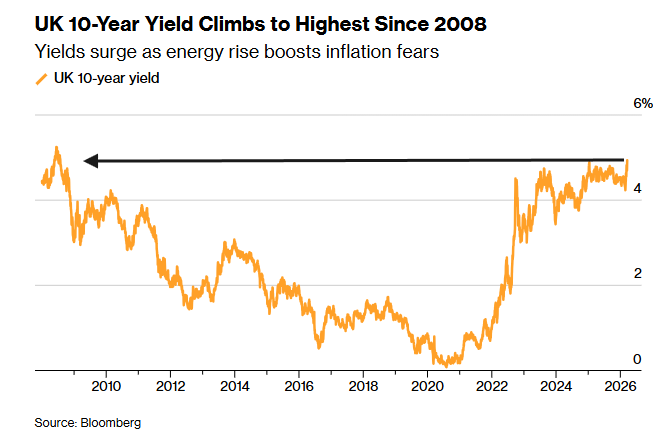
BBG - UK government borrowing costs reached their highest level since 2008, as traders ramped up wagers on interest rate hikes and new data showed the government’s finances deteriorating.
The benchmark 10-year bond yield rose as much as 11 basis points to 4.95%, the highest since the global financial crisis nearly two decades ago. That’s also beyond the level reached during the 2022 turmoil in the gilt market witnessed under Prime Minister Liz Truss.
Shorter-dated notes, which track central bank rates closely, have taken the brunt of the selloff, with the two-year yield up another 11 basis points to 4.52%,
WSJ - The U.K. government borrowed more in February than a year earlier, but was on track to reduce its budget deficit before the U.S. attack on Iran sent energy prices soaring and upended the economic outlook.
The Office for National Statistics said Friday that the government borrowed 14.3 billion pounds ($19.20 billion) in February, up 2.2 billion pounds from a year earlier as interest payments hit a record high. That brought total borrowing for the first 11 months of the fiscal year to 125.9 billion pounds, 11.9 billion pounds lower than in the same period the previous year.
Earlier this month, the Office for Budget Responsibility forecast that the gap between government spending and revenues would narrow to 4.3% of gross domestic product in the fiscal year ending in early April from 5.2% in the previous period. The budget deficit would continue to narrow over the coming years, it said.
However, the surge in energy prices after President Trump’s decision to attack Iran will likely slow economic growth and reduce tax revenues. The government has already announced a small package to help some households immediately disadvantaged by the rise in energy prices, and is likely to do more if the disruption is sustained.
BBG - Spain’s government is set to announce on Friday cuts on fuel and electricity taxes as part of a broad aid package to counter the surge in energy prices due to the war in the Middle East, according to people familiar with the matter.
VAT on gasoline and diesel will be reduced to 10% from 21%, the people said, asking not to be named as the matter isn’t public yet. A 5% special tax on electricity will also be reduced and a 7% tax paid by power generators will be scrapped, the people said.
Subscriber portion includes more news, corporate updates, etc., plus ING’s thoughts on the BoE decision, and BoA’s on that decision as well as the ECB.
The rest of the rundown of major European political, economic, and corporate news and analysis from Bloomberg, Reuters, FT, Briefing.com, WSJ, BoA, Goldman, etc., follows for paid subscribers.
