
Markets Update - 5/6/26
A look at what happened today impacting US equity, Treasury, and selected commodity markets, and what to watch for tomorrow

Quick Summary:
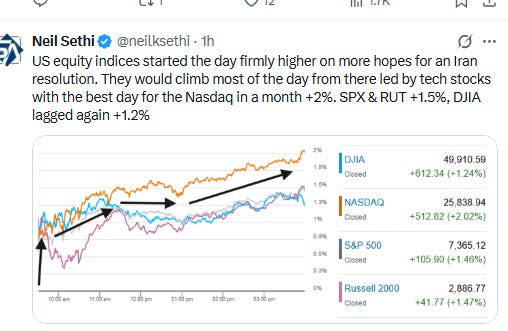
US equity indices would see strong gains Wednesday as oil prices fell as hopes for a resolution to the Iran conflict grew.
Tech stocks would lead on the back of AMD’s strong earnings report and other tech-positive headlines. Wednesday would be the best day for the Nasdaq in a month taking it, the S&P 500 and small cap Russell 2000 all to new record highs.
It was a lighter day of economic data with just April ADP job growth coming in at a very solid +109k, the fastest pace since January 2025.
US equity indices opened trading Wednesday firmly higher on more hopes for an Iran resolution along with a flurry of tech-favorable headlines including AMD’s 19% surge as detailed in the morning update.
While President Trump would cast some doubt on the progress in a NY Post interview saying it is "too soon" to start preparing for an imminent U.S.-Iran peace deal, he would later say an interview with PBS News Hour that the war has “a very good chance of ending” and there’s a possibility that happens before his trip to Beijing next week although he also said the war would be on the agenda.
Meanwhile Iran laid out an updated process for ships seeking to transit Hormuz, but several shipowners said they remained cautious about sending their vessels through the waterway. The Islamic Revolutionary Guard Corps said “safe, stable passage” will be possible with “new protocols in place.”
Elsewhere, bond yields softened along with crude prices as did the dollar and US natural gas futures. Gold, copper, and bitcoin tough were solidly higher (all covered in the subscriber section with charts).
The market-cap weighted S&P 500 (SPX) was +1.5%, the equal weighted S&P 500 index (SPXEW) +0.8%, Nasdaq Composite +2.0% (and the top 100 Nasdaq stocks (NDX) +2.1%, the SOX semiconductor index +4.5% (+8.7% the psat two sessions to a new all-time high), and the Russell 2000 (RUT) +1.3%.
Some market commentary:
“The market continues to price in de-escalation and an easing in supply constraints,” said Geoff Yu, senior macro strategist at BNY. “The road ahead is bumpy, but the direction of travel seems clear.”
“It’s possible that much of the ‘progress’ that the market is trading off of could still be foiled. In any event, if oil prices remain at current/lower levels, the biggest winners will be government bonds, gold, and currencies like the yen, which have demonstrated the greatest sensitivity to crude prices recently.”
- Cameron Crise, Macro Strategist.
“Markets need a permanent ceasefire in the Middle East and, crucially, a resumption of trade through the Strait of Hormuz to sustain the rally,” said Joachim Klement, head of strategy at Panmure Liberum.
“We remain on the path towards de-escalation, and towards an end to the conflict,” said Michael Brown at Pepperstone. “While that path is clearly a rough one, so long as we remain on it, and the direction of travel remains a more optimistic one, then risk appetite should remain underpinned, equity declines shallow, and dips buying opportunities.”
JPMorgan’s morning briefing, written by Andrew Tyler and Ellen Wang, said the market reaction to the Axios report of a one-page memo being drafted to end the war is suggestive of what will happen if a deal is officially agreed. “This news has launched a global risk-on tone and gives a template for what markets are likely to do once an official deal is reached: oil lower, bull steepening in yield curve, weaker USD, higher [equities] where the rally sees a sharp squeeze with Value / Beta leading and US lagging peers but quickly moving back to the Tech trade,” they said.
“Tech has obviously been a story of earnings delivery and earnings growth expectations,” said Sunil Krishnan, head of multi-asset funds at Aviva Investors. “The runway for the sector looks pretty clear over the next 12 to 18 months in terms of increases in demand as we are starting to see more AI adoption.”
Lori Calvasina, head of U.S. equity strategy at RBC Capital Markets, said on CNBC’s “Closing Bell: Overtime” on Tuesday afternoon that stocks appear to be “climbing a wall of worry.”
“I think maybe perhaps people in the geopolitical world don’t understand what’s happening with the AI trade and earnings and how much of a buffer that is for S&P 500 EPS. So we’re continuing to see rates of upward revisions that are positive on that AI-related trade,” Calvasina said. “I’m not saying there’s a ton of room before we have a little bit of a breather, and we don’t think markets move up in a linear fashion. But I don’t think we’re overheated right now.”
“If we truly achieve a point in time here where the hostilities begin to slow down or, in fact, stop in their entirety, and we see the reopening of the Strait of Hormuz, this will allow some of those most economically sensitive and hardest hit regions like Southeast Asia, like Europe, potentially avoid their own economic difficulties,” said Bill Northey, investment director at U.S. Bank Asset Management Group. That’s “setting up for a snapback in equity markets,” he continued.
The ADP report for April is “an encouraging sign of resilience from the U.S. economy,” amid anxiety in business and consumer surveys about the Iran War, according to Bill Adams, chief U.S. economist at Fifth Third Commercial Bank.
Still, the Iran war remains the biggest risk factor for the jobs outlook, he added in a Wednesday note. “If the war resolves relatively soon, other trends in the economy could easily push the unemployment rate lower by the end of this year.”
