
Markets Update - 6/11/26
A detailed look at what happened today impacting US equity, Treasury, and selected commodity markets, and what to watch for tomorrow.

For those who follow me on X, please note my account was suspended, apparently because I posted some BoA materials. The whole thing is quite odd given how many people post BoA charts, but you can read about it in the post below (just click on it) and replies to it (I explain it all in one of them). You can also refollow me at the new account (and a retweet would be appreciated!). If I somehow get the old account unfrozen, I’ll let you know.

Quick Summary:
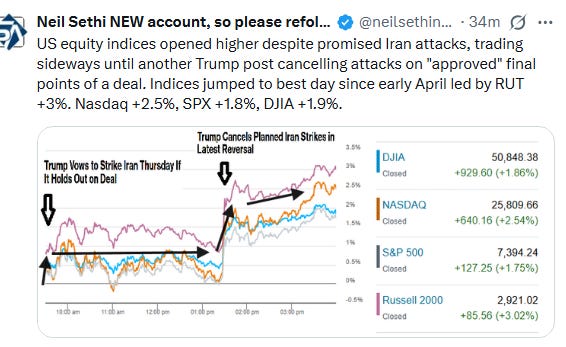
US equity indices would start Thursday’s session rebounding after the S&P 500 and Nasdaq closed Wednesday at the lowest levels since early May, however gains were trimmed after President Trump posted on social media that “the United States will be hitting Iran…VERY HARD TONIGHT,” as discussed in the morning update.
Equities were also digesting the producer (wholesale) prices report which saw prices rise the most since 2022 on a broad-based advance led by energy, as well as awaiting the debut Friday of SpaceX which priced today at $135 per share and is expected to raise $75 billion Friday.
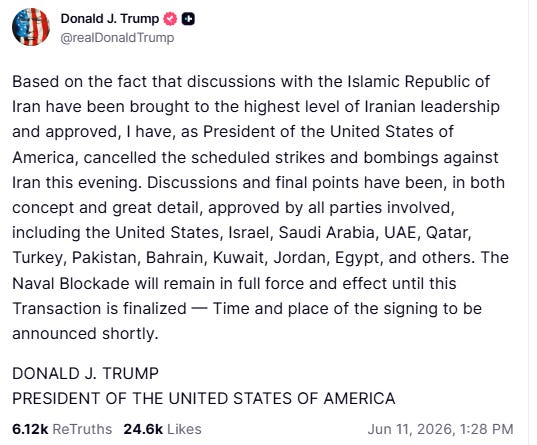
Equities would trade sideways until around 1.30pm ET when President Trump posted on social media that “Based on the fact that discussions with the Islamic Republic of Iran have been brought to the highest level of Iranian leadership and approved, I have, as President of the United States of America, cancelled the scheduled strikes and bombings against Iran this evening. Discussions and final points have been, in both concept and great detail, approved by all parties involved… The Naval Blockade will remain in full force and effect until this Transaction is finalized — Time and place of the signing to be announced shortly.”
Indices would jump and finish with their best session since early April led by the small cap Russell 2000’s +3%. The Nasdaq was +2.5%, the S&P 500 +1.8%, and the Dow Jones Industrial Average +1.9%.
Later Trump told reporters in the Oval Office that “we have a deal that Iran will never have a nuclear weapon…We [will] have a signing soon, and the documents are in pretty final shape. It should be done and it should be done pretty quickly… over the next few days.” CBS News later reported that “a memorandum of understanding between the U.S. and Iran is likely to be signed early next week, paving the way for further negotiations on a long-term deal.”
A rebound in semiconductor names also provided momentum to the market. The iShares Semiconductor ETF (SOXX) gained more than 8%. The chip ETF was under pressure again earlier this week following a 10% drubbing on Friday. That outweighed an 8% drop in Oracle as discussed in last night’s update.
Elsewhere, bond yields would drop sharply following the Trump post along with oil prices. US natural gas futures and the dollar were also lower, while gold, copper, and bitcoin rebounded.
Some market commentary:
“We’re keeping our overweight equity exposure,” said Christophe Boucher, chief investment officer at ABN Amro Investment Solutions. “The market has taken the view that Trump doesn’t want to escalate further and has no interest in seeing oil prices surge again.”
“Sentiment trends are shifting very quickly since Friday’s selloff and the market has become much more volatile and much more selective,” said Andrea Tueni, head of sales trading at Saxo Banque France. “Even if the trend remains upward, brace for some more erratic moves ahead.”
“There’s nervousness about how markets will react [to the SpaceX IPO],” said Josh Gilbert, lead analyst for Asia Pacific and the Middle East at Etoro Ltd. “How markets absorb the biggest listing in history at a rich valuation will tell us a lot about whether the appetite for the AI trade is still sky high.”
“A wave of IPOs by artificial intelligence firms, starting with SpaceX this week, could power another leg of the equity rally and also expose its limits. The former is more likely in the near term.” — Skylar Montgomery Koning, macro strategist.
“We maintain our positive outlook on US equities and believe investors should stay positioned for longer-term gains,” said Ulrike Hoffmann-Burchardi at UBS Chief Investment Office. “We also believe the current environment reinforces the importance of diversification and risk management as markets navigate elevated volatility.”
“The kind of volatility we’re seeing in the market is fairly typical in this environment,” said Tracie McMillion at Wells Fargo Investment Institute. “There is some substance behind that resilience. We saw solid earnings during the first quarter, and earnings revisions for the second quarter have also moved meaningfully higher.”
The hotter-than-expected wholesale prices report is another data point that could push the Federal Reserve to hike interest rates, said Clark Bellin, chief investment officer of Bellwether Wealth. ″[I]t’s clear that all of the main measures of inflation are flashing red,” he said. “We acknowledge that this inflationary spike is likely temporary and will subside once the Iran war ends, but there is increasing concern that the Iran conflict will persist for some time, which means higher oil prices and higher inflation.”
“I would say that the true FOMO — the wild-eyed, buy at any cost, whatever it is I’ll take it — is still potentially ahead of us,” Emanuel said Thursday on Bloomberg Television’s Surveillance. “Think about the headlines that we’re dealing with this morning,” he said, pointing to events that could normally undermine sentiment, including the latest Middle East attacks.
“This inflationary spike is likely temporary and will subside once the Iran war ends, but there is increasing concern that the Iran conflict will persist for some time,” said Clark Bellin at Bellwether Wealth. “The negatives of rising oil prices and high inflation are outweighed by the incredible earnings power and AI productivity gains that are pushing stocks higher.”
“What we have right now is an innovation boom,” Naomi Fink, chief global strategist and chief economist at Amova Asset Management, told MarketWatch on Thursday. That’s partly why the market is exhibiting “immense risk tolerance,” despite elevated oil prices triggered by the Iran conflict leading to ongoing inflation pressures, she said. For example, Thursday’s hotter-than-expected May reading from the producer-price index, a gauge of wholesale inflation in the U.S., reflected the “oil shock” from the Iran war, said Fink.
