
Markets Update - 7/27/26
A look at what happened today impacting US equity, Treasury, and selected commodity markets, and what to watch for tomorrow

Quick Summary:
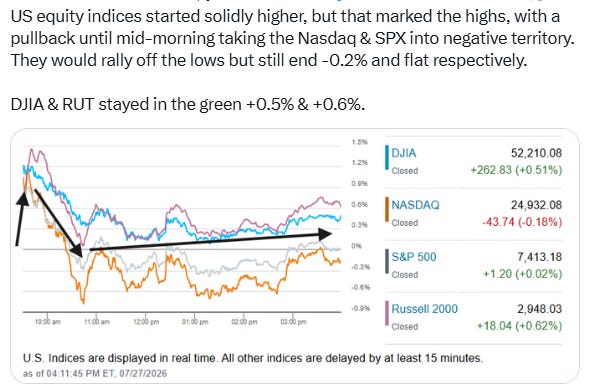
US equity indices opened firmly higher Monday, encouraged by the continued pause in strikes between the US and Iran as the latter held talks with Oman over the Strait of Hormuz which was sent oil prices sharply lower and bond yields also easing as covered in the morning update.
However, the early strength faded quickly as another bout of weakness in semiconductor and AI infrastructure names weighed on the market-cap-weighted indices dragging them into negative territory. They would battle back to finish little changed with the S&P 500 flat on the day, while the Nasdaq Composite slipped -0.2%. The PHLX Semiconductor Index fell -2.2%, now on track for its worst month since 2008, dragging the Information Technology sector lower despite strength in software and another all-time high for Apple.
In contrast the less Tech heavy equal-weighted S&P 500 Index finished +0.7%, the Dow Jones Industrial Average +0.5%, and the Russell 2000 +0.7%, as under the surface, participation was stronger than the headline indices suggested. Communication Services, Consumer Staples, and Financials were among the leaders.
WTI crude would see its largest decline since early April as US-Iran tensions eased with President Trump saying there was a “good chance” of reaching a deal with Iran. That said, Trump warned fighting could resume if negotiations do not produce a deal.
Separately, Iran and Oman are trying to reach an agreement to restart shipping through the Strait of Hormuz, according to people familiar with the matter.
Some market commentary:
“Today’s move in oil is supportive for both equities and bonds, but the impact is likely to be short-lived. Particularly given it’s difficult to make a sustained case for lower oil prices with no sign of transit through the Strait of Hormuz resuming.” — Skylar Montgomery Koning, BBG macro strategist.
“In yet another example of where stocks are headed once the Iran conflict is over, a suspension of attacks over the weekend has pushed crude oil prices lower, and interest rates are following,” said veteran strategist Louis Navellier. “That implies further equity upside when the conflict is fully over.”
“I expect a volatile week with the Fed, tech results, and a bunch of European inflation data coming out,” said Andrea Gabellone at KBC Securities. “Moreover, the Iran situation is still very fragile. For now, the President said that ‘all options are still open,’ so it will be difficult to put risk back on the table.”
“This is a week with more than its fair share of potential surprises, good and bad,” said Chris Larkin at E*Trade from Morgan Stanley. “Geopolitics and oil prices may be the biggest wild cards, but a bullish response to strong Magnificent Seven earnings isn’t a given, especially if AI spending levels continue to raise eyebrows.”
“There is a complex relationship between earnings releases and markets,” said Daniel Murray, deputy chief investment officer at EFG Asset Management. “If results are good but the response is anemic, that will be informative in terms of the underlying market tone and investor sentiment.”
“We know that Warsh does not want to provide the market with forward guidance, which is fine,” said Mark Cabana, head of US rates strategy at Bank of America. “But then the market has greater ability to price the outcome that it thinks the Fed should do, or price an outcome that perhaps will force the Fed to consider hiking.”
“We’re in a period where people are inclined to sell off on capex, and Microsoft and Meta and Amazon are all holding hands with Alphabet and jumping in to spend,” said Willy Lee, principal at venture firm Neostellar Capital. “We’re going to see scrutiny on all parts of their businesses as they keep spending.”
“There’s just a lot of uncertainty about what is happening with Chinese companies,” Thomas Martin, senior portfolio manager and partner at Globalt Investments, told CNBC. “You have a lot of competition and technological advancement ... in product markets that are very tight.” Additionally, traders are reshuffling their investments amid signs of “air being let out” of the artificial intelligence bubble, particularly as stocks remain off their record highs hit in late June, according to Martin. “There’s just this tremendous uncertainty in technology land,” Martin added. “There’s a lot of uncertainty among investors as to where this shakes out and whether they want to reposition some of their money.”
“I would classify a rotation as fundamentally driven — there’s a fundamental reason for people to sell one cohort of stocks and buy another — as opposed to a positioning unwind,” Jonathan Krinsky, chief market technician at BTIG LLC, said by phone. The drifting market action in recent weeks is “more of an unwind than a rotation.”
In today’s Markets Update:
A deeper look at Monday’s stock and sector breakdown, including renewed semiconductor weakness but strength in other areas with broad participation beneath the surface.
A closer look at key company movers and corporate developments.
Updated technical charts across the SPX, Nasdaq, Russell 2000, and equal-weighted SPX.
A review of market breadth and participation, including large individual winners and losers, NYSE positive volume, EPFR flows, and the split between market-cap-weighted weakness and equal-weighted strength.
A look at the rates and Fed backdrop, including Treasury yields, the 2-year yield’s break above its downtrend line, the setup into Wednesday’s Fed decision, and BoA’s Hartnett on the need for a Fed hike.
A look at volatility and market structure, including VIX, VVIX, 1-day VIX, and Tier1Alpha on systematic positioning.
A review of cross-asset trends, including WTI crude, the dollar, gold, copper, natural gas, and bitcoin.
MarketWatch on the SOX drawdown, Bloomberg on capex pressure and sector divergence, Goldman’s Callahan on AT&T, a look at SpaceX weakness, Sevens Report on sector dispersion, Goldman on hyperscaler correlations, Deutsche Bank and Goldman on positioning, BoA on EPFR flows, a look at Nvidia/SK/OpenAI developments, John Kemp and JPM’s Natasha Kaneva on oil positioning, Deutsche Bank on oil valuation and oil/rates volatility, CNBC/Goldman on gold sentiment, Yardeni on Dow Theory, BoA/Hartnett on blue-collar semis and MAGS, BoA’s trading desk on momentum, RenMac on core durable goods shipments, the updated Atlanta Fed GDPNow, Goldman on core PCE inflation breadth, Atlanta Fed on business inflation expectations, AAII on inflation expectations, SocGen’s Albert Edwards on ISM/EPS risk, BloombergNEF on data-center electricity demand, BoA/Hartnett on Treasury supply, and Mark Hulbert on active management.
A wrap-up on AI weakness, broader market resilience, the rates and oil backdrop, the Iran conflict, and the near-term market setup.
A look ahead to Tuesday’s calendar, including US economic data, the Fed blackout, Treasury auctions, SPX earnings, and ex-US highlights.
