
Markets Update - 7/29/26
A look at what happened today impacting US equity, Treasury, and selected commodity markets, and what to watch for tomorrow

Quick Summary:
US equity indices opened modestly lower Wednesday ahead of the most uncertain Fed meeting in a decade and key earnings from Microsoft and Meta Technologies, with stocks pressured by another selloff in Asian tech shares and oil prices rebounding following a return to kinetic action in the Mid-East all as covered in the morning update.
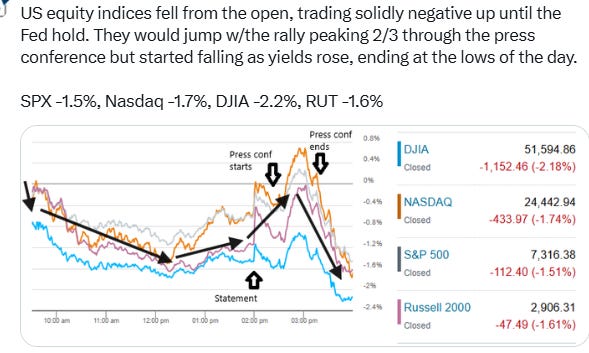
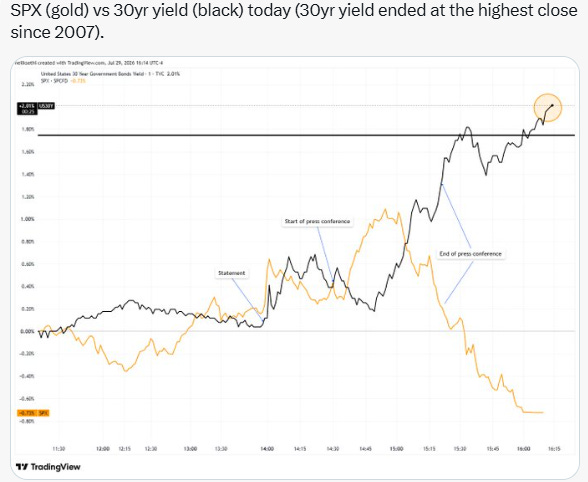
Those pressures though would pull indices lower throughout the morning session with the S&P 500 down 0.6% heading into the Fed decision. The initial reaction was favorable as the Fed held rates unchanged at 3.50% to 3.75% (with three dissents in favor of a 25-basis-point hike) sparking a rally in stocks. Indices would push into positive territory during Chair Kevin Warsh’s press conference, but things would turn around for equities right at 3pm as rising longer-end Treasury yields exerted pressure seeing equity indices drop sharply as the 30-year yield ended at its highest close since 2007.
At day’s end, the S&P 500 fell -1.5%, the Nasdaq Composite -1.7%, the Dow Jones Industrial Average -2.2%, and the Russell 2000 -1.6%, all finishing near their lows of the session. The Nasdaq-100 (100 of the largest non-financial companies listed on the Nasdaq) finished in correction territory.
The same pressure points that have dominated recently remained in place. Semiconductors continued their selloff, with the PHLX Semiconductor Index down -5.3%, remaining on pace for its worst month since 2001, while Technology, Industrials, Utilities, and Financials all lagged. Energy was the clear outperformer as WTI crude rose more than 6% after President Trump said the US would strike back at Iran after a recent attack that targeted a military base in Jordan, as the war in the Middle East flared up again following a pause in hostilities. “We’ll be hitting them hard,” Trump said in a phone interview, Fox News reported Wednesday, adding that “they’re going to get a beating.”
After the close Meta sold off following a miss on earnings and a weak revenue forecast while Microsoft shares were up after top and bottom line beats with cloud growth coming in above expectations.
Attention turns to a busy day of US economic data tomorrow including Q2 GDP and Apple and Amazon earnings after the close.
Some market commentary:
“Keeping rates on hold instead confirms that Warsh is putting a little space – conceptually and in time – between reasserting credibility on inflation and assessing whether this then requires operationalizing in the form of one or more rate increases,” said Krishna Guha at Evercore.
“Not that I thought hiking to establish credibility was the reason to do a hike, but instead of hiking to establish credibility, Warsh held, said we are in a period of watchful thinking and squandered some credibility,” said Neil Dutta at Renaissance Macro Research. Dutta said that Warsh “has bought himself only a temporary reprieve.” Central bankers will either be saved by the economic data, or they’ll hike in September, he said.
“If you really want to get to 2%, I think you have to raise interest rates,” said DoubleLine’s Jeffrey Gundlach on CNBC’s “Closing Bell,” noting that the jump in yields after the Fed decision was sending a message to Warsh. “The long bond yield went up significantly after the press conference because the bond market vigilantes are saying, ‘If you really want us to believe your rhetoric, you’ve got to start acting,’” said Gundlach.
Apollo Global Management’s Torsten Slok said the Fed’s abandonment of forward guidance is fueling historic bond market volatility, sending Treasury yields swinging “up and down like a yo-yo.”
“There is very little to hang your head on in the markets,” Slok said. “It was also a little bit complicated to figure out what was the basis of the decision today.”
Warsh indicated that one of the key questions debated is how effective interest rate changes are in combating economic shocks, and also how economic shocks translate into intermediate-term inflationary pressures, according to Josh Jamner at ClearBridge Investments. “However, consistent with his stated preference to provide less guidance to financial markets, Warsh offered precious few clues as to his current thinking on these key questions,” he said.
Today’s press conference offered little incremental news beyond a reaffirmation of chair Warsh’s commitment to restoring price stability and bringing inflation back beneath the 2% target, and suggested the chair is becoming more confident in the FOMC’s ability to deliver that as he settles into the job, Jamner noted.
“Parsimony, uncertainty, and volatility are the points put forward by Warsh as he attempts to change the Fed’s policy regime,” RSM Chief Economist Joseph Brusuelas wrote in a note. Sparse statements “will not be well received by the public outside a small section of institutional investors,” he said.
Jim Caron, portfolio solutions CIO at Morgan Stanley Investment Management said the Fed is invoking patience, rather than hiking, allowing the markets to correct: equities falling, bond yields rising, effectively a tightening of financial conditions. “However, the long-term trend I still think for the equity markets are positive,” he said in an appearance on CNBC’s “Power Lunch.” “What that tells me... is we can buy into some of these dips because the Fed is telling you we’re not getting in the way of this. We’re likely not going to hike interest rates and kill and crush the markets.”
While the focus has turned to the Fed outlook, the tech sector is still the most important issue on the docket for investors this summer, according to Matt Maley at Miller Tabak. “The decline in the chip stocks and the dramatic fall in South Korea’s Kospi are clear warning signs for US investors,” Maley said. “If history is any guide, these developments could be important examples of a canary in the coal mine.”
Stocks are vulnerable to a reversal that investors aren’t appreciating, with inflation and higher interest rates posing a risk even as the earnings picture remains strong, according to Barclays. “Despite renewed tensions in the US-Iran conflict, investors remain largely sanguine on inflation risks, as reflected in rising oil short positions and muted inflows into TIPS,” the firm’s Emmanuel Cau wrote on Wednesday. “Yet, financial conditions continue to tighten, with Fed rate hike expectations moving higher and US real yields approaching levels that have historically become a headwind for equities,” he added.
In today’s Markets Update:
A deeper look at Wednesday’s stock and sector breakdown, including the post-Fed reversal, renewed semiconductor weakness, Industrials pressure, Energy strength, and the broader risk-off tone.
A closer look at key company movers and corporate developments, including Meta and Microsoft after the close, KLAC, Nvidia, SK Hynix, Vertiv, Lennox, Qualcomm, Arm, Starbucks, Chipotle, and Carvana.
Updated technical charts across the SPX, Nasdaq, Russell 2000, and equal-weighted SPX.
A review of market breadth and participation, including large individual winners and losers, the Nasdaq-100 entering correction territory, Nasdaq positive volume, and the split between broad market weakness and continued relative strength in the equal-weighted SPX.
A look at the rates and Fed backdrop, including the Fed hold, Warsh’s press conference, the moves in 2-year, 10-year, and 30-year Treasury yields, Nick Timiraos on the FOMC statement, Goldman on rate-hike probabilities.
A look at volatility and market structure, including the sharp moves in VIX, VVIX, and 1-day VIX, Goldman on CTA positioning and the recent de-grossing in Technology, and Bloomberg/Goldman on the heavy catalyst calendar and single-stock volatility.
A review of cross-asset trends, including WTI crude, the dollar, gold, copper, natural gas, and bitcoin.
MarketWatch on Meta’s earnings reaction, Bloomberg on Microsoft’s cloud results, Bloomberg on Mag-7 valuation and performance dispersion, a look at the SOX selloff, Daily Chartbook/Bluekurtic on QQQ gap-up reversals, Fundstrat’s Tom Lee on the choppy SPX pattern, Yardeni on durable goods and Redbook sales, and CNBC/Truist on the semiconductor pullback.
A wrap-up on AI weakness, the Fed reaction, higher long-end yields, volatility pressure, the Iran conflict, and the near-term market setup.
A look ahead to Thursday’s calendar, including US economic data, the Fed blackout, SPX earnings, and ex-US highlights.
