
Markets Update - 8/14/26
A look at what happened today impacting US equity, Treasury, and selected commodity markets, and what to watch for next week.

Quick Summary:
US equity indices opened little changed Friday after a weaker than expected retail sales report saw an initial drop in Fed rate hike expectations which pulled down shorter maturity Treasury yields, but the long end nevertheless was edging higher a day after the highest clearing yield for a 30-year auction since 2001 (discussed in last night’s update).
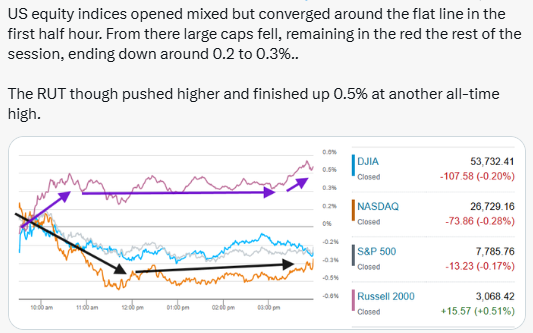
That pressure from yields would continue throughout the day (and even the short end would move higher as the day progressed) pushing large caps lower. The normally more rate sensitive small cap Russell 2000 though moved against that weakness, driving higher and finishing at another all-time high.
At day’s end, the Russell 2000 gained 0.5%, while the S&P 500 fell 0.2%, the Dow Jones Industrial Average slipped 0.2%, and the Nasdaq Composite lost 0.3%.
That said, volumes were extremely low (the fourth lowest of the year as discussed in the subscriber section) and excluding Energy the spread between the best and worst performing sectors was just 1.2% meaning traders weren’t taking big bets. Expectations for a low volatility environment were further evidenced by VIX settling at a low for the year.
The day’s economic data did little to provide excitement with July retail sales unexpectedly falling the most in over a year (ex-autos and gasoline the most since January 2025) as online sales dropped the second most from a month earlier since July 2021 lapping June’s Prime Day promotion. That led to downward revisions to Q3 GDP forecasts. August preliminary University of Michigan sentiment also missed expectations, with only 8% of consumers expecting income growth to exceed inflation over the next year.
Most of the index-level pressure came from megacap growth and parts of Technology, with semiconductors and software giving back some of Thursday’s strength. Applied Materials and Broadcom lagged in chips, while software stocks also saw profit-taking, though Sandisk and memory names remained a notable pocket of strength.
Under the surface, six S&P 500 sectors finished higher, the equal-weighted S&P 500 was flat, and in addition to the Russell 2000 the S&P MidCap 400 reached a fresh record high during the session.
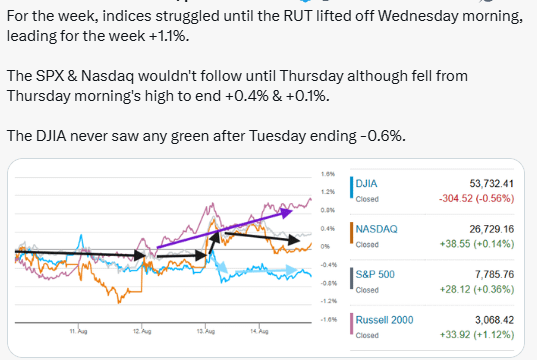
For the week, the Russell 2000 led with a +1.1% gain, while the S&P 500 rose +0.4%, the Nasdaq Composite added +0.1%, and the Dow Jones Industrial Average fell -0.6%. Energy was the clear winner, with the S&P 500 Energy sector up +7.3% for its best week since October 2022, while Consumer Discretionary led to the downside.
Some market commentary:
US equities:
“The market is appropriately bullish right now,” Anastasia Amoroso, chief investment strategist at Partners Group, told CNBC’s “Closing Bell” in an interview, noting the strength in U.S. corporate earnings. Amoroso also noted that software has “rallied and rebounded … I think the market came to the realization that maybe we did not appropriately price in those risks.”
“Markets remain remarkably resilient and are likely to enjoy a happy end to summer. But beneath that calm, the tails are getting fatter: the risks increasingly point to higher commodity prices, stagflationary risks and higher long-end yields.” —Skylar Montgomery Koning, macro strategist.
Given the back-to-back gains on the S&P 500 following subdued inflation readings on Wednesday and Thursday, Jay Hatfield of Infrastructure Capital Advisors said Friday’s digestion is a sign of what’s to come for the rest of August and September. “Today is like the start of that post-earnings flattening out trade,” the CEO said to CNBC.
“I don’t think we will get a fully flowing Strait of Hormuz, unfortunately, in the near term,” Patrick Armstrong, chief investment officer at Plurimi Wealth, said in an interview on Bloomberg TV. “The market I do think is complacent on the risks.”
Retail sales/UMich consumer sentiment:
Friday’s data “leave the consumer looking a little less healthy,” Stephen Brown, the chief North America economist at Capital Economics, said in a note. “Nonetheless, the miss in July was mainly due to a sharp fall in non-store sales which likely reflects the different timing of Amazon Prime Day this year, rather than a fundamental downshift in consumer spending growth.”
“Unexpected weakness in consumer spending isn’t good news for the wider economy, but markets may embrace the data in the near term because it strengthens the case for avoiding rate hikes,” said Ellen Zentner, chief economic strategist for Morgan Stanley Wealth Management
“It was a troubling update on the overall health of the consumer,” said Ian Lyngen at BMO Capital Markets. “This will contribute to the case for a Fed pause next month.”
One poor month of spending doesn’t necessarily mean the economy is falling off a cliff, but it becomes harder to dismiss alongside disappointing jobs figures, according to Bret Kenwell at eToro. Combined with tame inflation data, it should ease pressure on the Fed to raise rates, he said. “Still, investors should be careful what they wish for,” Kenwell noted. “Economic weakness is a steep price to pay to avoid a quarter-point hike. For the economy to stay resilient, consumers will need to do the same.”
The economy is highly dependent on consumer spending, so a big slowdown could end up hurting corporate profits and the stock market, according to Chris Zaccarelli at Northlight Asset Management. “But in an environment where inflation can cool down and the Fed can keep rates on hold as a result of that, would be very good for this bull market,” he said.
In today’s Markets Update:
A deeper look at Friday’s stock and sector breakdown, including the large-cap pullback, narrow sector dispersion outside Energy, and the continued resilience in small caps and mid caps.
A review of the week’s market action, including the Russell 2000’s leadership, the S&P 500 and Nasdaq’s modest weekly gains, sector results, and Energy’s strong weekly move.
A look at selected CNBC midday movers and Bloomberg corporate headlines, including Cisco, drone stocks, Reddit, Applied Materials, Workday, Sandisk, Tesla, SpaceX/Cursor, and Tyson Foods.
Updated daily and weekly technical charts across the SPX, Nasdaq, Russell 2000, and equal-weighted SPX.
A review of market breadth and participation, including large individual winners and losers, low SPY volume and Nasdaq speculative activity.
A look at the rates and Fed backdrop, including Treasury yields, updated Fed hike expectations, long-end yield pressure, and BoA/Hartnett on Treasury supply and debt-service risk.
A look at volatility and market structure, including drops in the VIX, VVIX, and 1-day VIX.
A review of cross-asset trends, including WTI crude, the dollar, gold, copper, natural gas, and bitcoin.
An update on Q3 GDP tracking and the post-retail-sales revisions from the Atlanta Fed and Goldman, along with the July PCE inflation setup after CPI and PPI.
A look at consumer and earnings-related posts, including BoA on card-spending dynamics, BoA on earnings-growth regimes, and the FT/Christophe Barraud on hyperscaler debt issuance and credit-market capacity.
A wrap-up on the market setup, low-volume consolidation, long-end yields, and the quieter near-term calendar.
A look ahead to next week’s calendar, including US economic data, FOMC minutes, Treasury auctions, and SPX earnings.
