
Markets Update - 8/17/26
A look at what happened today impacting US equity, Treasury, and selected commodity markets, and what to watch for tomorro.

Quick Summary:
US equity indices started Monday mixed, with mixed with tech shares higher but non-tech lower following Claude chatbot maker Anthropic’s release to prospective investors that its second-quarter revenue jumped at least 14-fold from a year earlier, but non-tech shares pressured by rising crude prices and bond yields.
The main macro pressure point was the US-Iran backdrop, with the 60-day ceasefire agreement expiring Monday and President Trump saying he was not interested in extending the agreement. Meanwhile, Iran signaled a more offensive posture if diplomacy fails.
The rise in oil also kept pressure on long-end Treasury yields, with the 30-year yield climbing to its highest level since 2007 and the 10-year yield closing at its highest since January of last year.
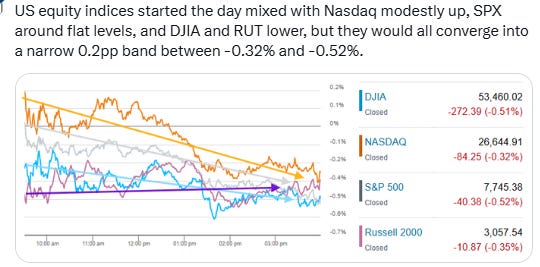
The Nasdaq Composite would open modestly higher, the S&P 500 around flat, and the Dow Jones Industrial Average and Russell 2000 lower, but they steadily converged into a narrow range of losses as the session progressed. At day’s end, the S&P 500 fell 0.5%, the Dow Jones Industrial Average declined 0.5%, the Russell 2000 slipped 0.4%, and the Nasdaq Composite lost 0.3%.
Under the surface, breadth was weak. Just one of the 11 S&P 500 sectors finished higher in Energy while Communication Services, Consumer Discretionary, Financials, and Staples all fell more than 1%. Keeping the selloff contained was strength in the AI-trade which kept the megaweight Technology sector close to flat despite weakness in most megacap tech names, as semiconductors and memory stocks outperformed. The PHLX Semiconductor Index rose +1.6%.
Tomorrow attention turns to a full US economic data docket.
Some market commentary:
US equities:
“We continue to see strong risk appetite among institutional investors, particularly in areas where earnings are strongest, such as US equities and technology,” said Marija Veitmane, head of equity research at State Street Global Markets.
“Any signs of stress in the outlook [from consumer companies this week], against a backdrop of slower hiring and higher borrowing costs, could challenge the resilient growth narrative,” said Laura Cooper, global investment strategist and head of macro credit at Nuveen.
“You’ve had the shift in interest rate expectations which feeds into some of those tech names, I think that helps explain some of that big rally we’ve had recently in tech after quite a quiet July where we had all those strong earnings but really tech didn’t do very much,” Rory McPherson, chief market strategist at Wren Sterling, told CNBC’s “Squawk Box Europe” on Monday.
“The bears are just scared,” Hackett told MarketWatch. He added that it’s a positive sign for the market that the S&P 500 was holding up near its recent record high, despite relatively light late-summer trading volumes that can exacerbate swings, more negative headlines out of Iran and rising long-term bond yields. While the bears continue talking about those risks, plus uncertainty around the artificial-intelligence boom, “nobody is willing to put their money where their mouth is,” he said. “The feeling is if you go to the sidelines, you’re going to get whipsawed again.”
Bonds:
“Whoever’s issuing, be it a government or a hyperscaler or a non-hyperscaler credit, is now competing with more borrowers,” said Tony Rodriguez, head of fixed-income strategy at Nuveen Asset Management. “And therefore yields have to be higher.”
“Investors are increasingly focused and concerned about the growing amount of US debt and America’s lack of fiscal discipline,” said Anthony Saglimbene at Ameriprise. “And frequent, large-scale treasury auctions are a chance for the bond market to push back against the government’s eroding fiscal trajectory, as they demand higher yields for the auctions to clear.” The calculus regarding longer-term Treasury holdings increasingly requires that an investor be comfortable financing ever-larger government borrowing needs at current yields, he added. “And should investors require more compensation in the future as more Treasury auctions come to market, it will be increasingly important for corporate fundamentals and AI momentum to continue meeting expectations if the equity market is to keep looking past a higher-for-longer rate environment,” Saglimbene concluded.
Dollar:
“Resilient growth, lessening inflation concern, loose financial conditions and low volatility create an ideal backdrop for risk. It’s hard to see an obvious catalyst for a significant dollar rebound before Jackson Hole.” — Skylar Montgomery Koning, macro strategist.
“We do not expect the dollar to be appreciating at ‘full throttle’ and the road ahead may be bumpy,” said Paul Mackel, global head of FX research at HSBC Holdings Plc. “But with sizeable gaps to interest-rate differentials remaining, we believe the currency can shift back to a higher gear and narrow the gap over time.”
Fed:
“The recent run of softer economic data has reduced the urgency for near-term tightening, so the minutes may carry less weight,” Cooper said. Still, “in a regime of the Fed keeping their cards close to the chest, any signals could be of outsized importance.”
“The key question: Are more committee members beginning to migrate toward the hawkish camp, or was the recent dissent more isolated than indicative of a broader shift in sentiment?” Darrell Cronk at Wells Fargo Investment Institute said. “The hawks appear dug in, the question is how many more come to their camp between now and September.”
Market bets on Fed hikes are still too aggressive given that inflation in the world’s biggest economy is cooling, according to Goldman Sachs Group Inc.’s Jan Hatzius. A rate increase at the central bank’s September meeting has become “very unlikely” due to softer retail sales data, disappointing employment numbers and slowing inflation prints, he said.
Iran:
“We’re back to watching the negotiations in real time, and I think a lot of people have just turned a blind eye to it,” said Jason Stephens, Evertern Wealth founder. “We think that there’s more bias to the downside in oil prices than there is the risk to the upside at this point in the game” due to the prospect of a deal being reached, especially as the midterm elections draw closer, he said.
“There’s a lot of pressure on the administration right now to really focus heavily on this and get something done,” Stephens added.
In today’s Markets Update:
A deeper look at Monday’s stock and sector breakdown, including broad sector weakness, Energy’s lone leadership, Technology’s relative resilience, semiconductor and memory strength, and pressure across the other megacap growth sectors.
A look at selected CNBC midday movers and Bloomberg corporate headlines, including memory chips, Intel, Workday, Alibaba, Intuitive Machines, EyePoint, JetBlue, Onto Innovation, Anthropic, Nvidia/OpenAI, L3Harris, RTX, and Berkshire.
Updated technical charts across the SPX, Nasdaq, Russell 2000, and equal-weighted SPX.
A review of market breadth and participation, including large individual winners and losers, the NYSE Composite 52-week highs versus lows, the strength of financials, Goldman on hedge fund buying, and the weakness in Nike shares.
A look at the rates and Fed backdrop, including the steepener move in Treasury yields, Goldman’s hold expectations, and Jim Bullard on why a rate hike makes sense.
A look at volatility and market structure, including VIX, VVIX, 1-day VIX, and the high-gamma backdrop.
A review of cross-asset trends, including WTI crude, the dollar, gold, copper, natural gas, and bitcoin.
A look at market setup and breadth-related posts from Morgan Stanley’s Wilson, Yardeni, MarketWatch/Jefferies on small caps, MarketWatch on Hindenburg Omen clusters, and Prof Plum on ownership and crowding.
A look at AI infrastructure, memory, and capex-related posts from BoA/Hartnett, Torsten Slok, ZeroHedge/JPM/Jefferies, the WSJ, BoA, and MarketWatch/Citi.
A look at inflation, credit, and dealmaking posts from the Cleveland Fed, BoA, Goldman, BoA/Hall on M&A, and the FT on private credit.
An update on the NAHB housing market index.
A wrap-up on the AI trade, oil and Iran risks, long-end yields, breadth, high gamma, and the near-term market setup.
A look ahead to Tuesday’s calendar, including US economic data, Fed speakers, Treasury auctions, SPX earnings, and ex-US highlights.
