

Quick Summary:
US equity indices started Wednesday higher after the Treasury Department announced plans to at least double the size of longer-dated bond buybacks as discussed in the morning update, helping pull long-end yields sharply lower after their recent surge.
The 30-year yield fell roughly 10 basis points to around 5.18% after hitting a fresh 19-year high Tuesday, while the 10-year yield dropped five basis points to around 4.64%. It remains to be seen though to what extent the announcement will ease some of the recent pressure from rising long-end yields, as several strategists noted that it does not change the underlying fiscal, inflation, and debt-supply issues.
While the rally faded as the session progressed, indices still finished modestly higher. The rate sensitive Russell 2000 led with a +0.5% gain, while the S&P 500, Nasdaq Composite, and Dow Jones Industrial Average all finished higher by roughly +0.2%, ending the S&P 500’s three-day losing streak.
Beneath the surface, the market was stronger than the headline indices suggested. The equal-weighted S&P 500 gained +1.0%, and SPX sector breadth improved further with 7 of 11 sectors higher.
Health Care led with a +3.5% gain after Moderna and Merck reported positive late-stage trial results for their experimental skin-cancer vaccine. Combined with Tuesday’s gain, Health Care posted its second-best two-day advance since November 2020. Rate-sensitive areas also benefited from the drop in yields, with homebuilders and consumer names benefiting. Materials also outperformed as precious metals and mining stocks rallied as gold crossed a key technical threshold (discussed in the subscriber section).
The main offset remained the AI trade. The PHLX Semiconductor Index fell another 2.1%, extending Tuesday’s decline to over 7% from Monday’s close and keeping the headline averages from showing more of the broader-market strength. That said, Marvell rallied on a Google TPU agreement, but it was offset by weakness in Google suppliers Broadcom and AMD. AI-related industrials were weak after OpenAI disclosed second-quarter results that disappointed investors.
While seeing little reaction on the long end, hawkish Fed minutes in the afternoon saw the rally in shorter-maturity Treasuries fizzle, with several officials favoring a hike at the last meeting and many indicating further tightening may be needed if inflation does not decline.
With little on the calendar the rest of the week, expect volumes to thin even further as traders increasingly make their way out of town as is typical in late August.
Some market commentary:
US equities:
“The question is no longer whether higher yields matter, they clearly do, but whether the strength of earnings and capital expenditure implies that the economy can absorb them,” said Florian Ielpo at Lombard Odier Investment Managers.
“AI stocks are increasingly in competition with their own bonds,” he said. “Yields close to multiyear highs in combination with a higher visibility of expected cash flows are making a compelling case for many investors.”
“The global economy has been resilient to higher rates and earnings remain strong. But the equation is becoming less favorable: higher yields driven by better growth are manageable; higher discount rates without higher expected earnings are a much wobblier backdrop for equities.”
— Skylar Montgomery Koning, macro strategist.
“I think the earnings and cash flows from these big companies are strong enough that they’ll power through any kind of scare that happens around this,” Adam Parker, founder and CEO at Trivariate Research, told CNBC’s “Closing Bell” on Tuesday.
“Markets have been able to overlook the increase in yields so far…because we’ve had this earnings boom,” said Keith Lerner, chief investment officer at Truist Advisory Services. “But I think as we move past the earnings season, there’ll be more focus on yields.”
“Value names, for example, are doing really well today, and that tells you that the economy and the corporate earnings cycle are still very strong,” said Massimo Santicchia, head of U.S. equities at Procyon. That said, there’s “a tension now in the market,” he added, noting that there are solid fundamentals on one hand and a higher cost of capital induced by higher yields on the other.
Overall, it’s still a “very, very good environment for stocks” because of the solid earnings outlook, Santicchia said.
Bonds before the increased buyback announcement:
“Basically, this is a normalization,” said Robert Tipp, chief investment strategist and head of global bonds at PGIM Credit.
“The fact that action by the Treasury Secretary up to this point has maybe not been as effective as he might have liked is another reason to think that this move higher could be sustained,” said Zach Griffiths, head of investment-grade and macro strategy at the research firm CreditSights.
“The issue is not so much the rising interest rates,” said Michael Strain, director of economic policy studies at the conservative-leaning American Enterprise Institute. “The issue is the deficit. If we can only be concerned about one thing, that one thing should be the 10-year deficit outlook.”
after:
“The intervention can help crowd in potential buyers tempted by the prior run-up in yields and force some near-term short-covering, while discouraging investors from going max short in the future for fear of being ambushed again,” said Krishna Guha at Evercore.
“The Treasury’s move to double long‑end buybacks from $2 billion to $4 billion was purely a liquidity‑management adjustment for outstanding 30‑year bonds. Yet, markets treated it as a broader easing signal, with yields falling 10 basis points and semis/tech rallying sharply,” said Ben Emons, founder of FedWatch Advisors.
“This is more of a band-aid than a panacea,” said Lawrence Gillum at LPL Financial. “But it is a reminder that the Treasury Department is paying attention and will do whatever it can to keep yields from getting too high too quickly.”
Oil:
“The next leg in oil may be driven less by another dramatic headline and more by the market’s fear of being on the wrong side of the physical trade,” said Priyanka Sachdeva, head of market insights at Phillip Nova Pte Ltd.
In today’s Markets Update:
A deeper look at Wednesday’s stock and sector breakdown, including the broader rebound beneath the headline indices but continued weakness in semiconductors and AI-linked names.
A closer look at the Health Care rally, including Moderna and Merck’s mRNA cancer-vaccine news, Moderna’s record one-day gain, and the sector’s strongest two-day move since the Covid-vaccine period.
A review of market breadth and participation, including the jump in large SPX winners and decline in large losers.
A look at selected Bloomberg and CNBC corporate headlines, including Moderna/Merck, Marvell/Google, Target, and Estée Lauder.
A technical update across the SPX, Nasdaq, Russell 2000, and equal-weighted SPX.
A look at the rates and Fed backdrop, including the long-end-led drop in Treasury yields.
A look at volatility and market structure, including VIX, VVIX, 1-day VIX, BTIG’s Jonathan Krinsky on complacency and downside-volume risk, and the high-gamma backdrop.
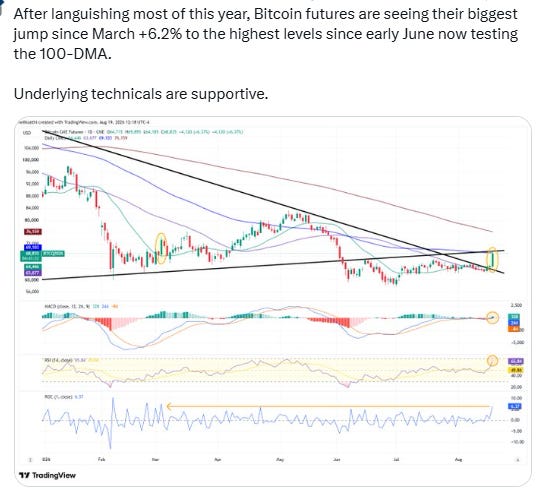
A review of cross-asset trends, including WTI crude, EIA crude, gasoline and distillate inventories, the SPR, diesel prices, the dollar, gold’s breakout, copper, natural gas, and bitcoin’s breakout.
A look at BoA client flows into Tech and out of Industrials, hedge-fund and institutional buying, BoA’s Global Fund Manager Survey on “no landing” and earnings optimism, Goldman’s buyback-desk update, BoA’s FMS read on Fed expectations, and Evercore/MarketWatch on negative-beta stocks.
A wrap-up on the Treasury-yield relief rally, AI-stock weakness, Health Care strength, high gamma, thin late-August trading, and the setup into the rest of the week.
A look ahead to Thursday’s calendar, including US economic data, Treasury auctions, SPX earnings, and ex-US highlights.
