

Quick Summary:
US equity indices started mostly lower Monday despite easing Treasury yields and lower crude prices, with renewed weakness in semiconductors and AI-related names weighing on the technology-heavy averages.
The S&P 500 Technology sector fell 1.6%, its seventh straight decline, the longest losing streak since February 2020 (i.e., the early days of Covid), as the PHLX Semiconductor Index dropped another 2.7% (now down nearly 10% over the past week). Nvidia also fell for a seventh straight session ahead of Wednesday’s earnings, its longest losing streak since 2022, while memory and semiconductor-component stocks also remained under pressure.
That Tech weakness offset an otherwise firmer tape. Eight of eleven S&P 500 sectors finished higher, with four up more than 1%, while the equal-weighted S&P 500 outperformed the market-cap-weighted index finishing with a slight gain (as did the less tech-heavy Dow Jones Industrial Average).
The broader market was aided by a decline in longer-end yields after reports that Treasury may use its General Account to help fund buybacks as discussed in the morning note, though the 2-year yield remained firm and Fed hike expectations edged higher ahead of Warsh’s Jackson Hole speech.
The geopolitical backdrop also stayed in focus after Treasury Secretary Scott Bessent formally launched the administration’s “Operation Economic Outcast” pressure campaign against Iran which threatens economic punishment against any country doing business with Iran as part of an “economic D-Day” campaign. Oil traders though were underwhelmed with Brent futures seeing the largest decline in three weeks.
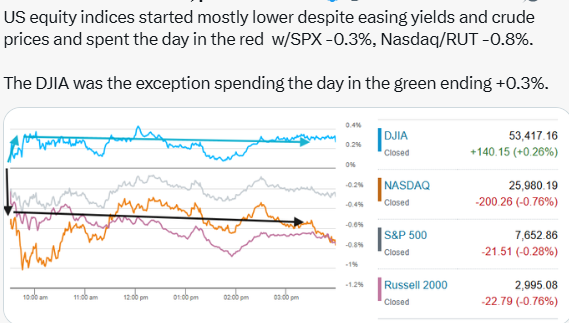
At day’s end, the Dow Jones Industrial Average as noted gained +0.3%, while the S&P 500 slipped 0.3%, the Nasdaq Composite lost 0.8%, and the Russell 2000 also fell 0.8%.
Tomorrow is relatively light on the calendar before a busy stretch of catalysts starting Wednesday, with July PCE inflation data and Nvidia earnings, followed by Chair Warsh’s highly anticipated Jackson Hole remarks Friday along with other important economic data.
Some market commentary:
US equities:
“Details about US economic sanctions on Iran, the Treasury’s attempts to lower long-term yields, and economic data may shape much of the sentiment backdrop, but Nvidia and other tech earnings are positioned to be a major weight on the market’s momentum scale,” Chris Larkin at E*Trade from Morgan Stanley said.
Analysts are expecting nothing short of astonishing from the chipmaker. LSEG consensus estimates point to Q2 earnings and revenue doubling from the year-earlier period. But with expectations that high, the risk for disappointment is also elevated. “All roads lead to Nvidia thanks to the enormous AI build out and the circularity of the financing, which makes Nvidia the alpha bank of all of it,” said Richard Reyle, chief investment officer at Questar Capital Partners. “The question is, will the stock still have a muted reaction even with great numbers.”
“We’re in a little bit of the little summer doldrums,” said Robert Conzo, chief executive officer at The Wealth Alliance. However, if earnings growth continues to come in strong and inflation prints are as expected, the state of the equity market should be “pretty good” from here, he added.
Bonds:
“We can’t cross 40 trillion in debt and have the Federal Reserve with a massive balance sheet and expect that rates can come down in the face of a good economy,” said Leo Kelly, founder and CEO of Verdence Capital Advisors. “This is going to be an ongoing tug of war on these rates now.”
“You have to fix the addiction to spending in government,” he continued.
“The ultimate problem with the Treasury’s intervention is that it costs money,” said Philip Marey, senior US strategist at Rabobank. “For now, the Treasury is funding this by shifting from longer-term debt to shorter-term debt. But with the total federal debt constrained by the debt ceiling, the Treasury will eventually run out of ammunition.”
“If yields come under renewed pressure, the Treasury’s response will be more revealing,” said Western Asset Management portfolio manager Robert Abad. “Further increases in buybacks or changes to long-end issuance would provide stronger evidence that policymakers are responding not only to market functioning, but also to the level of yields.”
“If the Treasury runs out of firepower and yields spike again, the Fed may feel compelled to step in and buy these bonds,” said Marey of Rabobank. “This scenario could render Kevin Warsh’s internal debate about balance sheet reduction entirely academic. Instead of exiting the fiscal space, the central bank would be pulled even deeper into it.”
“I’m nervous, because Bessent failed to cap long-term Treasury yields,” said Tracy Chen, portfolio manager at Brandywine Global. “The bond-market behavior shows that the bond vigilantes still don’t believe him.”
“This is set to be a pivotal week for asset markets, since there is still a chance the US Treasury selloff becomes a full-blown crisis,” wrote Kathleen Brooks, research director at XTB.
“I argue that the Treasury’s surprise decision to upsize tactical long-end buybacks is effectively a Treasury-led ‘Operation Twist’ designed to counter shifts in shorter term market conditions, rather than a form of QE,” wrote David Zervos, chief market strategist at Jefferies. “While buybacks do not create reserves and therefore lack QE’s direct money-printing channel, I believe they do leave room for fiscal expansion and deliver some QE-like reflationary effects.”
The U.S. Treasury intervention in the bond market — which includes tapping its near $1 trillion General Account to fund purchases — is a troubling and largely ineffectual strategy that undermines investor confidence, according to Mohamed A. El-Erian, chief economic adviser of Allianz. “Fundamentally, it doesn’t address what’s going on, which is there is significant demand for bond financing by the government, by tech in particular,” El-Erian told CNBC’s “Squawk Box” on Monday. “And the traditional suppliers are less dependable: China, Japan and the Gulf countries.”
“Why are we uncomfortable about this? For two reasons. One, is that this sort of intervention makes sense when you can identify either a market failure or an institutional trouble. Neither is the case today,” he continued. “The other reason we’re uncomfortable is that this is a situation where market pricing is leading the Treasury to say more and more, rather than the other way around.”
Fed Chair Warsh:
“Any indication of how he views persistent inflation, the recent rise in long-term yields or the future size and role of the Fed’s balance sheet could trigger a meaningful repricing across Treasuries, the dollar, gold and equities,” wrote Daniela Hathorn, a senior market analyst at Capital.com.
“The Treasury attempt to cap long rates by issuing more short-term paper as the financing tool will tether US government interest rate expense ever closer to what the Federal Reserve does with the fed funds rate,” said Peter Boockvar, chief investment officer at One Point BFG Wealth Partners. “I don’t think this is something Kevin Warsh will talk about in his speech Friday but it is a new element he’s going to have to deal with.”
In today’s Markets Update:
A deeper look at Monday’s stock and sector breakdown, including the Tech-led weakness, pressure in memory and semiconductor-component stocks, and broader strength across eight of eleven S&P 500 sectors.
A review of market breadth and participation, including the equal-weighted S&P 500’s outperformance, large SPX winners and losers, the day’s heatmap, and Goldman’s prime desk on selling in Industrials versus buying in Financials.
A look at the recent pressure in Technology and semiconductors, including the S&P 500 Tech sector’s losing streak, Nvidia’s losing streak into earnings, BoA/Hartnett on semiconductor ETF outflows, JPMorgan’s Jason Hunter on the near-term market setup, Goldman on high-beta momentum weakness, and Goldman/Daily Chartbook on AI-stock correlation and leveraged Nasdaq positioning.
A look at selected Bloomberg corporate headlines, including SpaceX’s planned AI satellites, Strategy’s balance-sheet funding plans, SoftBank’s record retail bond sale, and Alibaba’s Hong Kong offering.
Updated technical charts across the SPX, Nasdaq, Russell 2000, and equal-weighted SPX.
A look at the rates and Fed backdrop, including Treasury yields, updated Fed hike expectations, the General Account/buyback discussion, BoA/Hartnett on the Treasury’s long-end problem, BlackRock on the growing Treasury weight in bond indices, Mark Hulbert on rising rates and bull markets, and the setup into Chair Warsh’s Jackson Hole speech.
A look at volatility and market structure, including VIX, VVIX, 1-day VIX, Goldman on call-skew activity, and Tier1Alpha on the gamma backdrop.
A review of cross-asset trends, including WTI crude, the dollar, gold, copper, natural gas, and bitcoin.
A look at dollar and commodity-related posts, including Bloomberg/Barraud on dollar positioning, Goldman on oil prices and equities, Yardeni on S&P 500 earnings estimates, Fundstrat’s Tom Lee on the S&P 500 setup, and BoA’s Fund Manager Survey read on gold.
An update on the Chicago Fed National Activity Index.
A look at current macro, positioning, and sentiment posts, including Goldman on enterprise AI spending, BoA’s Fund Manager Survey on investor positioning and crowded trades, Realtor.com on housing inventory, Goldman prime-book market sensitivity, Daily Chartbook on data-center and semiconductor demand, Morningstar on BDC credit trends, and the WSJ on employer health-care costs.
A wrap-up on continued Tech de-risking ahead of Nvidia earnings, broader non-Tech market resilience, and the setup into Tuesday’s economic data.
A look ahead to Tuesday’s calendar, including US economic data, Fed speakers, Treasury auctions, SPX earnings, and ex-US highlights.
