
Markets Update - 8/3/26
A look at what happened today impacting US equity, Treasury, and selected commodity markets, and what to watch for tomorrow

Quick Summary:
US equity indices started Monday in the green on the back of President Trump announcing a restart of talks with Iran, which saw a drop in oil prices and some softening in bond yields, although the Nasdaq-100 lagged initially as a selloff in chipmakers resumed in Asia dampening US shares, even as gains were seen elsewhere in Tech.
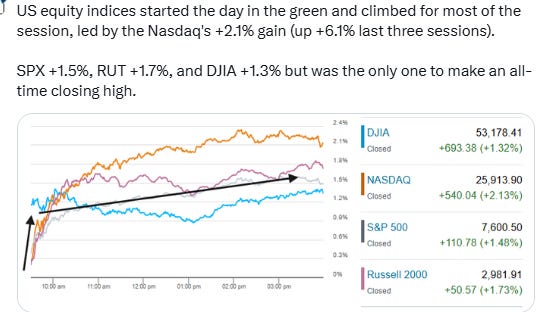
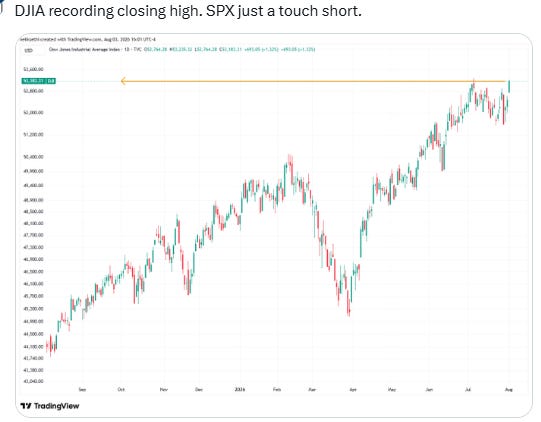
But indices would push sharply higher in the first hour as semiconductors recovered from early losses and gains broadened across the market and would climb for most of the session, led by the megacap growth rally. The Nasdaq Composite would finish +2.1%, the Russell 2000 +1.7%, the S&P 500 +1.5%, and the Dow Jones Industrial Average +1.3%, the last making a new all-time closing high.
It was the best first trading day of a month for the Nasdaq, S&P 500, and Dow since October 2022, with the Nasdaq now up +6.1% over the past three sessions, its best three-day run since May 2025. The move though has been less about semiconductors as opposed to the “old” megacap guard, with the Mag-7 ETF up sharply over the same stretch adding a record amount of market cap as Amazon crossed over $3 trillion.
As noted, though, participation was much broader Monday with eight of 11 S&P 500 sectors higher, and the equal-weighted S&P 500 +1.0%. The broader market was boosted by a sharp fall in oil prices after President Trump insisted that peace talks were imminent even as Iran said no such talks were scheduled.
“I want to give them every last chance before decapitation,” Trump told reporters in the Oval Office Monday. “You’ll find out today or tomorrow. I mean, they’re going to go quickly, one way or the other. It’s not very complex.” In contrast, Iran said it’s talking to Oman about a “temporary” new route to ensure the safety of ships and not about whether the Strait as a whole will be open or closed, Esmail Baghaei, an Iranian foreign ministry spokesman, said Monday. “We are not currently negotiating with the United States.”
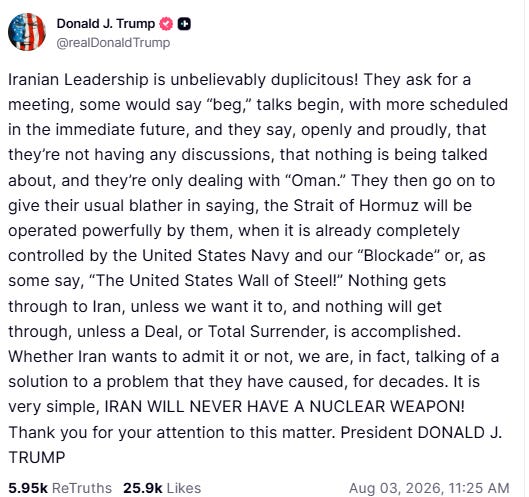
President Donald Trump then accused Iran’s leadership of being “unbelievably duplicitous,” saying it was publicly denying negotiations while privately seeking talks. In a social media post Monday, Trump also said the U.S. Navy effectively controls the Strait of Hormuz through what he described as a “blockade” and reiterated that “Iran will never have a nuclear weapon.”
The economic data were also supportive to the broader market. The S&P Global Manufacturing PMI remained solidly in expansion (although the release flagged several warning signs about the future growth trajectory). The ISM Manufacturing PMI was even more consistent in reflecting an accelerating economy rising to its highest level since May 2022 on broad expansion, led by production hitting a nearly five-year high, while employment returned to expansion for the first time since September 2023.
Treasuries rallied to start August, pulling longer-term yields off their worst levels of the year as lower oil prices eased some inflation pressure.
Attention now turns to another busy day of earnings, including AMD, and several more US economic reports as detailed in the subscriber section.
Some market commentary:
“If we get something concrete on a peace deal, or more importantly the reopening of the strait of Hormuz, then we could see some strong relief rallies across the market,” said Nick Twidale, chief market analyst at AT Global Markets. “For now it feels we will continue to see volatility across different markets, especially as AI trade remains the dominant theme for equities.”
“Oil markets can’t yet put the Iran-US conflict in the rear-view mirror, with risks still skewed to the upside. Options markets continue to point to greater concern over higher prices than lower ones. That suggests the market continues to view a supply-driven price spike as a more likely risk than a sharp decline in Brent.” —Skylar Montgomery Koning, macro strategist
“investors are keeping their enthusiasm in check as ‘we’ve been here before’ and it’s likely the conflict has further to go before reaching a resolution (if it ever does),” wrote Vital Knowledge founder Adam Crisafulli.
“Geopolitical news is helping out with oil prices going down and easing pressure on yields,” said Alexandre Baradez, chief market analyst at IG in Paris. “There is, however, a real lingering issue on bond yields, on leverage, on Fed policy: until there’s clarity on these fronts, it’s hard to say that the stock market is all clear.”
“The weight of the AI sell-off is gone right as [Situational Awareness] got liquidated last week, and then the biggest thing is there was some fear going into the weekend of more Middle East instability,” Michael Monaghan, partner and portfolio manager at Founder ETFs, told CNBC. “Even though that ebbs and flows and seems to be on-off every single week, the tone and the rhetoric really seems to be we’re going to try and get this thing fixed.”
“The market is poised to get an early boost from falling oil, but the on-again, off-again nature of US-Iran diplomacy could mean earnings and jobs data will have to do the heavy lifting for the bulls this week,” said Chris Larkin at E*Trade from Morgan Stanley.
“A silver lining to the over-hanging clouds of recent volatility and selling has been some further reduction in the forward earnings multiple of the S&P 500 which ended last week at 19.7 times the next 12-month earnings estimates,” said John Stoltzfus, chief investment strategist and managing director at Oppenheimer Asset Management. “Stocks are getting relatively cheaper.”
Forces that propelled US stocks to record highs this year remain “firmly intact” after a reset in retail investors’ speculative trading, according to Citadel Securities’ Scott Rubner. “Markets are transitioning from a flow-driven environment back to one increasingly dictated by earnings, corporate demand, and the macroeconomic backdrop,” he wrote.
In today’s Markets Update:
A deeper look at Monday’s stock and sector breakdown, including the broad rally, continued Communication Services and Consumer Discretionary leadership and Mag-7 rebound.
A closer look at key company movers and corporate developments, including Palantir after the close, Alphabet, Meta, Amazon, Tesla, Microsoft, Nvidia, AMD, Sandisk, Trump administration AI safety-testing plans, Boeing, Marriott, and Yum/Taco Bell.
Updated daily and monthly technical charts across the SPX, Nasdaq, Russell 2000, and equal-weighted SPX.
A review of market breadth and participation, including large individual winners and losers, strong NYSE and Nasdaq positive volume, and Nasdaq speculative trading activity.
A look at the rates and Fed backdrop, including the moves in 2-year, 10-year, and 30-year Treasury yields, the Treasury’s updated Q3 borrowing estimate, and the setup into Wednesday’s quarterly refunding announcement.
A look at volatility and market structure, including VIX, VVIX, 1-day VIX, and Tier1Alpha on SPX gamma positioning and key support/resistance levels.
A review of cross-asset trends, including WTI crude, the dollar, gold, copper, natural gas, and bitcoin.
Tier1Alpha on gamma, Yardeni on the summer stall and semiconductor weakness, MarketWatch/HSBC on the high-beta momentum unwind, Nationwide’s Mark Hackett on momentum volatility, BTIG’s Jonathan Krinsky on the momentum crash, Deutsche Bank on the rotation back into Tech and hyperscaler risk/reward, Goldman’s Oppenheimer on derated Tech shares, Bloomberg on factor rotation, Goldman’s Callahan on Sandisk, Goldman on AI-related investment, Bloomberg on hyperscaler capex, BoA/Hartnett on risk assets, BoA/EPFR on equity and Tech flows, Deutsche Bank on Tech credit spreads, AAII on Kevin Warsh, and the WSJ on HOA financial pressure.
A wrap-up on the AI trade flipping back on, broader participation, positioning, long-end yields, systematic-flow risks, and the near-term market setup.
A look ahead to Tuesday’s calendar, including US economic data, Fed speakers, SPX earnings, and ex-US highlights.
