
The Week Ahead - 7/19/26
A look at the upcoming week for the US economy and equities — covering key drivers including earnings, positioning, breadth, valuations, sentiment, seasonality, and the Fed.

The Week Ahead
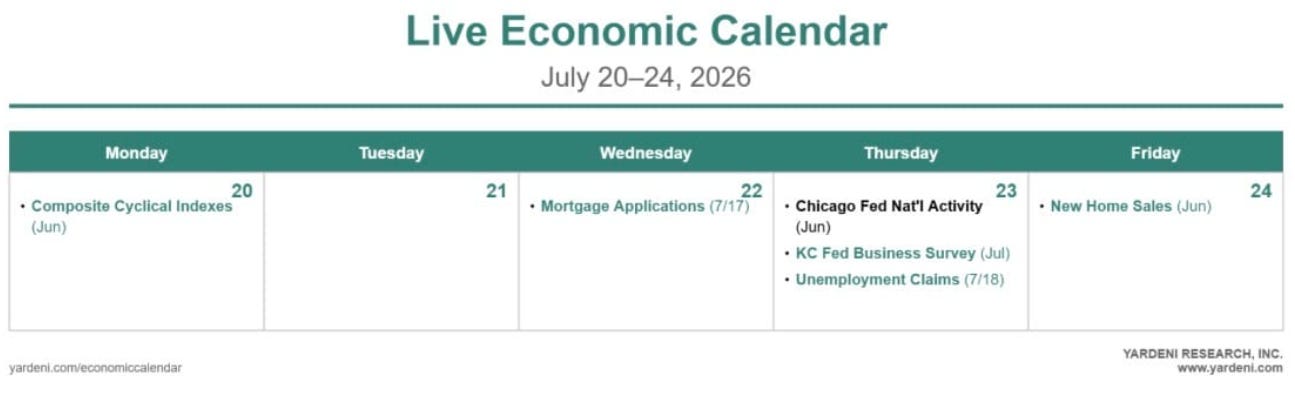
After a non-stop barrage of US economic data and Fed speakers last week, things lighten up on that front next week, while earnings ramp up:
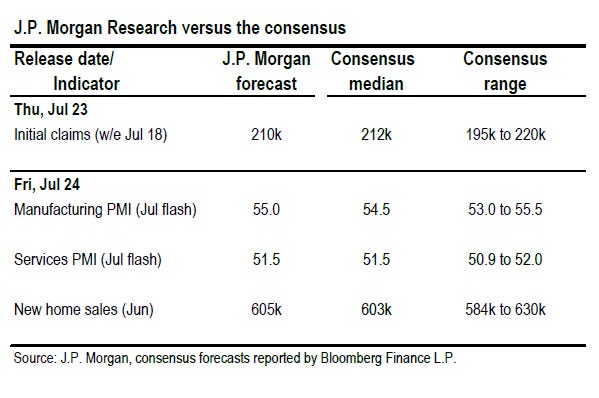
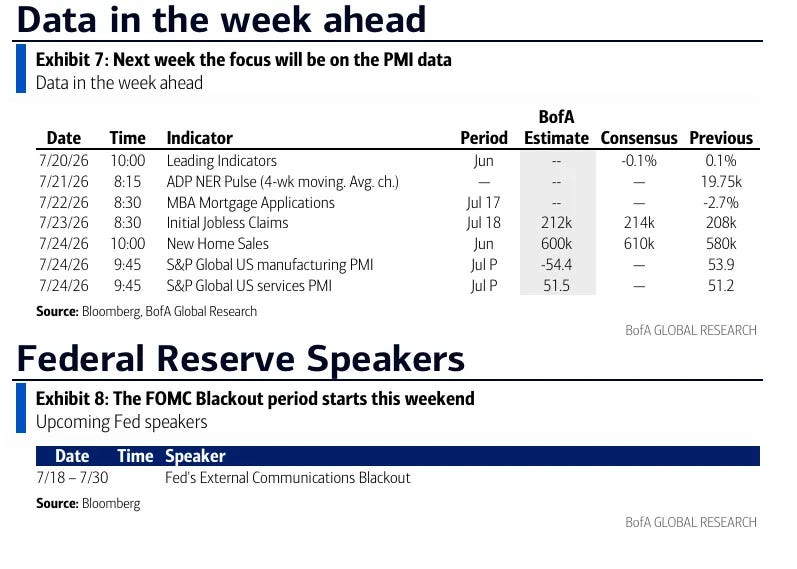
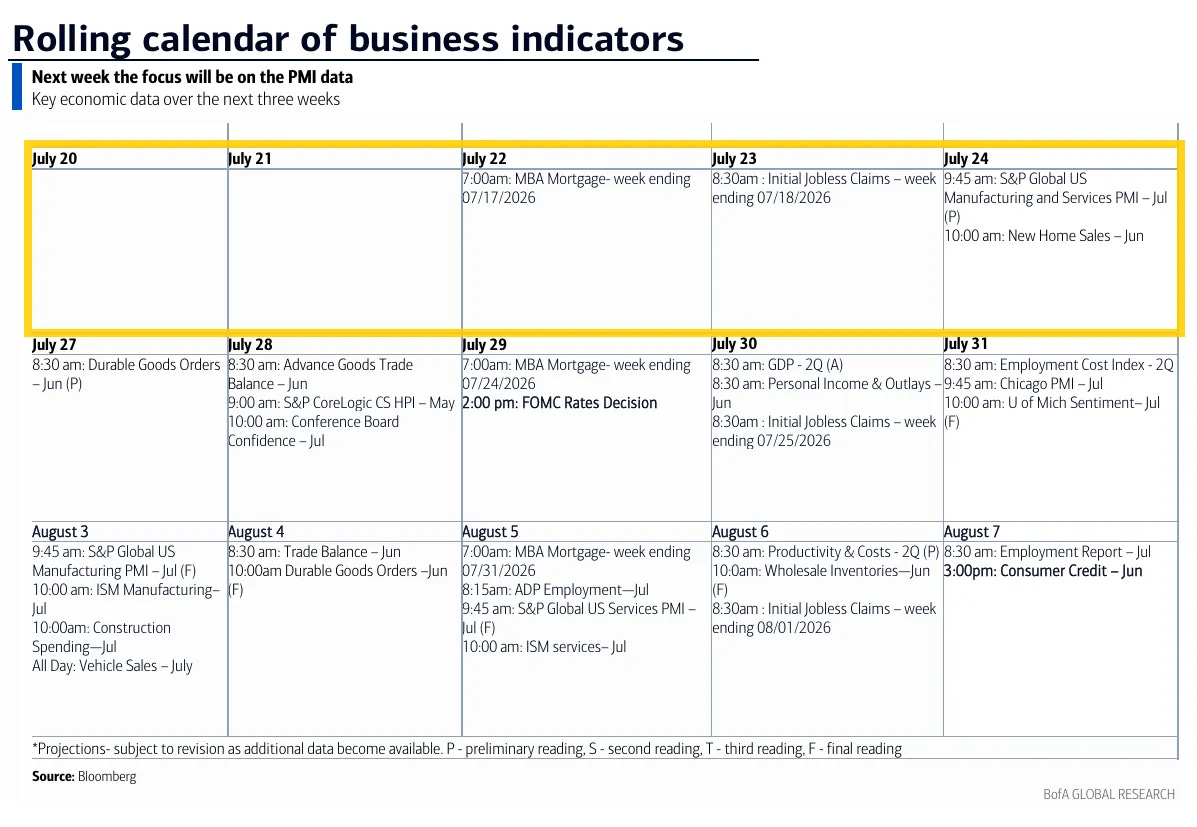
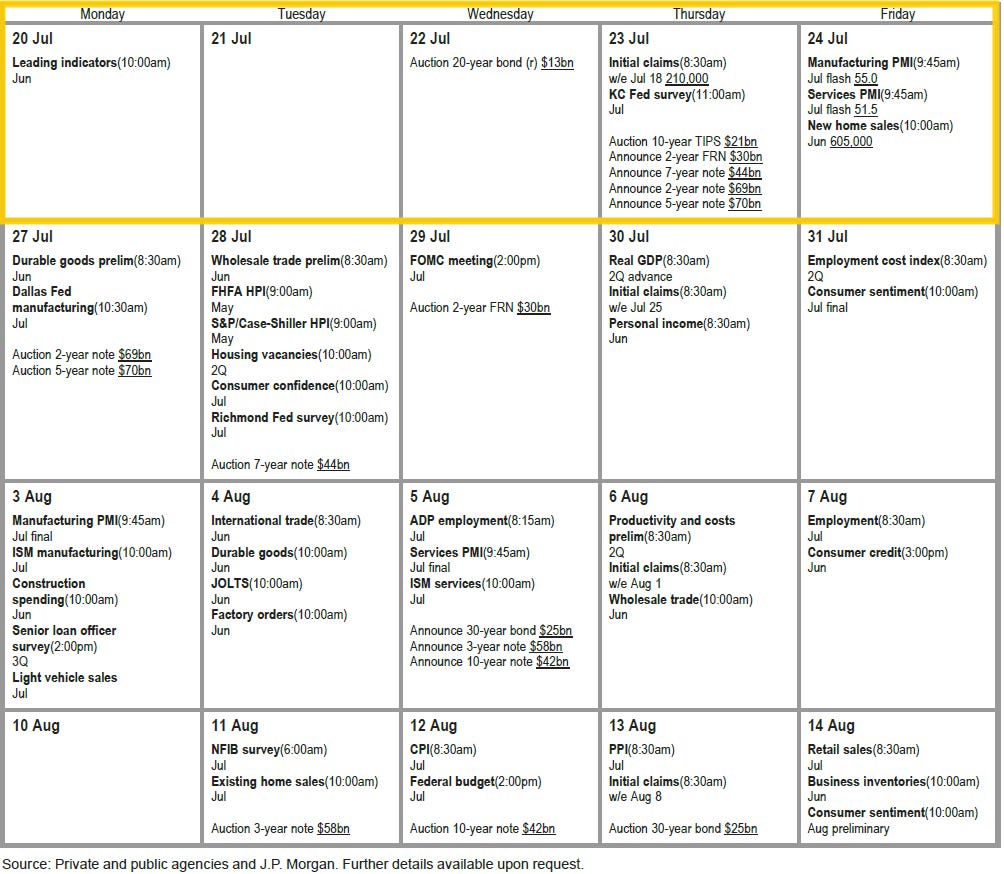
In terms of US economic data, it’s about as light a week as you’ll get, with just the June leading indicators and APD weekly report on the calendar in the first three days. The leading indicators have become relatively useless as a forecasting tool, but the coincident indicators are good for giving an economic nowcast. Otherwise this week we’ll get July flash PMIs and June new home sales on Friday plus the normal weekly reports (unemployment claims, etc.).
We’re into the blackout period for the July meeting a week from Wednesday, so no Fed member will be speaking about monetary policy.
Treasury auctions will pick back up, but just the little-watched 20-year bond and a 10-year TIPS auction next week.
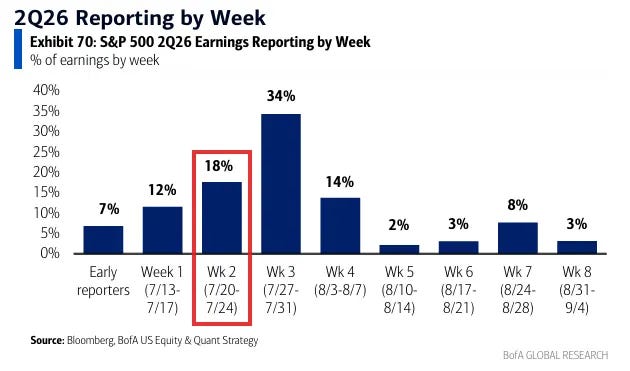
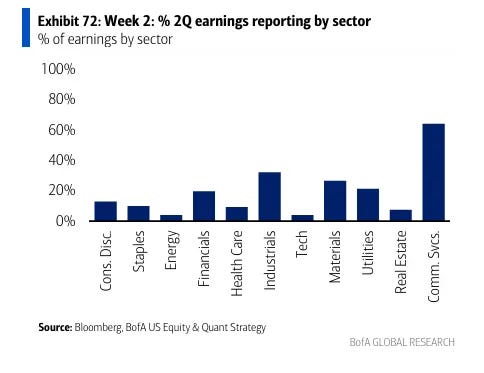
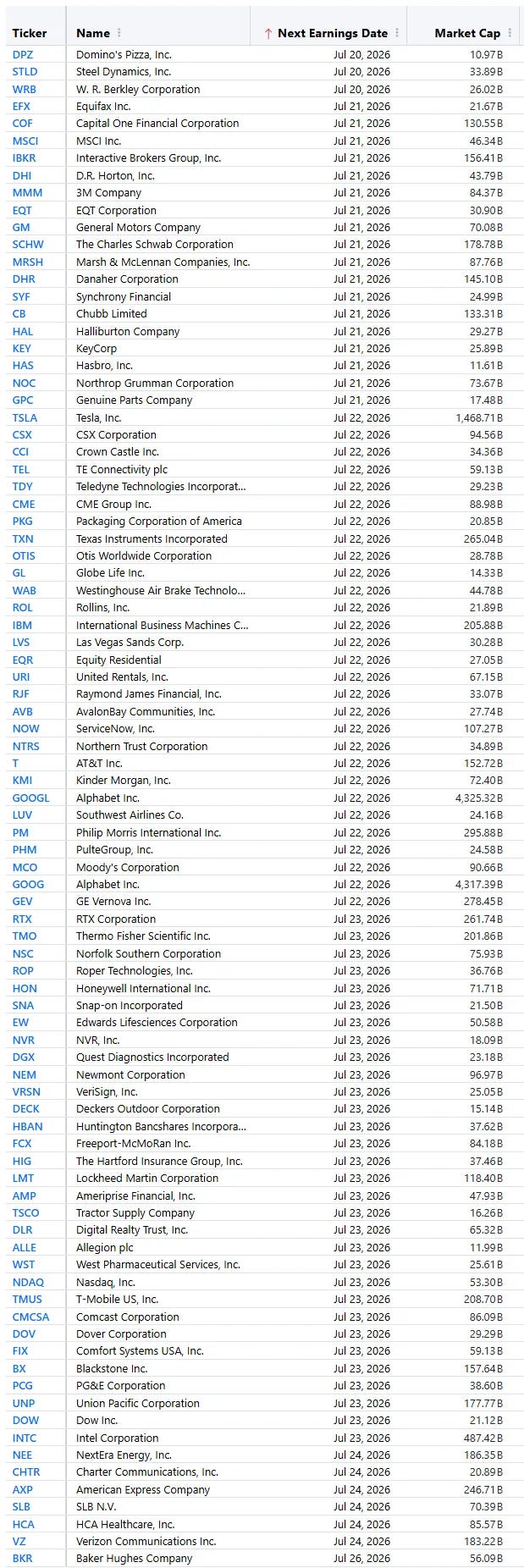
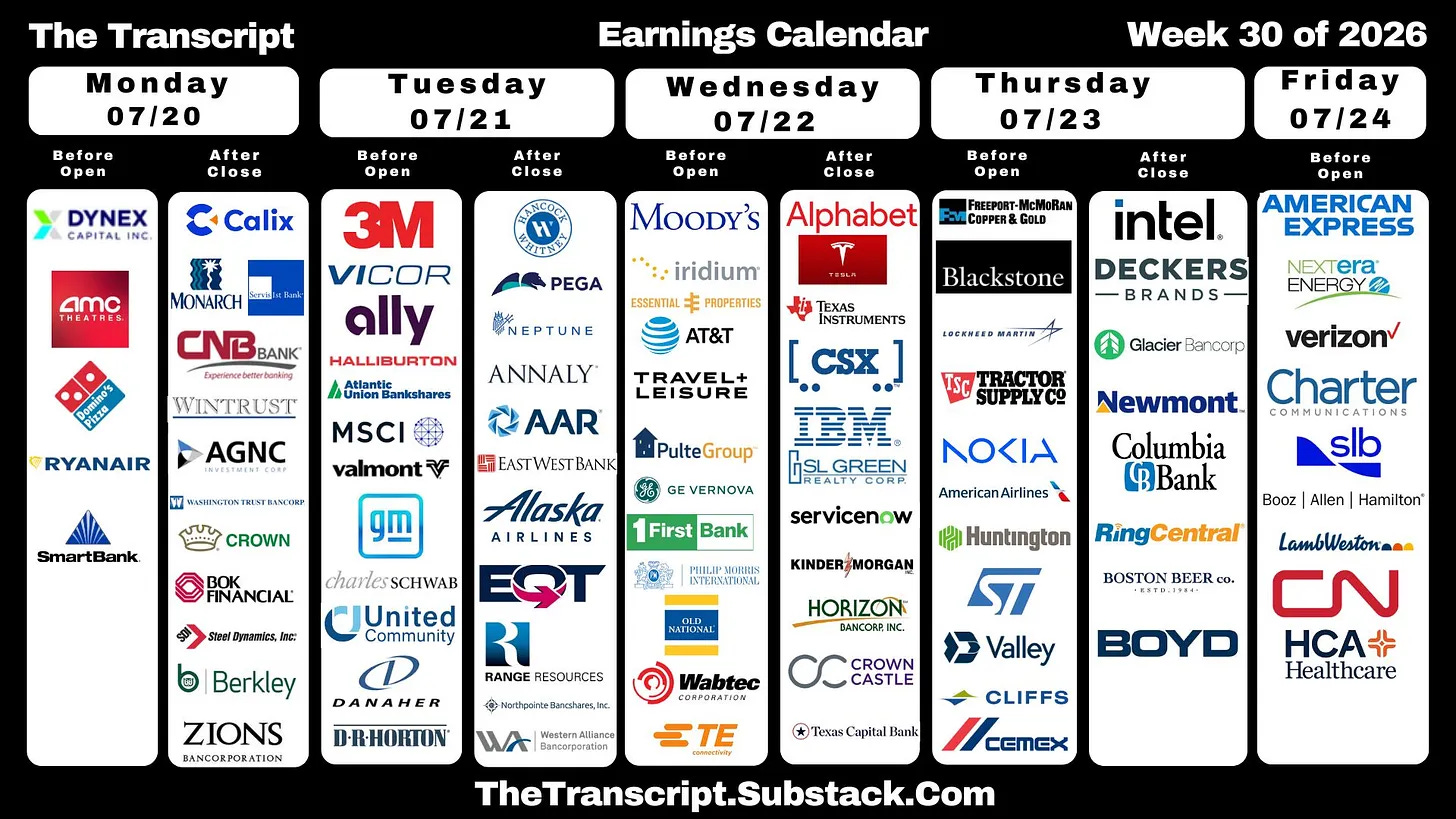
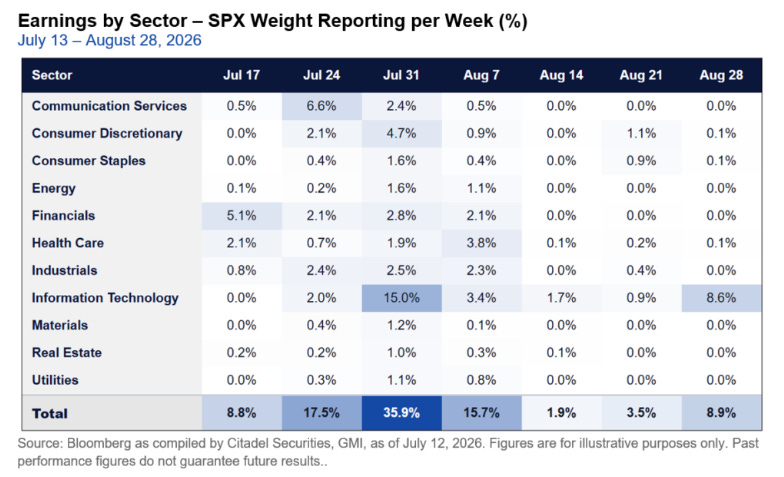
Which leaves a lot of airtime to be filled by whatever is going on in Washington and second quarter earnings season, the latter of which will kick up a gear with our second heaviest (in terms of SPX earnings weight) week of the season with 18% of SPX earnings weight reporting, consisting of 88 SPX components including two Mag-7 components (GOOGL, TSLA) and 21 others >$100bn in market cap (INTC, PM, GEV, TXN, RTX, AXP, TMUS, IBM, TMO, NEE, VZ, SCHW, UNP, BX, IBKR, T, DHR, CB, COF, LMT, NOW, in order of earnings weight). We’ll also hear from a number of ex-US heavyweights including headline-grabbing SK Hynix in South Korea.
In terms of Iran, I had warned two weeks ago that the detente things had seemingly settled into could be challenged by “Iran pushing things beyond the current state of play (such as reasserting control over the Strait of Hormuz” or by “kinetic conflict which escalates beyond the ‘tit-for-tat’ back and forth that we’ve seen thus far, and as I noted last week we have seen both of those things have come into play “but neither has so far passed either side’s ‘red lines,’ so while we remain closer to a return to full-out conflict, we are still within the now stretched bounds of talks continuing.”
That seems to have changed now though with Iran officially joining President Trump in at least pausing its adherence to the Memorandum of Understanding, a slow but steadily escalation in the US pressure campaign, and three US service members being killed over the weekend. The week of back-and-forth strikes has expanded beyond strictly military targets to include bridges, utilities and port facilities.
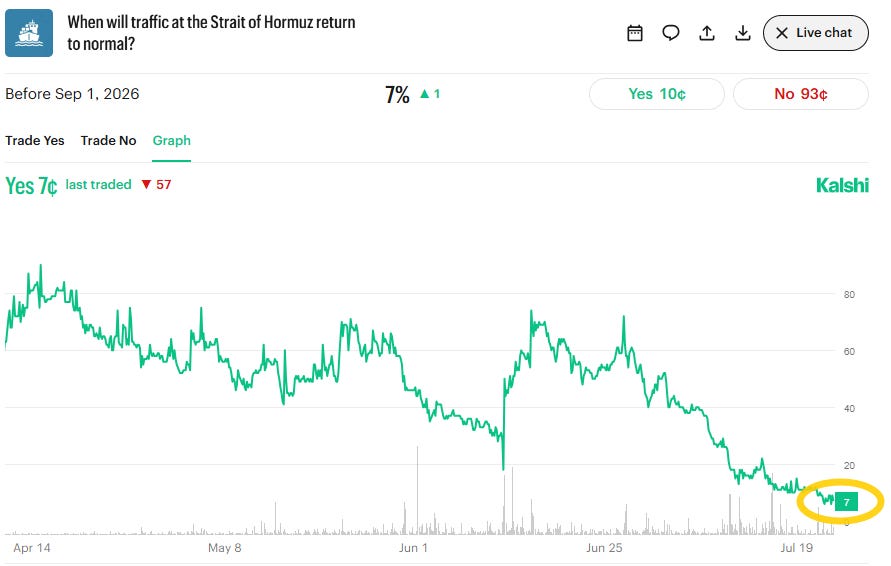
So as I said five weeks ago “we’ll just have to see how things progress”. While odds on Kalshi that traffic through the Strait would normalize by Sept 1st had risen as high as 69% June 25th, that has dropped to 7% today, the least since the start of the contract (although also with the least amount of time remaining), with just a 41% chance of normalization by the end of the year.

Ex-US highlights from DB:
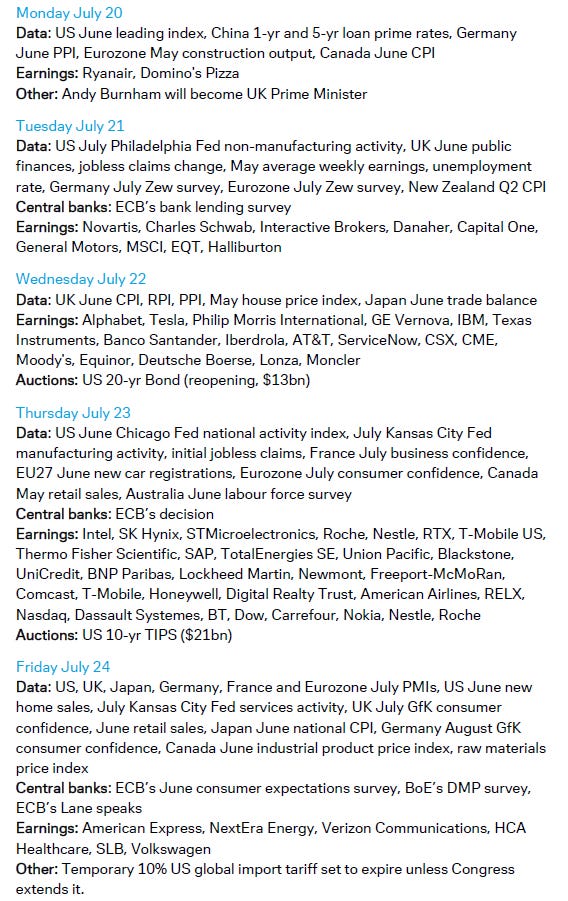
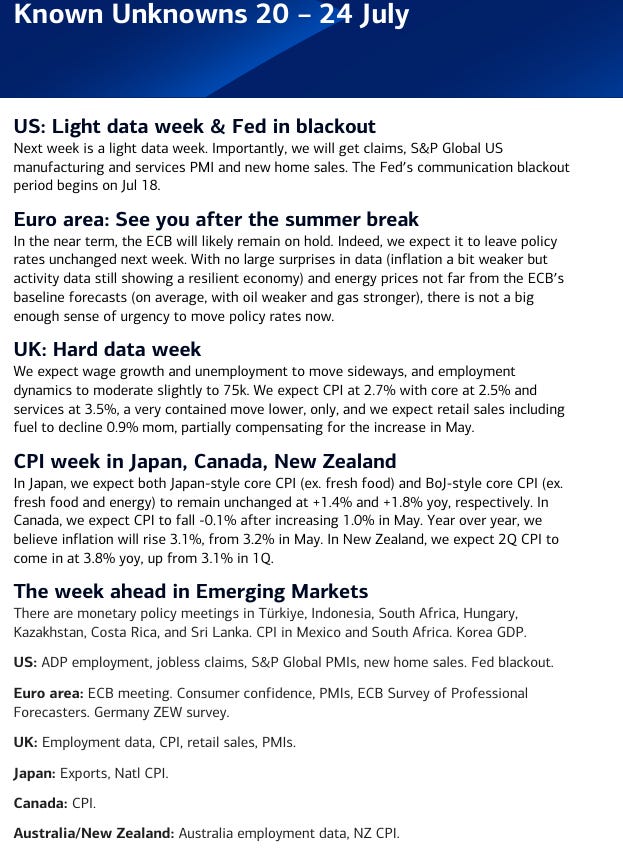
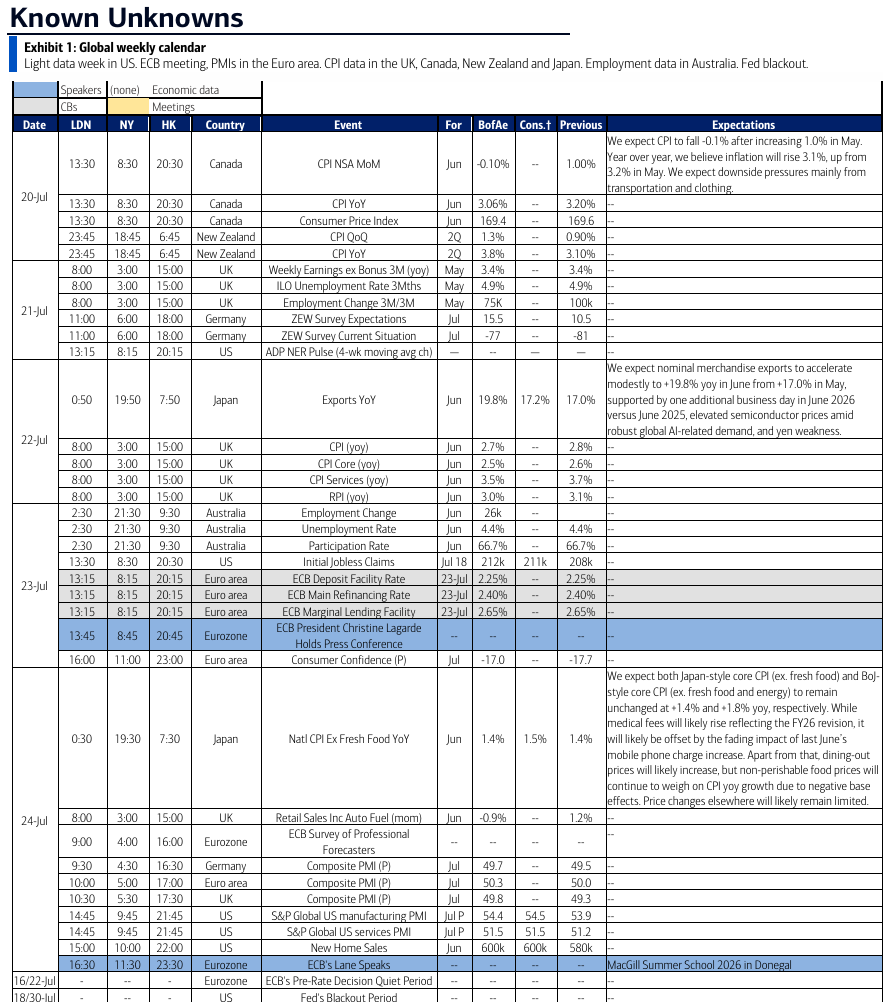
For next week’s economic indicators, the focus will be on the flash July PMIs out on Friday. Those will give a health check on several economies including the US, the UK, Japan, Germany and France amidst ongoing geopolitical risks, as well as last month’s ECB rate hike.
Speaking of the ECB, its decision on Thursday will be one of the key macro events next week. Market expectations are for hikes later in the year, but investors are pricing in a hold at this meeting, which our European economists also expect. They don’t expect a second hike in the deposit rate to 2.50% until September. The central bank will also release its quarterly bank lending survey on Tuesday and the June consumer expectations survey on Friday.
In the UK, in addition to Labour party member Andy Burnham becoming the new Prime Minister on Monday, other key events to watch out for will be the June inflation reports on Wednesday as well as labour market indicators on Tuesday. For the former, our UK economist expects headline CPI to slow to 2.70% y/y, with core CPI at 2.55% y/y. Services CPI is also expected to drop to 3.45% y/y. Rounding out the week ahead for the UK, there will be the June retail sales report and the July GfK consumer confidence index on Friday, with the BoE publishing its latest DMP survey also that day.
Other European releases include the July ZEW surveys for Germany on Tuesday.
Over in Asia, the focus will be on Japan’s June trade balance on Wednesday and national CPI for June on Friday. On inflation, our Japan economist forecasts core CPI to rise to 1.7% y/y (from 1.4% in May), while core-core inflation to be up 1.9% y/y (1.8% in May). Elsewhere in the region, Australia’s June labour force survey is out Thursday.
Finally, the Q2 earnings season moves into full swing next week. Technology highlights include SK Hynix in Asia, as well as SAP and Dassault Systemes in Europe.
Here’s their one-pager:
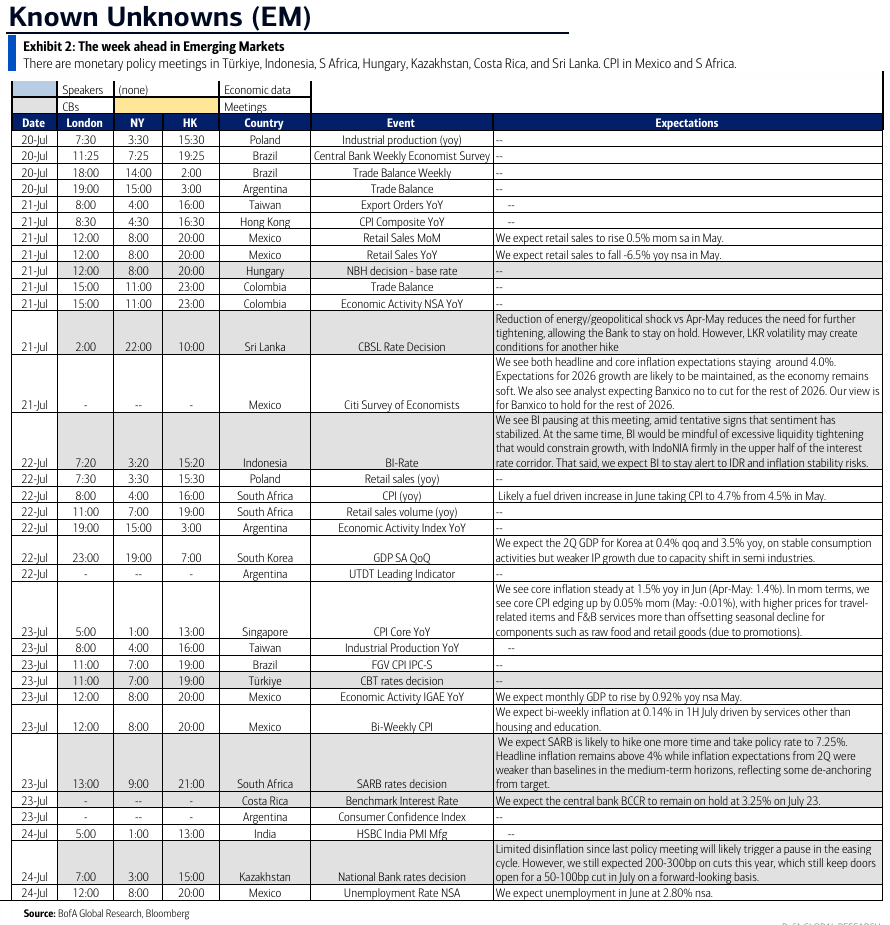
BoA’s cheat sheets:
In this week’s Week Ahead:
An update on the economy, including the latest GDP trackers, JPM’s Mike Feroli on Q2 GDP and the 2H growth outlook, the Dallas Fed Weekly Economic Index, Goldman’s Current Activity Indicator, BoA card spending, Redbook sales, consumer credit, lower-income spending, small business profitability, housing, and the Beige Book.
A look at last week’s inflation data, including CPI, PPI, import prices, and implications for the Fed setup heading into the July meeting.
A Q2 earnings season update, including early beat rates, the magnitude of earnings and revenue surprises, sector-level expectations, margins, FactSet’s work on beats and misses, and Evercore’s thoughts on muted rewards for double beats.
A closer look at the earnings setup, including Mag-7 vs. the other 493, Micron and Nvidia’s contribution to expected earnings growth, 2026 and 2027 earnings expectations, and whether revisions are starting to cool from very strong levels.
An update on valuations, including how rising earnings expectations have affected forward P/Es for the Mag-7, large caps, mid caps, and small caps.
A breadth update, including the McClellan Summation Index, stocks above 20- and 200-DMAs, new highs minus new lows, equal-weight vs. cap-weight, small caps vs. large caps, and growth vs. value.
An extensive positioning and flows section, including Deutsche Bank’s composite positioning work, the divide between discretionary and systematic investors, large-cap Tech positioning, semiconductor fund flows, BoA’s systematic flow estimates, CTAs, vol-control funds, risk parity, and buybacks.
An update on leveraged ETF positioning, including the latest moves in SPX, Nasdaq-100, and single-stock leveraged ETF AUM, with a focus on memory stocks and the largest single-stock leveraged ETFs.
A look at retail positioning and options activity, including BoA private client allocations, put/call ratios and Citadel’s retail flow data.
An update on gamma from BofA and Tier1Alpha, including the impact of monthly options expiration, and the potential volatility implications if the market weakens further.
A sentiment check, including AAII, NAAIM, Goldman’s sentiment indicator, CNN Fear & Greed, BoA’s Bull & Bear Indicator, Yardeni on Investors Intelligence, Citi’s Panic/Euphoria model, and Helene Meisler’s weekend poll.
An update on interest rates and Fed expectations, including the impact of last week’s inflation readings, rate-hike expectations, the Fed-favored 5-year, 5-year forward inflation rate, John Authers on inflation swaps, and the setup heading into the July FOMC blackout.
A wrap-up with some thoughts on the AI trade, earnings season, systematic positioning, gamma, Iran, and whether the bull case remains intact.
Note: While I cannot post BoA charts on X, I include many in the Week Ahead.
