
The Week Ahead - 8/2/26
A look at the upcoming week for the US economy and equities — covering key drivers including earnings, positioning, breadth, valuations, sentiment, seasonality, and the Fed.

The Week Ahead
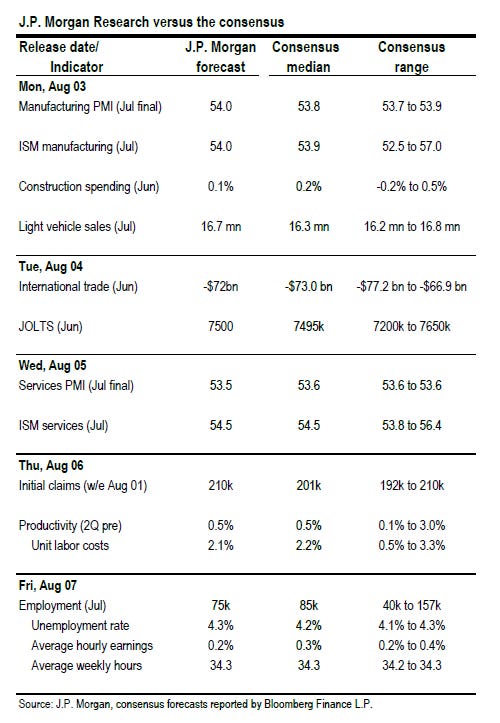
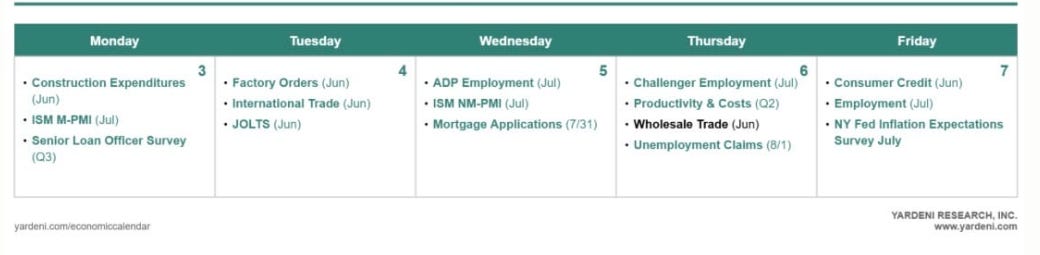
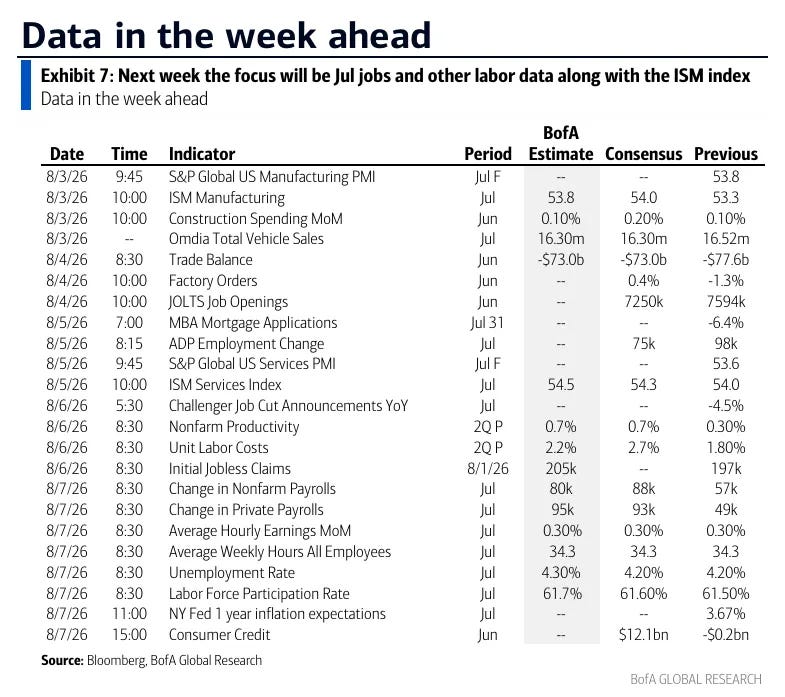
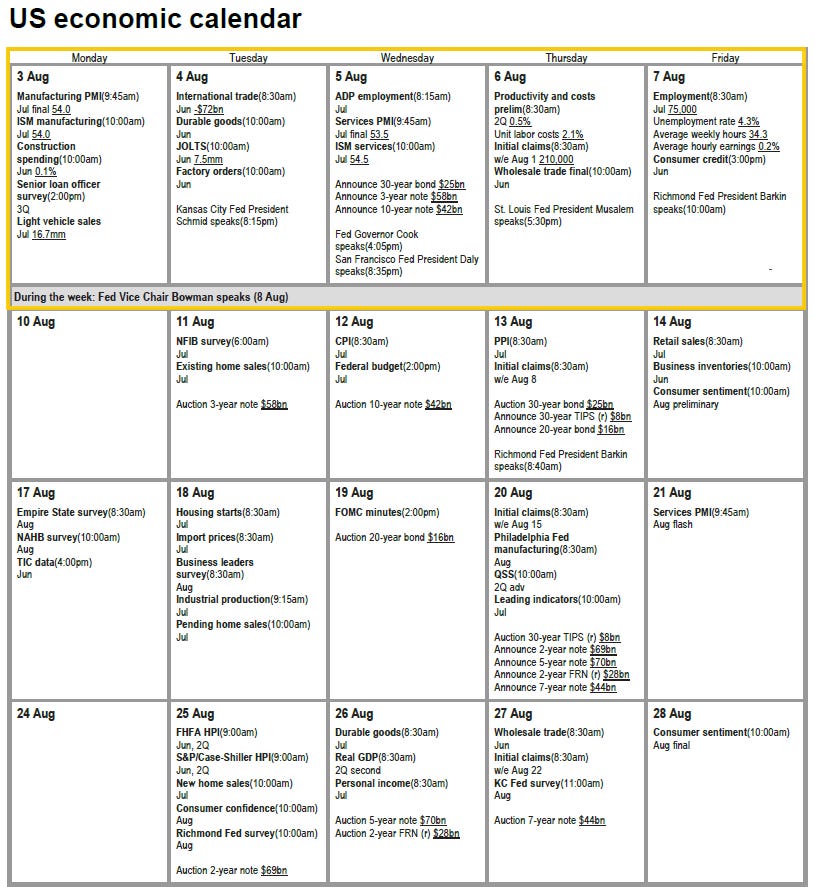
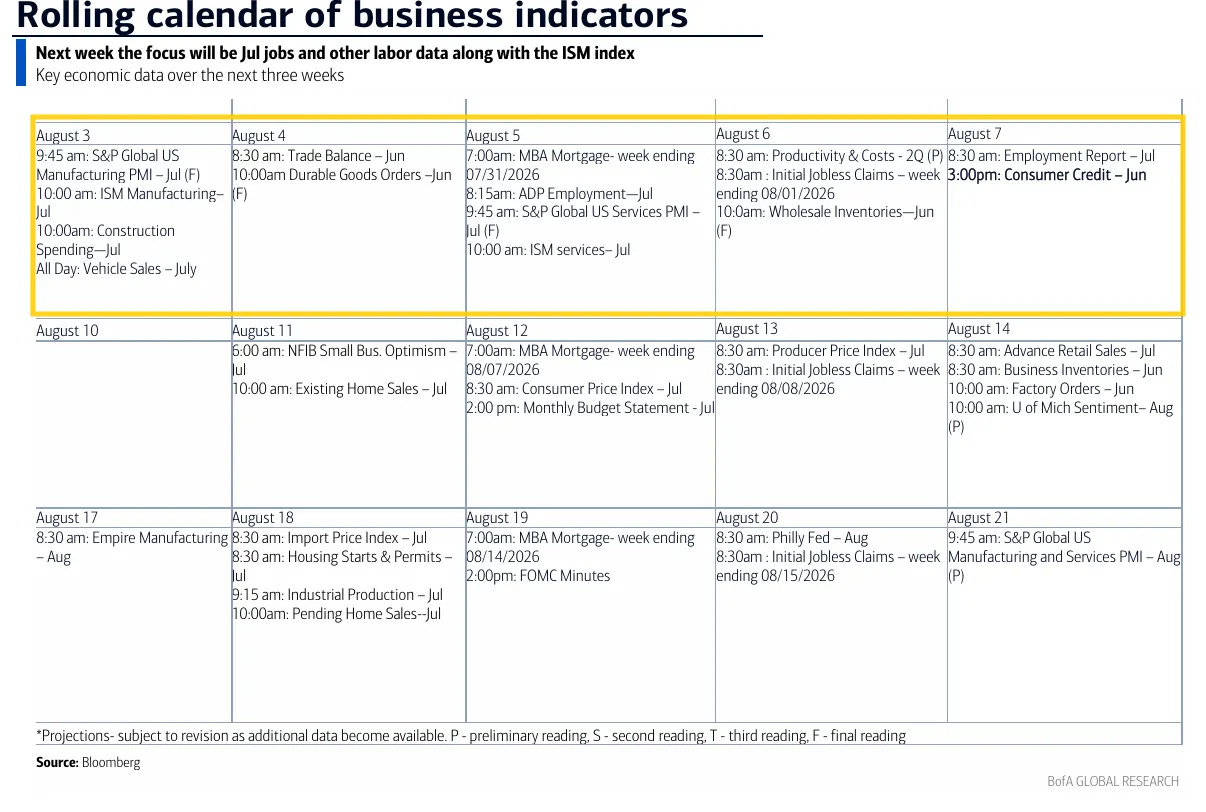
Next week is the first week of the month which also means it’s jobs week in the US, and we’ll get the normal first-week-of-the-month cadence of reports culminating in the July Nonfarm Payrolls Friday (technically the Employment Situation report) along with the NY Fed’s consumer survey and June consumer credit.
As usual before we get to jobs day we’ll get the July ADP monthly employment, Challenger job cuts, PMIs, and auto sales, June JOLTS, construction spending, factory orders, trade balance, as well as the standard weekly reports (jobless claims, mortgage applications, and US petroleum inventories (not ADP though with the monthly report this week)). We’ll also get the first read on Q2 productivity and unit labor costs as well as the Q2 Fed’s Senior Loan Officer Opinion Survey SLOOS).
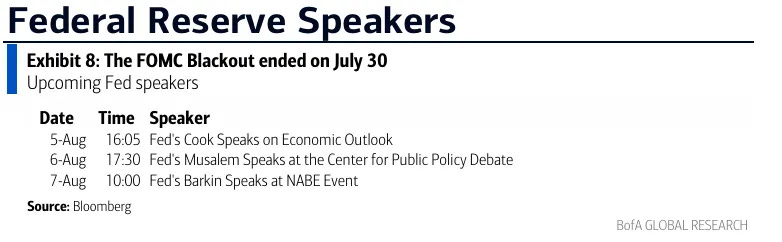
While the Fed policy speaking blackout is over (and we did hear from the three dissenters as I mentioned we might in last night’s update) Fed speakers on the calendar are light with just Governor Cook and regional bank presidents Musalem and Barkin. I can assure you there will be more.
In terms of non-Bill (>1-yr in maturity) US Treasury auctions, we’re off next week. But more importantly, we’ll get the Q3 refunding announcement which will give us our auction sizes for every maturity for the upcoming quarter. It will come in two parts. On Monday we’ll get the aggregate expected borrowing amount for the quarter which is generally less market moving but can tip us to whether to expect anything Wednesday, which is where the action is when specific borrowing amounts by maturity are announced for the next three months as well as a forward looking statement on whether those might change. With 10-year yields the highest in 18 months and 30-years the highest since 2007, I’m sure Scott Bessent is loathe to add fuel to the fire by tipping a coming increase in long-end supply with the forward looking statement, but most expect that to come at some point. Probably something though at this point best left for another day.
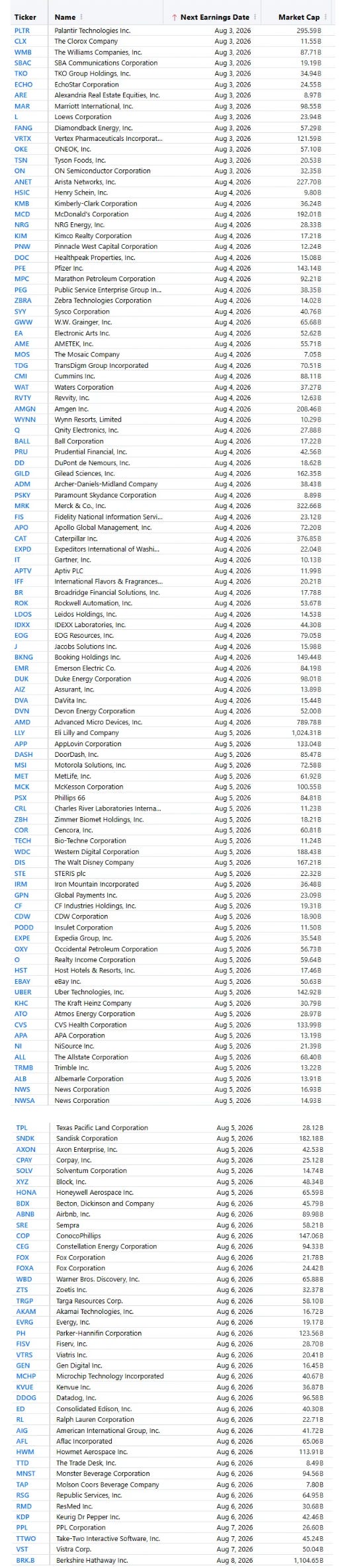
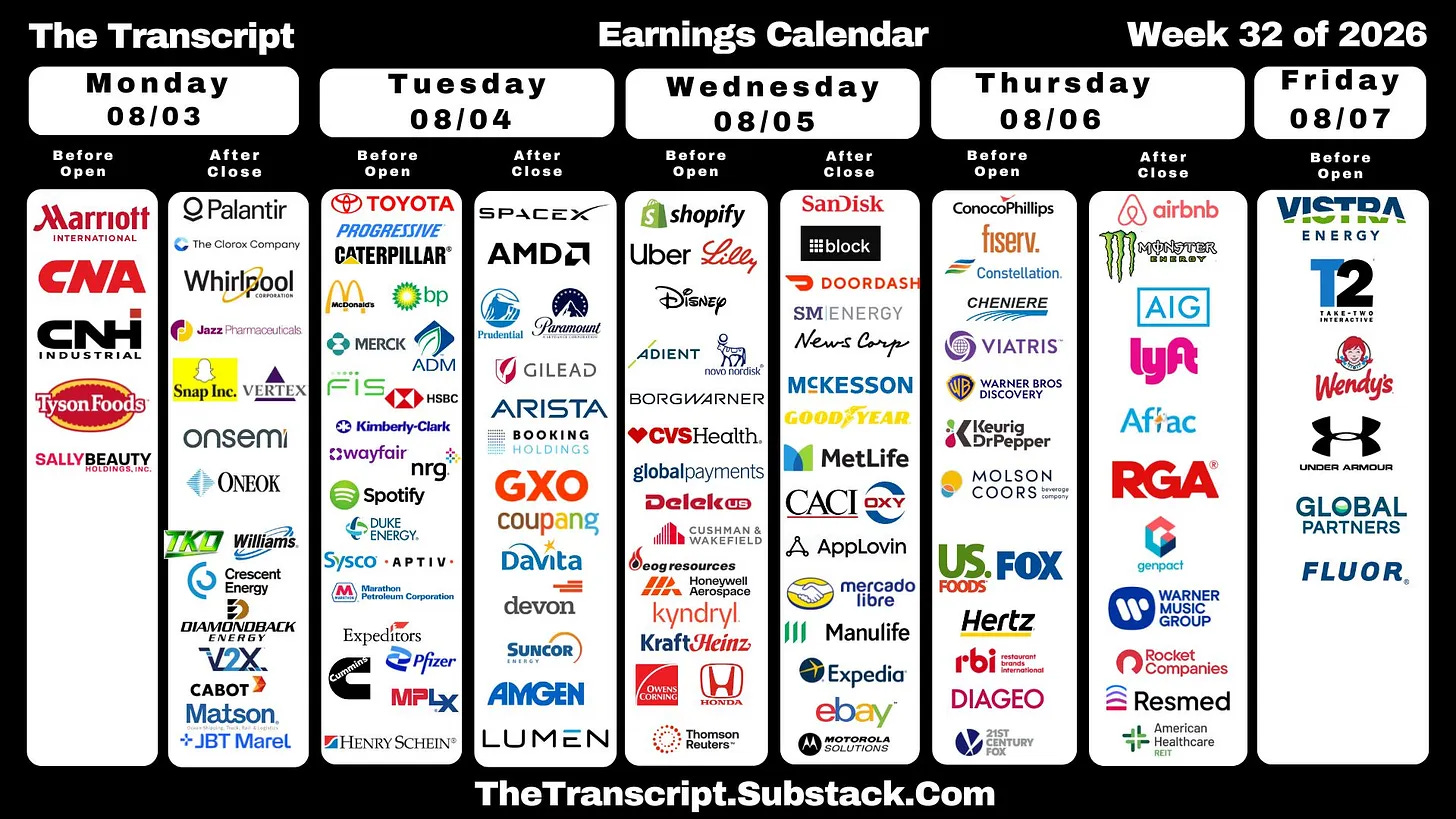
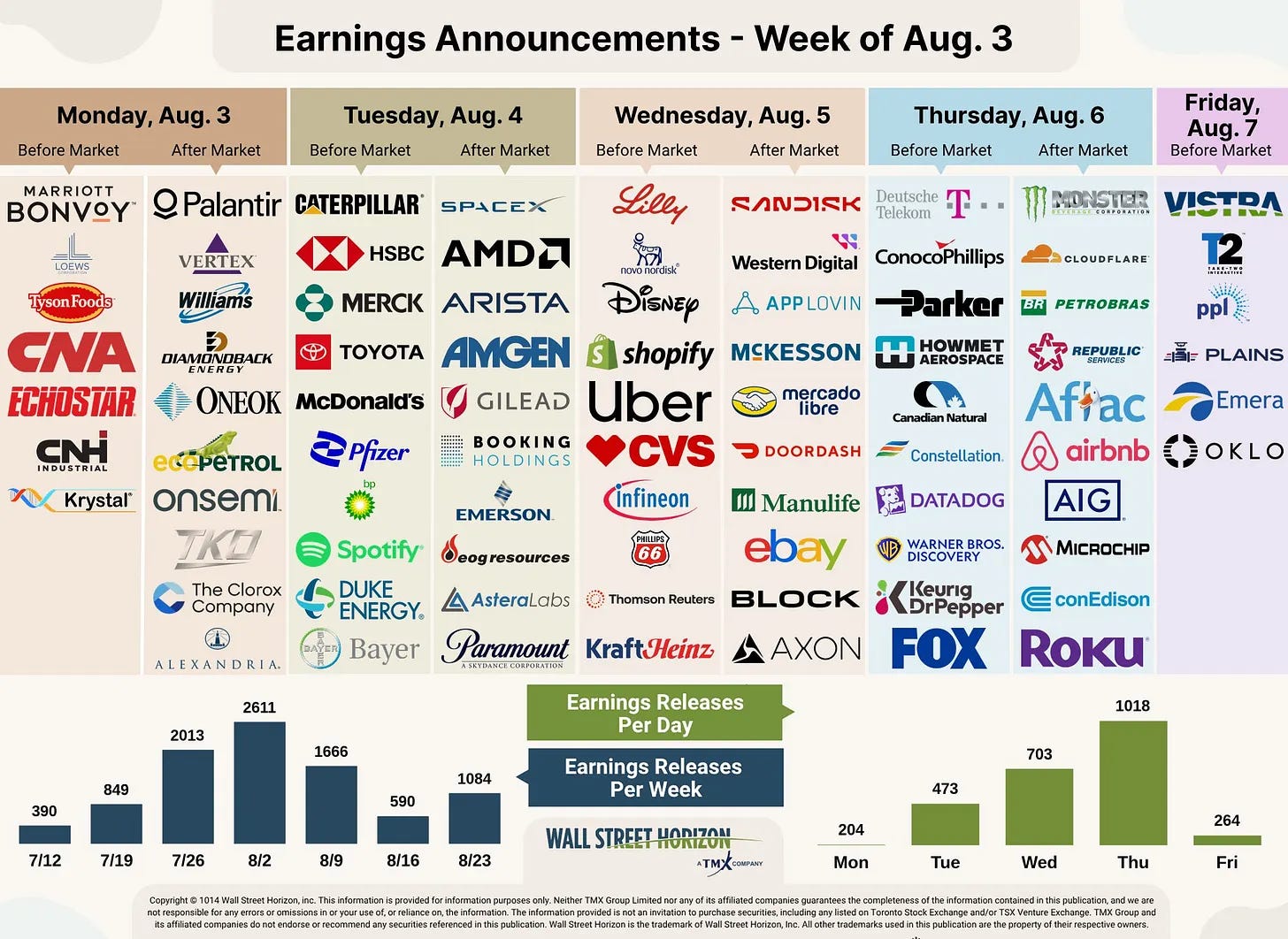
While we’re now on the downslope (at least in terms of SPX earnings weight) for Q2 earnings season, the number of reporters actually increases with 140 SPX components (and 2,600 total companies according to WallStHorizon) reporting next week with 23 >$100bn market cap (BRK/B (Saturday), LLY, AMD, CAT, MRK, PLTR, ANET, AMGN, MCD, WDC, SNDK, DIS, GILD, BKNG, COP, PFE, UBER, CVS, APP, PH, VRTX, HWM, MCK in order of earnings weight). In addition, while not yet in the SPX, we’ll get the first earnings report from SpaceX which I’m sure will garner plenty of attention.
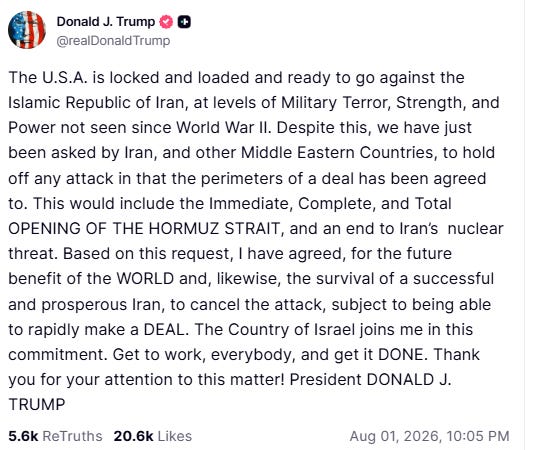
In terms of Iran, while we have seen threats of escalation come and go (the latest the latter as President Trump says in a social media post (below) he was holding off on further strikes on Iran on indications a deal may come together to reopen the Strait and deal with Iran’s nuclear program), as I said last week:
things remain very fluid. After two weeks of escalation, things seem to have de-escalated over the weekend. The Iranians know he needs to bring this to a close, but they also know that their hand gets weaker after the midterms. How far they want to push things, I’m not sure.
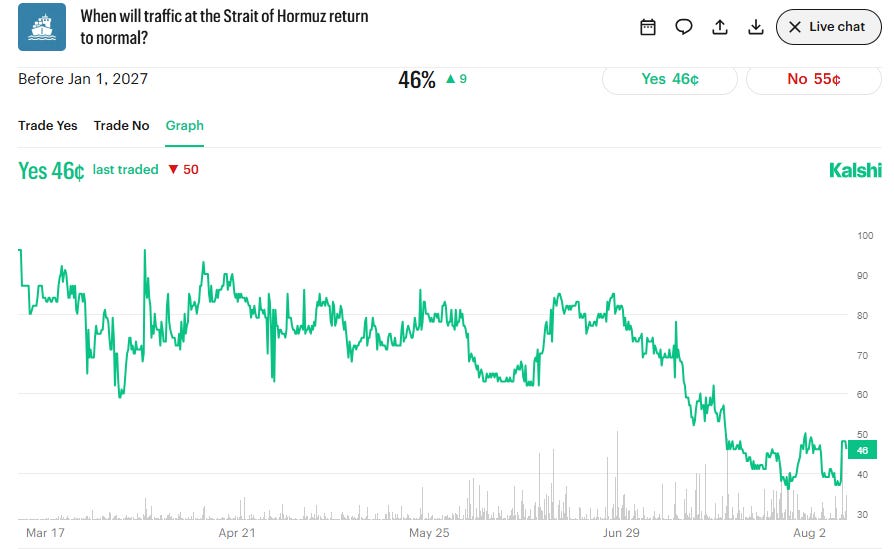
So as I said now eight weeks ago, “we’ll just have to see how things progress”. While odds on Kalshi that traffic through the Strait would normalize by Sept 1st had risen as high as 69% June 25th, that dropped to 7% two weeks ago and remains at 8%, although with only a month to go, I will shift to the Jan 1st contract which stands at 46%, little changed from last week’s 48% chance of normalization by that time.
Ex-US highlights from DB:
Moving on to Europe, July CPI reports are due from Switzerland on Monday and Sweden on Thursday. There will also be plenty of June economic indicators for Germany throughout the week, including retail sales, factory orders, industrial production and trade data.
Over in Asia, the focus in China will be on private July PMI gauges, with the manufacturing one due Monday and services on Wednesday, and July trade data are out Friday. In Japan, June labour cash earnings and household spending will be amongst notable releases, due Wednesday and Friday respectively. Finally, The BoJ will publish the minutes of its June meeting on Wednesday. For more detail and forecasts, see DB’s week ahead for Japan here.
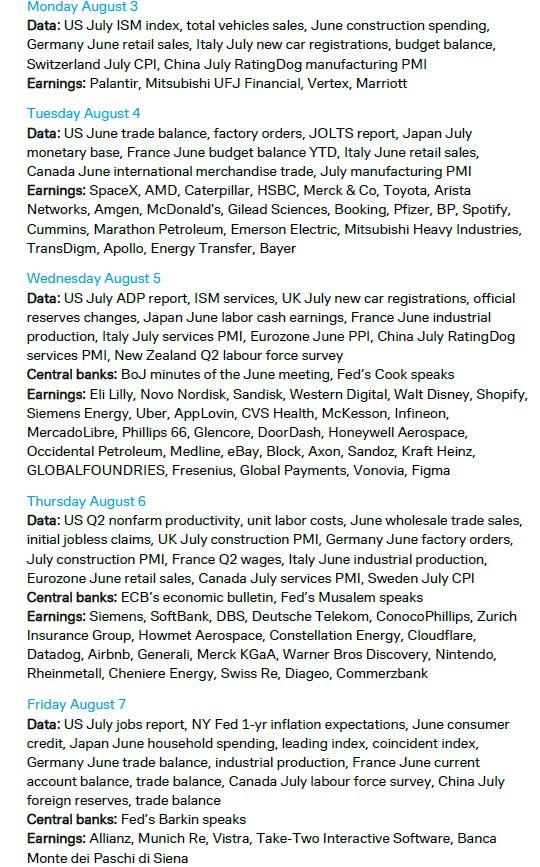
In corporate earnings, the Q2 season continues. The focus in Europe will be on Siemens, Novo Nordisk and Rheinmetall, amongst other large caps in the region. The list in Japan includes Toyota, SoftBank and Nintendo.
Here’s their one-pager:
BoA’s cheat sheets:
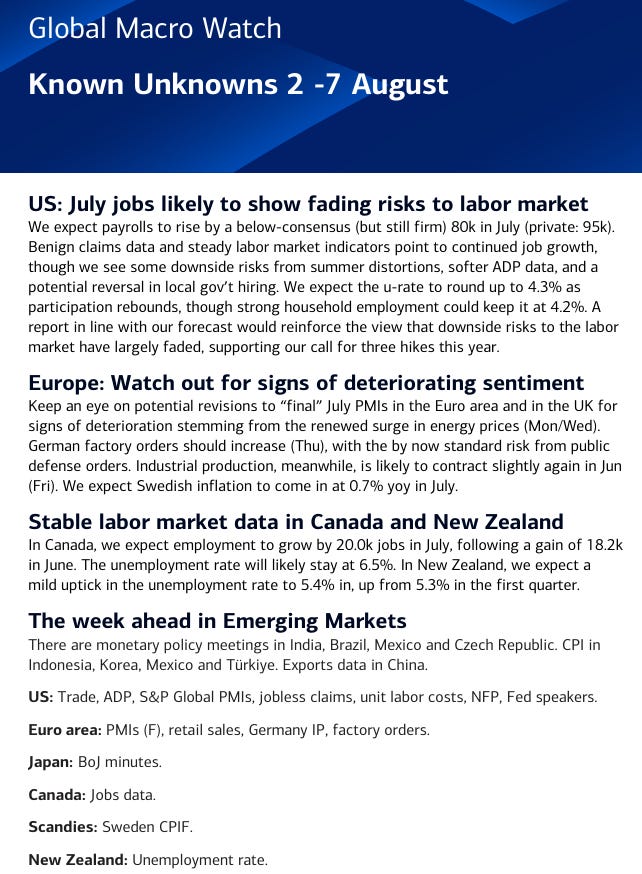
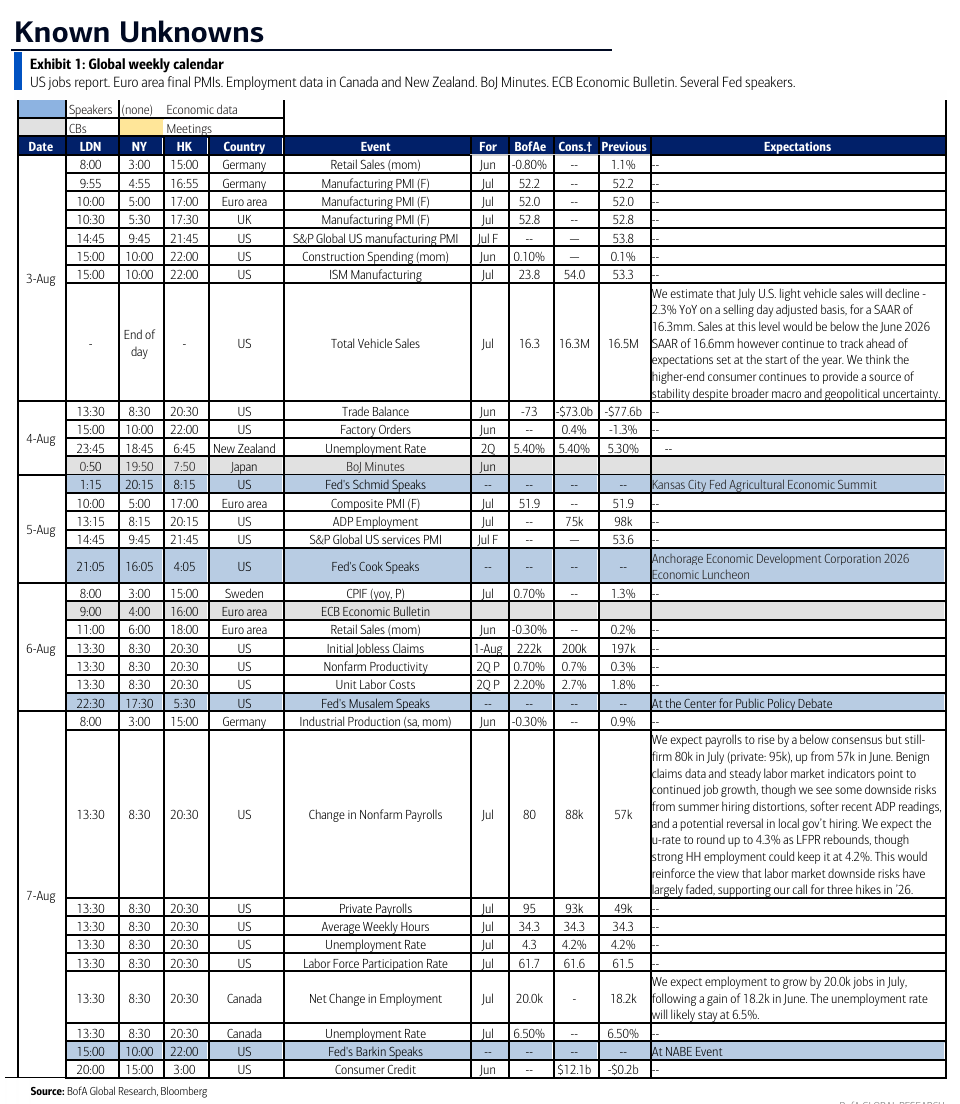
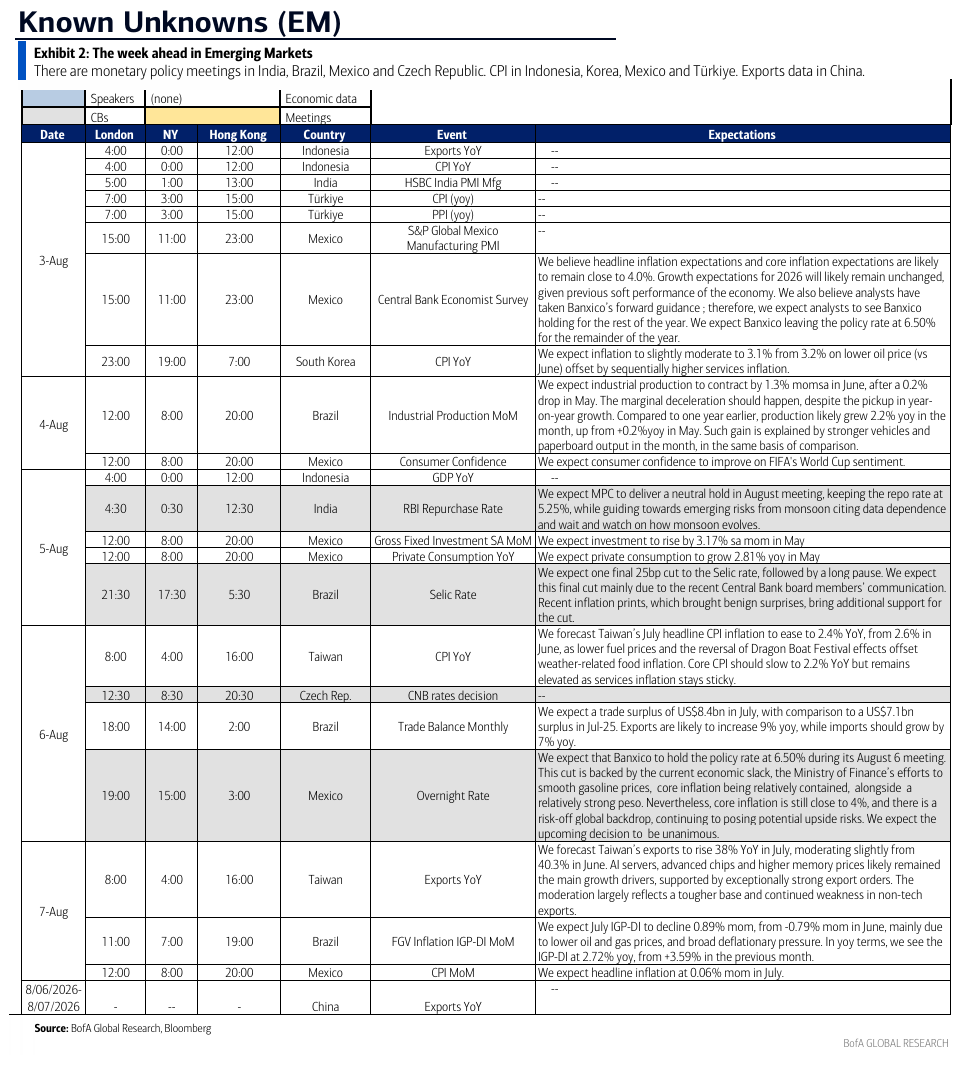
In this week’s Week Ahead:
An update on the economy, including Q2 GDP and details including real final sales to private domestic purchasers and real disposable personal income, the Citi Economic Surprise Index, a review of how the Q2 GDP trackers performed, early Q3 GDP trackers, the Dallas Fed Weekly Economic Index, Goldman’s Current Activity Indicator, BoA card spending, and Yardeni on Redbook sales.
A closer look at the consumer and underlying growth setup, including Yardeni on consumer spending, the rebound in BoA card spending and Redbook sales.
A lengthy Q2 earnings season update, including beat rates, earnings and revenue surprises and current expectations for earnings, revenues, and profit margins, Amazon and Alphabet’s impact on headline earnings growth, sector-level earnings and revenue expectations, margins, and market reactions to beats and misses.
A closer look at the earnings setup beyond Q2, including Q3, 2026, and 2027 earnings expectations, revisions, analyst price targets, ratings, and the impact of investment gains and “other income” on headline earnings.
Goldman’s latest thoughts on earnings season, including AI infrastructure stocks, semiconductor price volatility versus earnings estimates, equal-weight S&P 500 earnings, mega-cap Tech “other income,” the contribution of AI infrastructure to earnings growth, revision breadth, and margin pressure.
An update on valuations, including how rising earnings expectations and softer stock prices have affected forward P/Es for the Mag-7, large caps, mid caps, and small caps.
A breadth update, including the McClellan Summation Index, stocks above 20- and 200-DMAs, new highs minus new lows, equal-weight vs. cap-weight, small caps vs. large caps, and growth vs. value.
A detailed positioning and flows section, including Deutsche Bank’s composite positioning work, the divide between discretionary and systematic investors, large-cap Tech positioning, BoA’s systematic flow estimates, Deutsche Bank, and Goldman on CTAs, vol-control funds, risk parity, and options positioning.
A closer look at BoA’s updated systematic flow work, including a more two-sided flow setup, the remaining downside risk in a weaker market, and the CTA levels to watch across Nasdaq, the S&P 500, and Russell 2000.
An update on leveraged ETF positioning, including BoA’s SPX and Nasdaq-100 leveraged ETF work, ZeroHedge/Goldman on broader US leveraged ETF AUM and net exposure, Tier1Alpha on SOXL and leveraged-fund feedback loops, and the latest moves in single-stock leveraged ETF AUM.
A look at retail positioning and options activity, including put/call ratios, Deutsche Bank on call/put buying and options skew, Vanda on retail selling in single stocks, Nvidia dip-buying, memory-stock flows, and BoA private-client allocations.
An update on gamma and buybacks, including BoA and Tier1Alpha on dealer gamma, the potential impact of expiring options, Citadel’s buyback-window work, and BoA client buyback trends.
A sentiment check, including AAII, NAAIM, Goldman’s US Equity Sentiment Indicator, CNN Fear & Greed, BoA’s Bull & Bear Indicator, and Helene Meisler’s weekend poll.
A seasonality update, including early-August seasonality, BofA on August/September weakness and October/November reversal led by midterm years, Goldman’s deep dive on midterm-election uncertainty, volatility, fund flows, and sector relationships.
An update on interest rates and Fed expectations, including the market reaction to Chair Warsh’s press conference, Yardeni on bond vigilantes, Bloomberg’s John Authers on the yield-curve message, BoA on Fed credibility and September hike risk, BlackRock’s Wei Li on the long end, St. Louis Fed President Alberto Musalem’s comments, the MOVE index, breakevens, and the Fed-favored 5-year, 5-year forward inflation rate.
A wrap-up with some thoughts on the AI trade, earnings season, positioning, gamma, buybacks, long-end yields, Iran, and whether the market setup has improved.
