
The Week Ahead - 8/9/26
A look at the upcoming week for the US economy and equities — covering key drivers including earnings, positioning, breadth, valuations, sentiment, seasonality, and the Fed.

The Week Ahead
After a packed two weeks, things calm down a bit in the upcoming week, although still with some key catalysts.
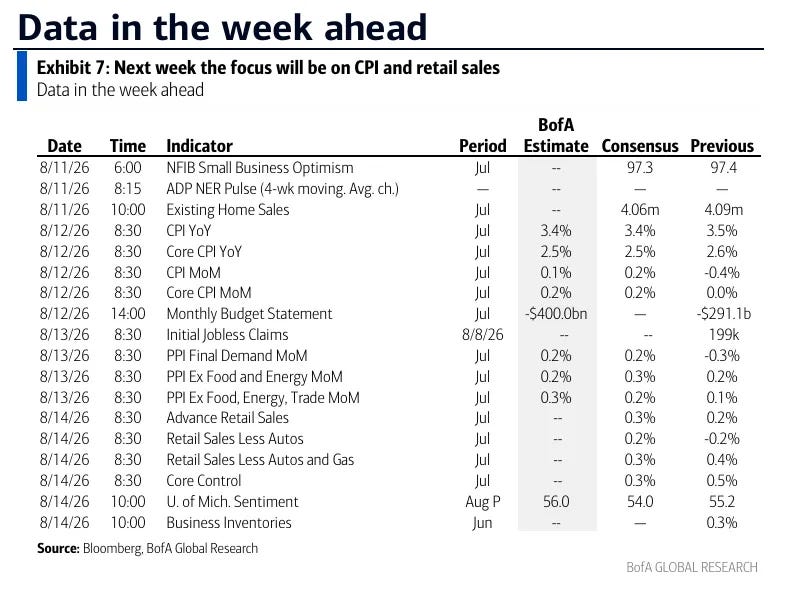
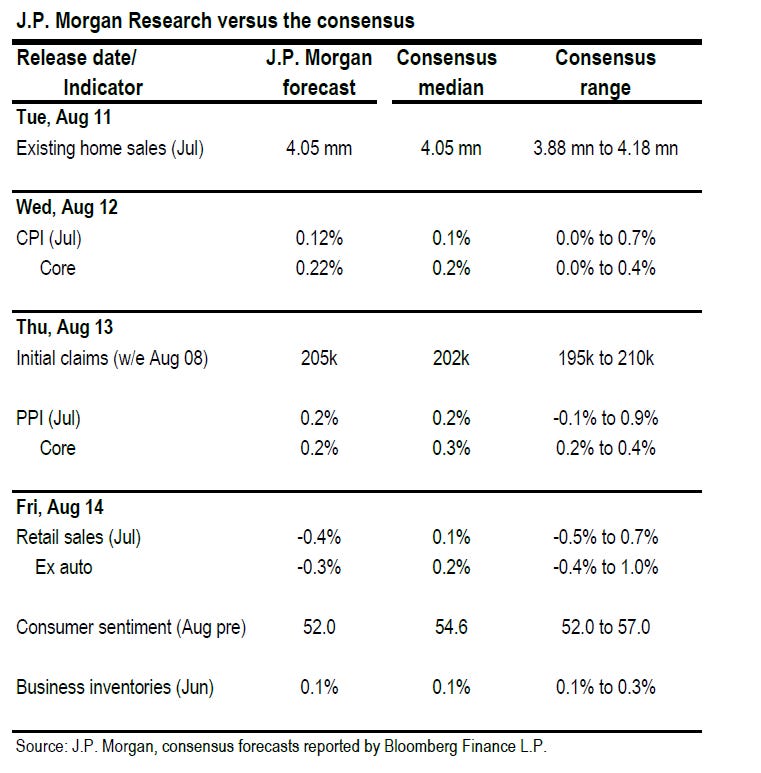
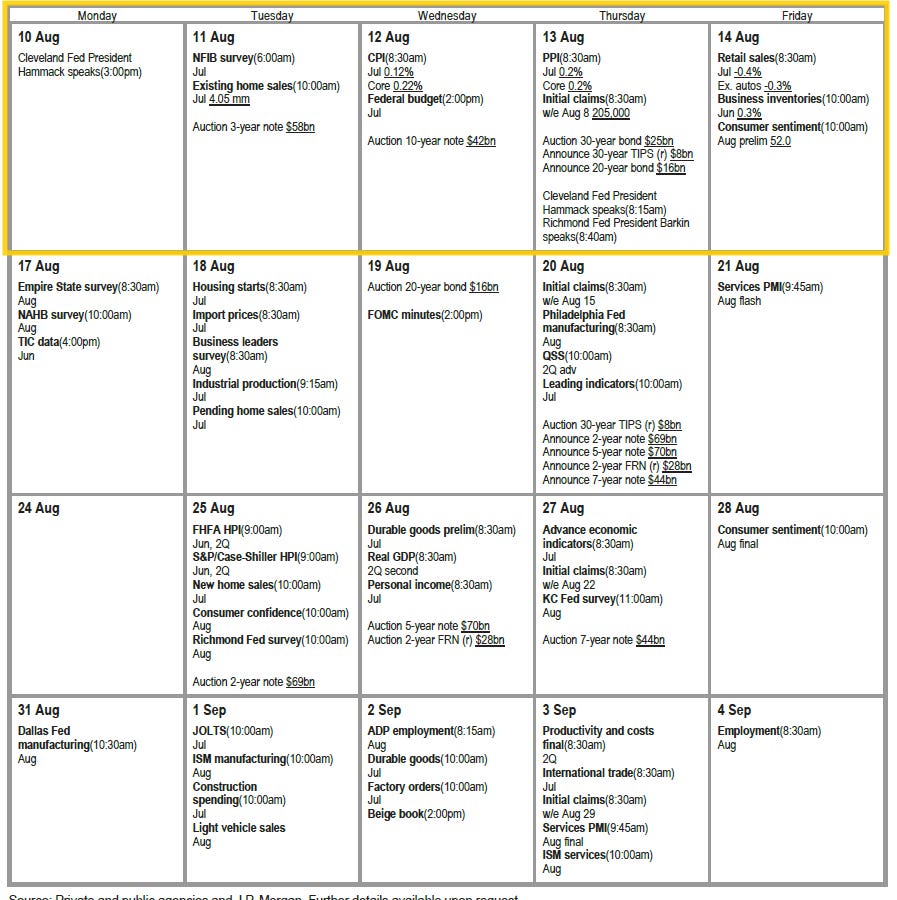
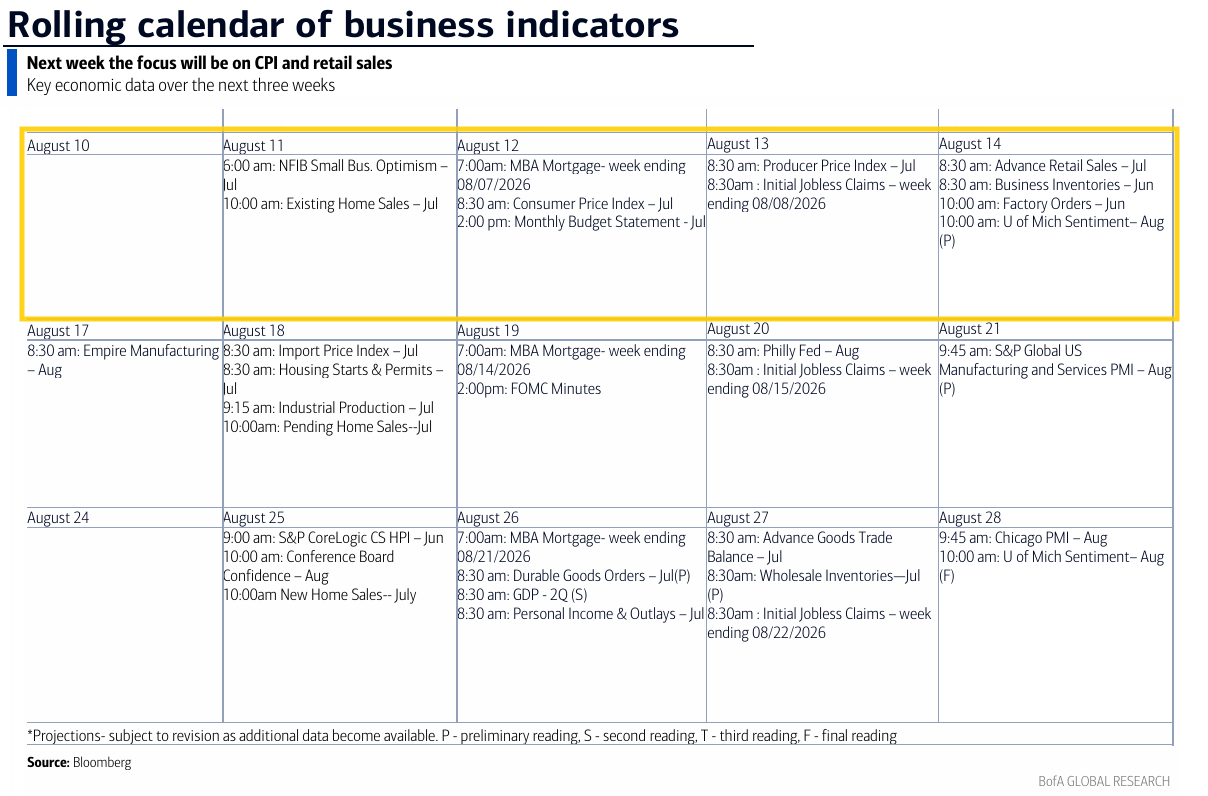
US economic data lightens up considerably in the week ahead although we’ll get two top-tier reports in July CPI (Wednesday) and retail sales (Friday). Other reports include July PPI, existing home sales, and NFIB small business sentiment, August preliminary UMich consumer sentiment as well as the Q2 household debt/credit report and the standard weekly reports (ADP, jobless claims, etc.).
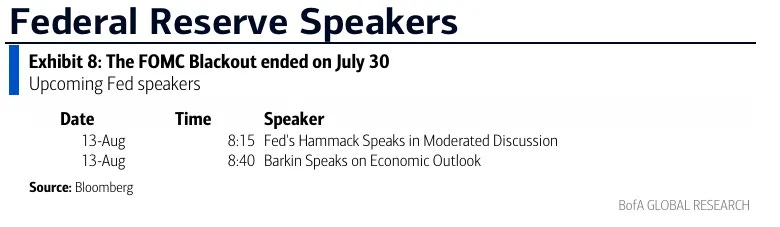
In terms of Fed speakers just a couple on the calendar next week in regional Fed presidents Hammack and Barkin, but there will almost certainly be more.
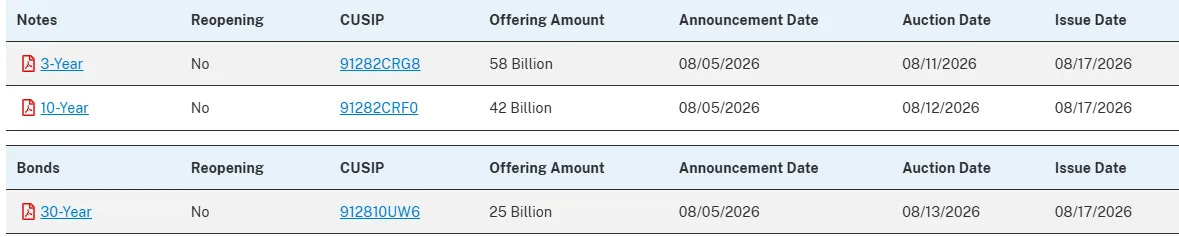
US Treasury auctions pick back up for non-Bills (>1yr in maturity) with 3, 10, and 30-yr auctions Tues, Wed, Thurs respectively.
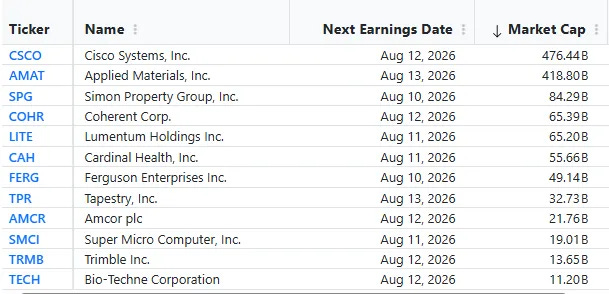
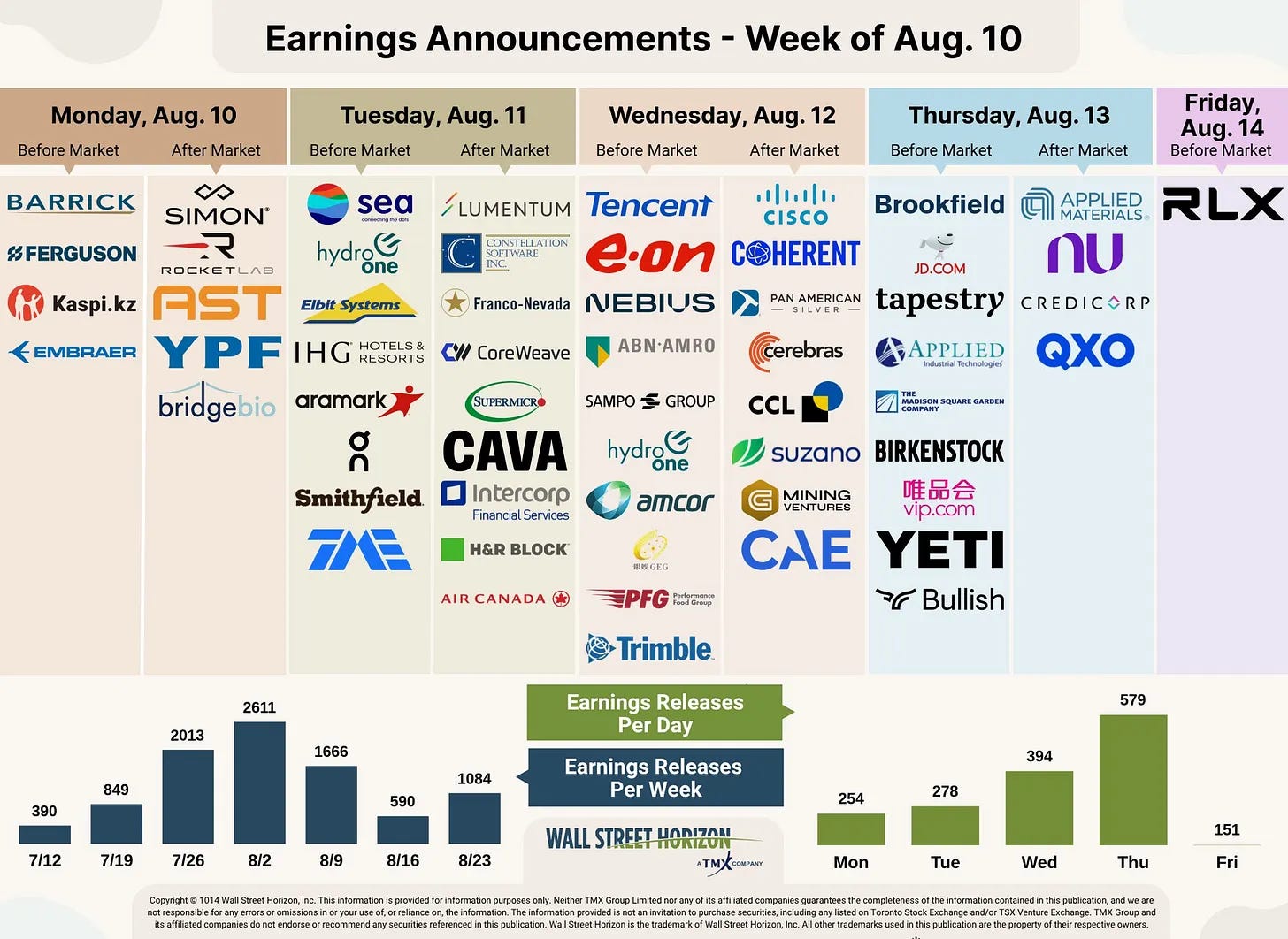
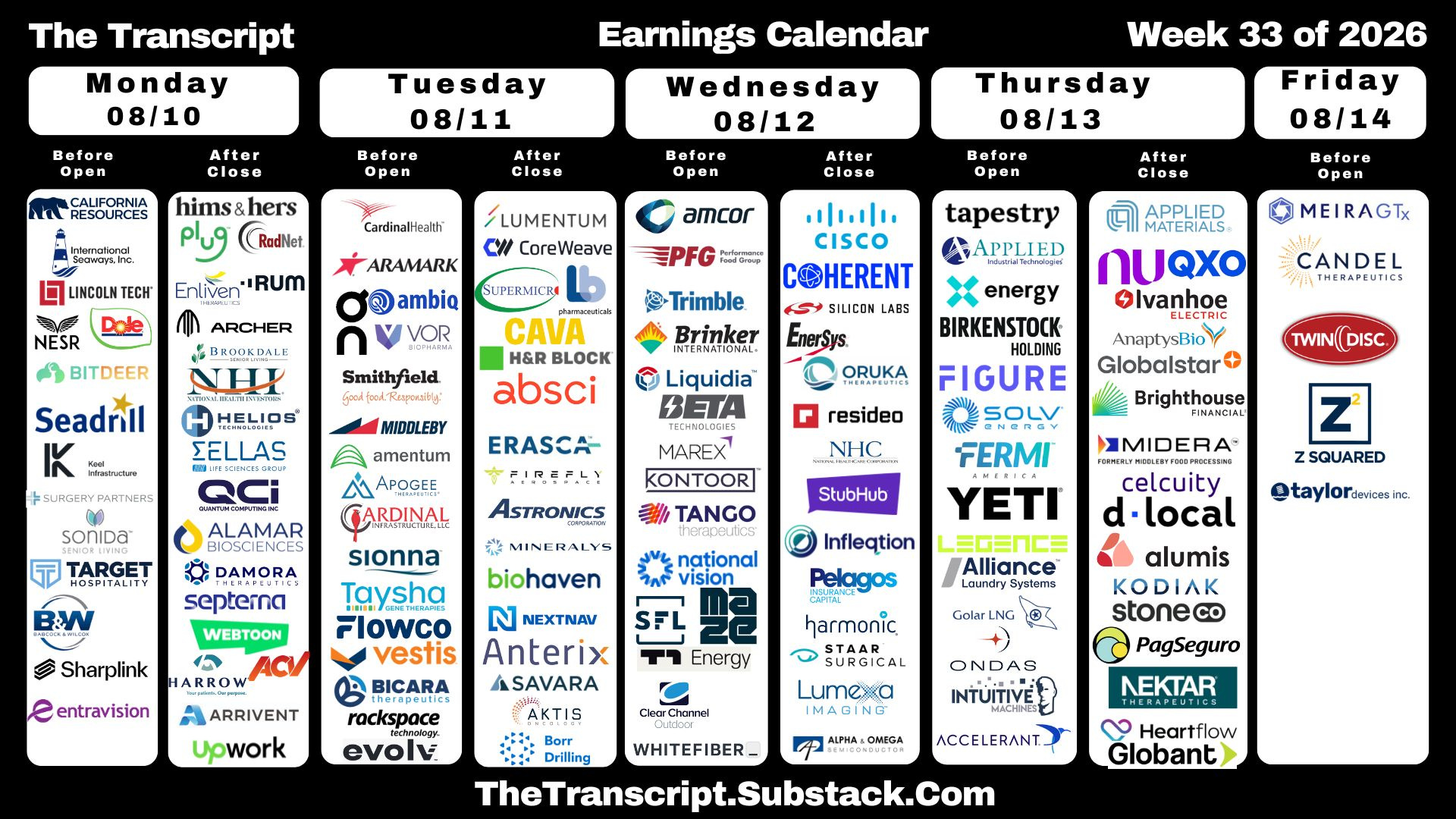
In terms of SPX Q2 earnings we’re very much in the windup phase now with just a few heavyweights left including NVDA at the end of the month (AVGO is the start of next month). In the upcoming week, just 1% of the SPX reports by earnings weight consisting of 12 components with two >$100bn in market cap in CSCO and AMAT (in descending order by market cap). We’ll also get Berkshire tomorrow. There are though over 1,600 total companies reporting this week according to WallStHorizon including several non-US heavyweights which I’ll cover on Sunday.
In terms of Iran, as I said two weeks ago:
things remain very fluid. After two weeks of escalation, things seem to have de-escalated over the weekend. The Iranians know he needs to bring this to a close, but how far they want to push things, I’m not sure.
And the latest on Sunday is Axios reporting that President Trump has decided against escalating things militarily (taking into consideration he has in the past made such statements just before an escalation).
"We are low keying it," Trump said during a brief phone call. “We are only semi-negotiating with them. We are just watching Iran with its huge inflation and the fact they have no money.” He stressed that Iran “is in very bad shape” economically and has no money to pay its troops. The U.S. naval blockade has exacerbated the Iranian regime’s economic crisis, Trump said. At the same time, Trump said that with oil down to slightly over $75 a barrel, U.S. consumers are feeling less pain from the war. “It will work out. It always works out. It’s like a chess game,” Trump said of the back-and-forth with Iran.
…
When Iran isn’t engaged in war, it is forced to confront a grim reality with no real solutions at hand, a U.S. official said. At the same time, the U.S. official said, around 8 million barrels of oil are going out of the Gulf every night through the southern lane of the Strait of Hormuz in coordination with the U.S. military.
Complicating things has been “growing disagreements inside the Iranian regime. One camp, led by President Masoud Pezeshkian, is extremely worried about an economic collapse and believes Iran needs to reach a deal with the U.S. Another led by the commander of the Islamic Revolutionary Guard Corps, Ahmad Vahidi, rejects any concessions.”
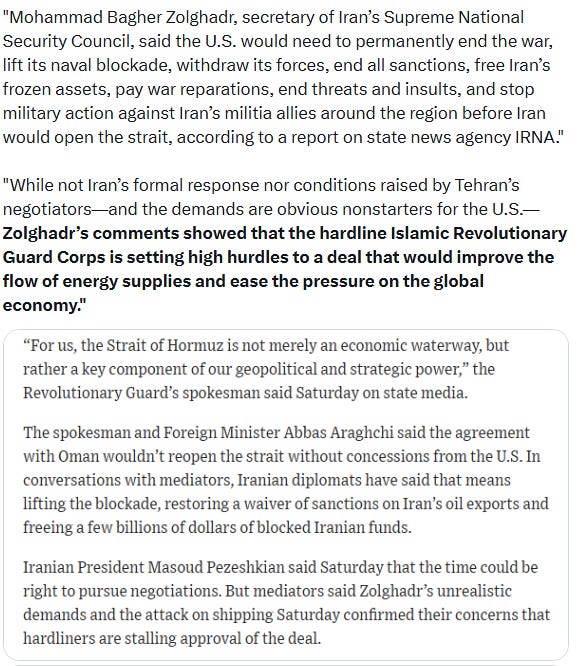
The interview comes after the head of Iran's Supreme National Security Council, Mohammad Bagher Zolghadr, laid out new terms for reopening the strait over the weekend most of which are clear red lines for the administration (see post below).
So it appears for now things will drag on with little change through the mid-terms unless/until Iran decides they want to reopen the Strait.
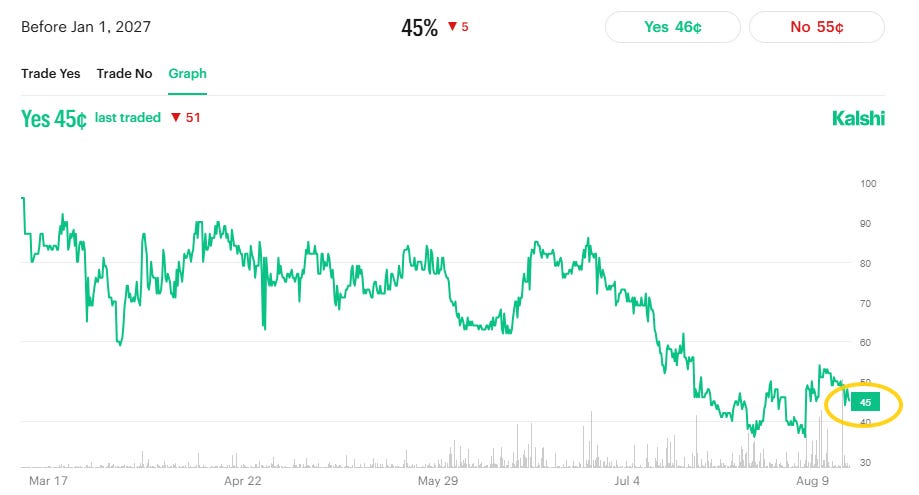
So as I said now nine weeks ago, “we’ll just have to see how things progress”. While odds on Kalshi that traffic through the Strait would normalize by the end of the year had risen as high as 86% June 24th, that dropped as low as 36% in late July and remains at 45% little changed from this time a week ago.
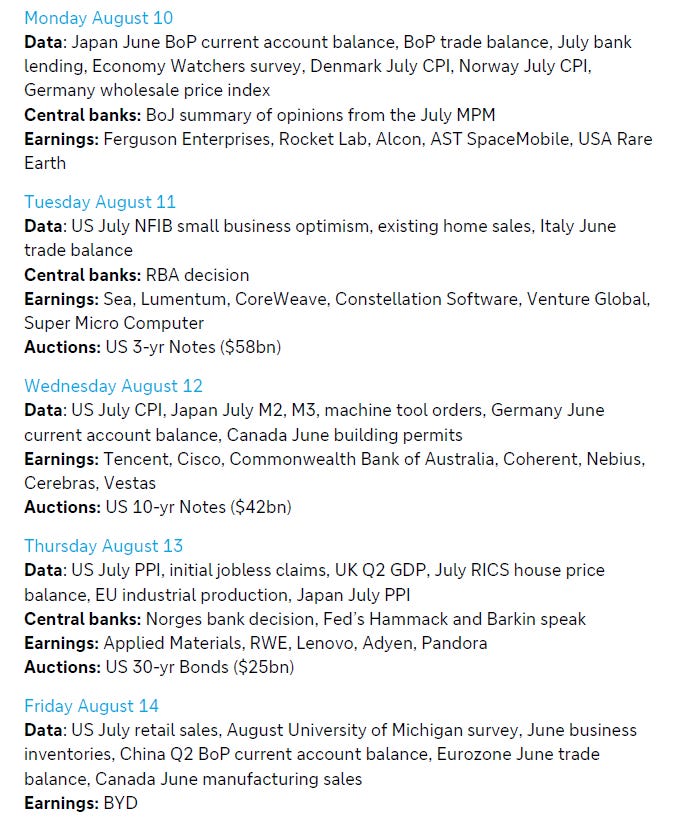
Ex-US highlights from DB:
Turning to central banks, the RBA (Australia) decision is due Tuesday (DB expects a hold at 4.35%), while Norges Bank (Norway) announces its decision on Thursday. The BoJ will release its summary of opinions from the July meeting on Monday.
In Europe, the key UK release will be the Q2 GDP report on Thursday, where our UK economists expect June GDP to slip to -0.1% MoM, leaving Q2-26 GDP growth running at 0.4% QoQ, with risks skewed to the downside. Elsewhere, both Denmark and Norway release July CPI numbers on Monday.
July inflation indicators will also be in focus in China this Sunday. Our economists project +0.9% YoY growth for CPI (+1.0% in June) and PPI to increase by +4.0% (+4.1%). In Japan, notable data includes the Economy Watchers survey out Monday.
China’s Tencent and BYD lead ex-US reports next week.
Here’s their one-pager:
In this week’s Week Ahead:
An update on the economy, including last week’s mixed data, the Citi Economic Surprise Index, the latest Q3 GDP trackers, JPM’s Mike Feroli on why JPM raised its Q3 GDP forecast despite the weak jobs report, Goldman’s more cautious take on underlying job growth, the Dallas Fed Weekly Economic Index, Goldman’s Current Activity Indicator, BoA card spending, Redbook sales, the NY Fed consumer survey, and the Conference Board’s CEO Confidence survey.
A closer look at the consumer and business backdrop, including BoA’s card-spending update, the closing of BoA’s “K” in higher- vs. lower-income spending, Redbook sales, NY Fed consumer inflation and earnings-growth expectations, job-finding expectations, and CEO views on the economy, capital spending, hiring, and wages.
A Q2 earnings season update, including FactSet and BofA’s latest beat rates, the magnitude of earnings and revenue surprises, Amazon and Alphabet’s impact on headline earnings growth, sector-level earnings and revenue expectations, margins, and market reactions to beats and misses.
A closer look at the earnings setup beyond Q2, including Q3, 2026, and 2027 earnings expectations, revisions, guidance trends, analyst price targets, ratings, and BofA’s work on AI vs. non-AI earnings growth.
A look at margins and AI, including FactSet’s record margin estimates, the impact of Amazon and Alphabet’s non-cash earnings, 22V Research on AI-related margin gains, Bloomberg Intelligence on expectations for further margin expansion from AI, and BofA’s view of an exceptionally strong but still AI-led earnings season.
An update on valuations, including how the latest moves in stock prices and earnings expectations have affected forward P/Es for the Mag-7, large caps, mid caps, and small caps, as well as Bloomberg’s look at the S&P 500’s relative valuation versus MSCI World ex-US.
A breadth update, including the McClellan Summation Index, stocks above 20- and 200-DMAs, new highs minus new lows, equal-weight vs. cap-weight, small caps vs. large caps, and growth vs. value.
A detailed positioning and flows section, including Deutsche Bank’s composite positioning work, discretionary vs. systematic positioning, large-cap positioning, large-cap Tech and mega-cap growth positioning, Goldman’s prime-book flows, hedge fund leverage, BoA’s systematic flow estimates, CTAs, vol-control funds, and risk parity.
A closer look at Tech positioning and performance, including Deutsche Bank’s work on large-cap Tech positioning, hyperscaler relative performance, the relationship between earnings growth and market cap, and whether the recent Tech rotation has more room to run.
An update on options and leveraged ETF positioning, including Goldman on call buying and their Panic Index, Deutsche Bank on call/put volume and skew, BoA on SPX and Nasdaq-100 leveraged ETF positioning, and the latest moves in single-stock leveraged ETF AUM.
A look at retail positioning and activity, including Vanda Research on changing retail investment patterns, ETF vs. single-stock flows, and BoA private-client allocations.
An update on gamma, including BoA and Tier1Alpha on dealer gamma, positive-gamma conditions, the potential for upside acceleration, and Citadel’s buyback-window work, and BoA client buyback trends.
A sentiment check, including AAII, Goldman’s US Equity Sentiment Indicator, CNN Fear & Greed, BoA’s Bull & Bear Indicator, BoA’s Sell Side Indicator, Helene Meisler’s weekend poll, and Citi’s Panic/Euphoria model.
A seasonality update, including Jeff Hirsch’s August seasonal work and mid-August inflection.
An update on interest rates and Fed expectations, including the July jobs report’s impact on rate-hike pricing, BofA’s call for three hikes this year, Chair Warsh’s Fed setup, the MOVE index, and the Fed-favored 5-year, 5-year forward inflation rate.
A wrap-up with some thoughts on the “on again/off again” AI trade, the broader “AI-plus” rally, earnings, positioning, gamma, buybacks, rates, Iran, and why the market setup still looks broadly constructive.
