
Markets Update - 5/21/26
A detailed look at what happened today impacting US equity, Treasury, and selected commodity markets, and what to watch for tomorrow.

Quick Summary:
US equity indices would start the Thursday session trading lower, giving a collective shrug to another historic earnings report from the world’s largest company, Nvidia, and under pressure from rising bond yields and crude prices after headlines that Iran’s Supreme Leader issued a directive that the country’s near-weapons-grade uranium should not be sent abroad (which was disputed by the White House and later Al Jazeera said no new uranium directive has been issued.) as covered in the morning update.
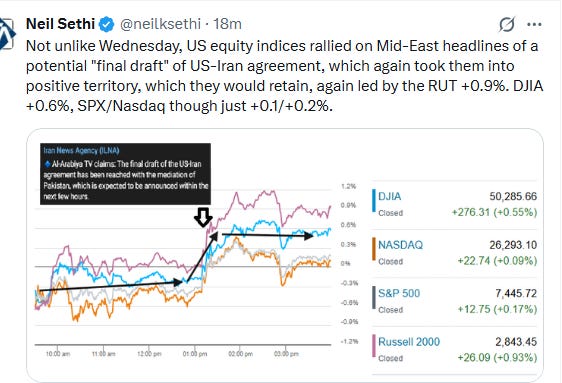
Like Wednesday, though, equities would rally on a headline from a Mid-East news source that a US-Iran agreement was close (see below), and like Wednesday, oil prices and yields would fall back. And like Wednesday the boost to equities would take the indices into positive territory (although not nearly to the same extent) where they would remain (for the most part) through the close, again led by the small cap Russell 2000 +0.9% (after +2.6% Wednesday). The Dow Jones Industrial Average +0.6%, but S&P 500 just +0.2% and the tech-heavy Nasdaq +0.1%.
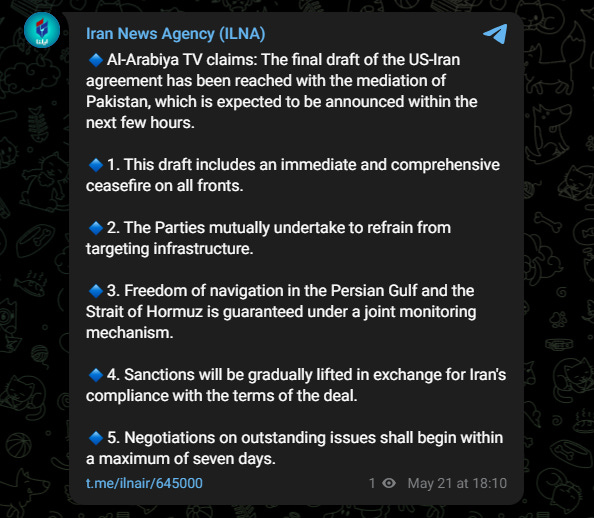
In other Iran headlines though Bloomberg reported Iran said it was discussing with Oman how to set up a permanent toll system that would formalize Tehran’s control of maritime traffic through the Strait of Hormuz. President Trump though said "we want it open. We want it free. We don't want tolls. It's international. It's an international waterway and not charging tolls." Similarly US Secretary of State Marco Rubio said that any Iranian move to impose tolls in the Strait of Hormuz would make a diplomatic deal with Tehran “unfeasible,” calling the plan “unacceptable, completely illegal, and a threat to the world." Iranian President Masoud Pezeshkian in turn said “we will never back down” in talks. But Rubio also said there were “some good signs” that a deal with Iran could be reached, adding that he expected Pakistani mediators to travel to Tehran, according to the Financial Times.
As noted in the Week Ahead, this week is light for US economic data, but today was heavier with weekly jobless claims little changed and remaining very low historically, April housing starts and permits coming in solidly above expectations (blog post tomorrow), and preliminary purchasing manager indices (PMIs) which came in unchanged in May at the headline level which, though, masked a continued widening between a resurgent manufacturing sector and “sluggish” services sector while prices rose the most since 2022.
Elsewhere, moves were modest with the dollar and major commodities little changed for the most part (all covered in the subscriber section).
The market-cap weighted S&P 500 (SPX) was +0.2%, the equal weighted S&P 500 index (SPXEW) +0.4%, Nasdaq Composite +0.1% (and the top 100 Nasdaq stocks NDX) +0.2%, the SOX semiconductor index +1.3%, and the Russell 2000 (RUT) +0.9%.
Some market commentary:
“Death, taxes, and Nvidia beats on earnings are three things we can always count on. Today’s report further showed the insatiable demand for AI isn’t slowing and the future remains bright,” writes Carson Group’s chief market strategist Ryan Detrick.
“The market is coming off a really strong earnings season that delivered positive revisions to earnings expectations, but concerns around inflation and demand destruction in the economy are proving persistent,” said Scott Helfstein, head of investment strategy at Global X ETFs. “That can be hard to look through, but there are still a lot of positive trends that can help propel the economy and markets.”
“Equity markets have clearly become more vulnerable as valuations are back close to previous highs and as positive news from the earnings season is starting to fade,” said Wolf von Rotberg, equity strategist at Bank J Safra Sarasin. “They need oil prices to go down and yields to stabilize.”
“Investors keep being pushed around like a ball in a pinball machine,” said Joachim Klement, head of strategy at Panmure Liberum. “The ever-changing news on Iran prevents equity markets from finding a direction, but ensures that bonds price in ever higher inflation.”
Investors’ conviction levels have been “extraordinarily low” with inflationary concerns back at the center of market discussions and the Iran war about to enter its fourth month, according to TD Securities. “It’s still the Iran uncertainty that’s fundamentally driving things,” said Gennadiy Goldberg, head of U.S. rates strategy at TD Securities. “The catalysts effectively haven’t changed, but what’s changed is the time decay. The Iran conflict has just lingered much longer than investors expected.” In a phone interview on Thursday, Goldberg told MarketWatch: “We’re in this uncomfortable world where rate markets are being pushed higher because inflation expectations are rising, Fed expectations are rising, but growth expectations are not falling because energy is not at sufficiently high levels that is actually creating a significant negative hit to growth.”
“With inflation concerns unlikely to ease meaningfully until a clearer path toward ending the Middle East conflict emerges, we expect yield volatility to persist in the near term,” said Ulrike Hoffmann-Burchardi at UBS Chief Investment Office. “Given the less liquid nature of the long end of the curve, even incremental news headlines can trigger outsized market moves.”
“If inflation kicks up because oil prices stay at $100 or more, which could happen, there could be short-term concerns around that, and you’ll hear a lot of headline risk,” said The Wealth Alliance CEO Robert Conzo. However, he noted that the current level of the Cboe Volatility Index – around 17 – signals that investors are “feeling pretty comfortable” given the proliferation of artificial intelligence, strong earnings and low unemployment. “All eyes on a deal,” he said.
“While geopolitical risks could still flare up, the more pressing issue appears to be macro-related,” said Bret Kenwell at eToro. “Elevated energy prices continue to fuel concerns about longer-term inflation. Markets will have plenty to digest in the coming weeks and months.”
“The primary takeaways are that the labor market remains on solid footing and there are crosscurrents in the manufacturing sector,” Ian Lyngen, head of U.S. rates strategy at BMO, said in a note emailed Thursday. “Treasuries have improved modestly in the wake of the data, although yields remain higher on the session in the absence of tangible progress toward a peace deal in the Middle East.”
