
Markets Update - 8/11/26
A look at what happened today impacting US equity, Treasury, and selected commodity markets, and what to watch for tomorrow

Quick Summary:
US equity indices started Tuesday modestly higher after Pakistan’s defense minister said signals in recent days suggest the US and Iran are “close to some sort of arrangement.”
Crude initially pulled back on those reports, but oil reversed higher later in the day as Iran reiterated conditions that must be met before the Strait reopens which as discussed in the Week Ahead are generally all red lines for the US. WTI finished up more than 1%. Still Treasury yields fell back after the 10 and 30-year yields tested Friday’s highs (the highest closes since January 2025 and 2007 respectively) giving some space for equities.
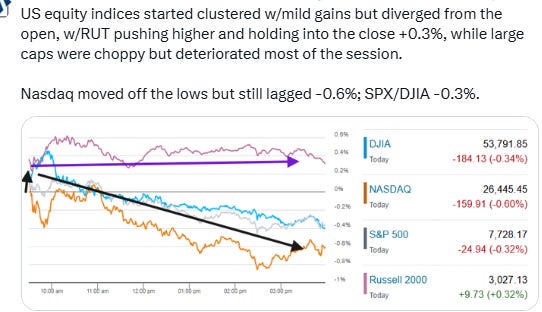
And while the small cap Russell 2000 capitalized holding early gains to end +0.3% higher on the day, the large-cap indices were choppy and deteriorated for most of the session. The Nasdaq Composite lagged at -0.6%, and the S&P 500 and Dow Jones Industrial Average both fell -0.3%. Positively the equal-weighted version of the S&P 500 though edged up +0.2% to a record high.
The index weakness Tuesday was driven by megacap growth and software, with Communication Services the worst-performing sector as Alphabet remained under pressure, while Amazon weighed on Consumer Discretionary and Oracle/AppLovin pressured software. Nvidia gave back an early gain tied to its AI infrastructure financing initiative discussed in the morning update and finished basically flat.
Traders were also likely cautious ahead of Wednesday’s July CPI report (discussed in more detail in the subscriber section), which is the first of three key data prints (in addition to next month’s employment and CPI reports) that will determine whether we get a September rate hike.
In Tuesday’s economic data, as discussed in the morning update, the ADP weekly job growth number fell to the lowest since January. In addition July existing home closings fell back for a second month from the highs of the year in May, although remained up from a year ago. Sale prices hit a new record high for July, but affordability nevertheless improved for the first time since January.
Some market commentary:
On the upcoming CPI print:
I expect the CPI report to continue its downward trend which will further support the case for the Federal Reserve to hold rates steady rather than hiking them, even with last Friday’s weak jobs report,” said Dennis Follmer, chief investment officer at Montis Financial. “Services inflation could continue to be a sticky problem, but that sector is not very sensitive to interest rates, so it shouldn’t really damage the case for holding steady,” he added.
“If we get a July CPI report anywhere near my forecast, the balance of the committee is going to look right through the supply shock, and the FOMC will remain on hold for the remainder of the year,” said Joe Brusuelas, chief economist at RSM. The data, he added, will provide “something of an assist” for Fed Chairman Kevin Warsh, who has faced stiff policy challenges since taking the post in May.
Even as price pressures ease in some areas, Vanguard economist Adam Schickling expects some of June’s “unusually large declines” across several categories to return to recent trend levels in July. Overall, “inflation has been stickier and persistent,” he says. However, “we think it is trending in a positive direction, moving gradually closer toward [the Fed’s] 2% target.” Schickling says the July jobs report, combined with what he expects will be improved inflation news, will strengthen the case for the Fed staying on hold through year-end. “We expect the Fed’s focus is starting to shift to a more balanced weight of labor and inflation data vs. six weeks ago, when inflation was front and center,” he says. “Our conviction in the Fed holding rates constant through year-end has only grown in light of recent data releases.”
On the Iran conflict:
“We see crude oil prices driving the war narrative, with price swings likely to dictate the pace of escalation and de-escalation,” said Elias Haddad at Brown Brothers Harriman & Co.
“A resolution to the Middle East conflict could provide an additional boost to sentiment,” said Jeffrey Roach at LPL Financial. “One particularly encouraging observation from the report’s summary was the reminder that ‘the world has plenty of oil.’ Economic conditions are favorable for risk appetite.”
“Investors have been awaiting a [U.S.-Iran] deal for a few weeks, and tangible progress is likely required for yields to fall significantly and stocks to rally further at this juncture,” said José Torres, senior economist at Interactive Brokers.
On oil:
“Our year-end West Texas Intermediate oil price forecast of $80-$90 per barrel incorporates a geopolitical risk premium reflecting higher shipping and insurance costs, periodic logistical disruptions and stronger inventory rebuilding demand,” said Ian Mikkelsen, equity sector analyst for energy at Wells Fargo Investment Institute.
In today’s Markets Update:
A deeper look at Tuesday’s stock and sector breakdown, including megacap growth pressure, stronger small-cap and equal-weight performance beneath the surface, and BTIG’s Jonathan Krinsky on Energy strength.
A look at selected corporate headlines from Bloomberg and CNBC including after-hours movers.
Updated technical charts across the SPX, Nasdaq, Russell 2000, and equal-weighted SPX, including BTIG’s Jonathan Krinsky on the broader market setup.
A review of market breadth, participation, and sentiment, including large individual winners and losers, Nasdaq positive volume, MarketWatch on equal-weight performance, Schwab on retail trading activity, Morgan Stanley on margin debt, and Bloomberg/Authers on AI infrastructure investment.
A look at US economic data and the CPI setup, including NFIB small-business sentiment and Goldman’s preview of Wednesday’s CPI report.
A look at the rates and Fed backdrop, including Treasury yields, updated Fed hike expectations, Beth Hammack’s hawkish speech, and AAII members on the Fed decision.
A look at volatility, options, and market structure, including VIX, VVIX, 1-day VIX, Goldman on call activity and put-call skew, Goldman/DailyChartbook on Nasdaq futures positioning, and MarketWatch/Schaeffer’s on options-market sentiment.
A review of cross-asset trends, including WTI crude, EIA on the oil outlook, CNBC on the SPR, the dollar, gold, copper, natural gas, and bitcoin.
A wrap-up on the near-term setup into CPI.
A look ahead to Wednesday’s calendar, including US economic data, the Fed calendar, Treasury auctions, SPX earnings, and ex-US highlights.
